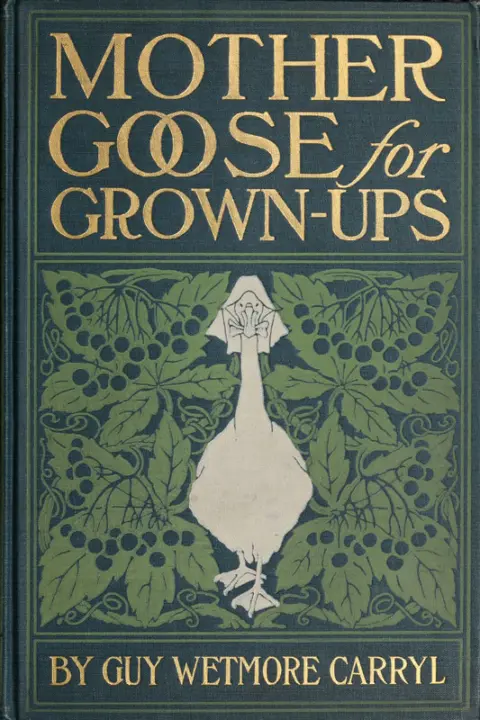
Mother Goose for Grown-ups
Guy Wetmore Carryl
THE CLASSIC COLLECTION · 1904
"The Transgression of Andrew Vane" by Guy Wetmore Carryl is a novel written in the early 20th century. The book explores themes of love, despair, and human relationships, primarily focusing on Andrew Vane, a young man navigating the complexities of life, love, and societal expectations, especially as he grapples with the aftermath of his family's struggles and personal failures. The narrative promises to delve into the contrast between idealism and reality, particularly through Andrew's interactions and evolving dynamics with other characters. At the start of the story, readers are introduced to Helen Sterling, who reflects on her deteriorating marriage with John Vane, Andrew's father. Helen's life embodies a difficult journey filled with disillusionment and heartbreak as she waits for her husband, consumed by his failures and alcoholism. As she grapples with the drastic change in her circumstances, a chance encounter with a stranger hints at potential companionship and change. Meanwhile, Andrew Vane arrives in Paris, freshly released from his past and in search of direction, underscoring the generational and existential conflicts that permeate the narrative. The opening sets a tone of melancholy mixed with hope, positioning both Helen and Andrew at crossroads in their lives.
Introduction adapted from the source catalogue; source summaries may be automatically generated.
Free to read · English · 76,615 words · No account needed
MAKE TIME FOR A GOOD BOOK
On by default. Untick to stop anonymous reading totals. Each page counts after 10 seconds in view. How this works.
Anonymous counting is on unless you have switched it off.
He was holding out his hand with the confidence of one who knows it will be accepted, and, after a moment, she laid her own within it. His fingers closed firmly on hers, and, of a sudden, the world drew in about her, graying, as under the touch of fog. Her last perception was of his eyes fixed full on hers with an expression of quiet amusement.
"I'm faint," she murmured, "I am--faint--"
When she came to herself, his eyes still held her.
"In the strange, unknowable book of Fate," he said, "it was written, from the beginning of time, that you and I should meet upon a dull hillside in late November, and--and that all that has been should be!"
Before she had time to answer, he had left her.
Briefly she stood, dizzy and perplexed, and then, after one great leap, her heart seemed to shudder and stand still. She was in the sordid little living-room of the Kingsbridge cottage, and outside the day was glooming into twilight!
Without power to move, she watched from the window the man who had just gone, pass down the path and through the gate, and, turning, wave a farewell, before he hurried away in the direction of the station. Then she was fully aroused by the entrance of the postman, and went slowly to meet him at the door. There was only one letter, but this was directed in her husband's unsteady hand, and, as she opened it, the contents leapt at her like a blow:
"Let me be as brief as you will think me brutal. When this reaches you I shall already be far at sea--with another woman. I have seen how you despised me, and I think that you know this, and that I hate you for it. I shall not ask you to forgive me, for I, too, have many things to forgive. If you had understood me, much that has happened might never have been. But what is past is past. Let us bury it and have done."
For minutes, which seemed an eternity, Helen stood, fingering the wretched sheet, and gazing straight before her with blank, unwinking eyes. Then, with a rush, came remembrance, and with it a great wave of relief. Before she fully comprehended her intention, she was at the gate of the cottage. But there she halted, with a nameless sense of loss and desperation. From the distance had come the yelp of a signalled locomotive, and then a dozen short, choking pants, as it dragged the reluctant train into motion. He had gone!
"But he will come back!" she murmured, "and, that he may come sooner, I
will write."
Your reading position is saved on this browser. Take it to another device with a library code. Reading pages adapt to text, rather than matching a printed edition.
Guy Wetmore Carryl
Guy Wetmore Carryl
Guy Wetmore Carryl
Guy Wetmore Carryl
BEHIND THE BOOK
This eBook is for the use of anyone anywhere in the United States and most other parts of the world at no cost and with almost no restrictions whatsoever. You may copy it, give it away or re-use it under the terms of the Project Gutenberg License included with this eBook or online at www.gutenberg.org. If you are not located in the United States, you will have to check the laws of the country where you are located before using this eBook. Read the source licence.
The original source file, including credits and licence, is retained by this library. Request an original-format copy at no charge. Please include the book title and Project Gutenberg identifier #38020.
KEEP YOUR CURIOSITY GOING
Coulson Kernahan

Maurice Baring
Frances Wright
Cécile Tormay

Frederic Jesup Stimson

W. H. P. (William Henry Pope) Jarvis