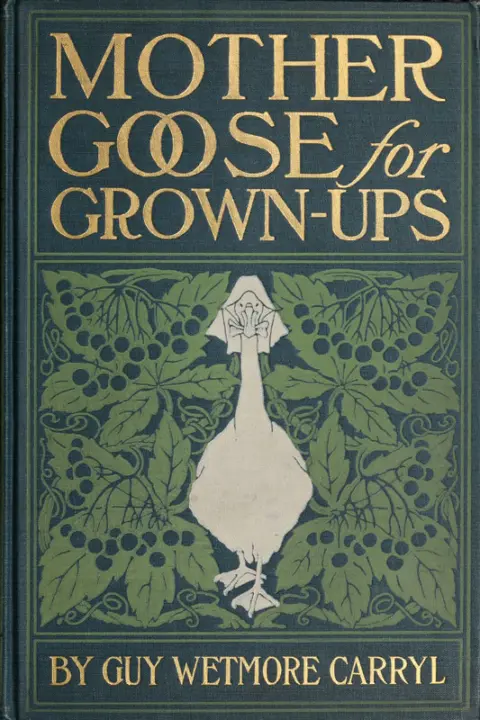
Mother Goose for Grown-ups
Guy Wetmore Carryl
THE CLASSIC COLLECTION · 1904
"The Transgression of Andrew Vane" by Guy Wetmore Carryl is a novel written in the early 20th century. The book explores themes of love, despair, and human relationships, primarily focusing on Andrew Vane, a young man navigating the complexities of life, love, and societal expectations, especially as he grapples with the aftermath of his family's struggles and personal failures. The narrative promises to delve into the contrast between idealism and reality, particularly through Andrew's interactions and evolving dynamics with other characters. At the start of the story, readers are introduced to Helen Sterling, who reflects on her deteriorating marriage with John Vane, Andrew's father. Helen's life embodies a difficult journey filled with disillusionment and heartbreak as she waits for her husband, consumed by his failures and alcoholism. As she grapples with the drastic change in her circumstances, a chance encounter with a stranger hints at potential companionship and change. Meanwhile, Andrew Vane arrives in Paris, freshly released from his past and in search of direction, underscoring the generational and existential conflicts that permeate the narrative. The opening sets a tone of melancholy mixed with hope, positioning both Helen and Andrew at crossroads in their lives.
Introduction adapted from the source catalogue; source summaries may be automatically generated.
Free to read · English · 76,615 words · No account needed
MAKE TIME FOR A GOOD BOOK
On by default. Untick to stop anonymous reading totals. Each page counts after 10 seconds in view. How this works.
Anonymous counting is on unless you have switched it off.
"Oh, shade of Larousse!" murmured Mrs. Carnby into her coffee-cup. "Where did the creature learn her French? Shall we take a little walk?" she added aloud, turning to Margery.
"Why, yes--with pleasure, Mrs. Carnby," answered the girl, with a quick start. Her eyes had been fixed upon an indistinct form beyond the window of the dining-room, which was the person of Mr. Andrew Vane.
For a few moments they trod the winding gravel path in silence. Then, as a clump of shrubbery hid the house from view, she stopped impulsively, and laid her hand on the arm of her hostess.
"Fairy godmother--" she began.
"Now, my dear girl," interrupted Mrs. Carnby, "don't say anything you'll be sorry for afterwards. I'm a very vain, weak, silly, gossipy old woman--but I am a woman, Margery, and that means that I often see things I'm not meant to see, and which I wish I hadn't. Don't give me your confidence just because you feel that I may have guessed--"
"I know you've guessed, Mrs. Carnby!" broke in Margery, "and, after all, it's just as well, because I must speak to some one. I feel, somehow, as if I'd lost my way, and I think I'm a little frightened. I've always been very sure of myself till now, very confident of my ability to judge what was the right thing to do, and to get on without advice. But now--it's different. I'm unhappy."
Mrs. Carnby slid her arm across the girl's shoulders.
"Go on, my dear," she said. "I didn't mean that I wasn't willing to listen--only that I wouldn't like to feel that I was surprising your confidence."
"First of all," said Margery, "and in spite of everybody's kindness to me, I'm afraid I hate this new life, which is so different from everything I've learned to know and love. I hate all this pretence and posing which we're carrying on, day after day, among people who smirk before our faces and ridicule us behind our backs; and I'm coming to hate myself worst of all. I want my life to be better than that of a butterfly among a lot of wasps! In America I hadn't time to stop and think whether I was happy or not, and I've read somewhere that that is just what true happiness means. Everything was very natural and simple over there. I used to wake up wanting to sing, and life seemed to begin all over again every morning. And then, without the least warning, came to me--what you've guessed, you know. I was sure of it at once. There was nothing said, but one feels such things, don't you think?--feels them coming, just as one feels the dawn sometimes, even while it's still quite dark? I had a little hint or two--just enough to make me confident and happier than ever. I knew there were reasons for his not speaking: I guessed at his grandfather, and a very little thought showed me that it could do no harm to wait. I wanted him to be sure, just as sure as I was. I was even content to come away and leave him. I knew, you see, and I saw it was only a question of time. I never doubted for a moment how it would end, and so I wasn't the least bit surprised when he came through the salon door, that Sunday in Paris. I thought--I was sure he'd come for me. I could have shouted, I was so happy, Mrs. Carnby! I had to turn away and pretend to be admiring some roses, I remember, because I felt that I was smiling--no, grinning--and just at nothing! Well--"
Your reading position is saved on this browser. Take it to another device with a library code. Reading pages adapt to text, rather than matching a printed edition.
Guy Wetmore Carryl
Guy Wetmore Carryl
Guy Wetmore Carryl
Guy Wetmore Carryl
BEHIND THE BOOK
This eBook is for the use of anyone anywhere in the United States and most other parts of the world at no cost and with almost no restrictions whatsoever. You may copy it, give it away or re-use it under the terms of the Project Gutenberg License included with this eBook or online at www.gutenberg.org. If you are not located in the United States, you will have to check the laws of the country where you are located before using this eBook. Read the source licence.
The original source file, including credits and licence, is retained by this library. Request an original-format copy at no charge. Please include the book title and Project Gutenberg identifier #38020.
KEEP YOUR CURIOSITY GOING
Coulson Kernahan

Maurice Baring
Frances Wright
Cécile Tormay

Frederic Jesup Stimson

W. H. P. (William Henry Pope) Jarvis