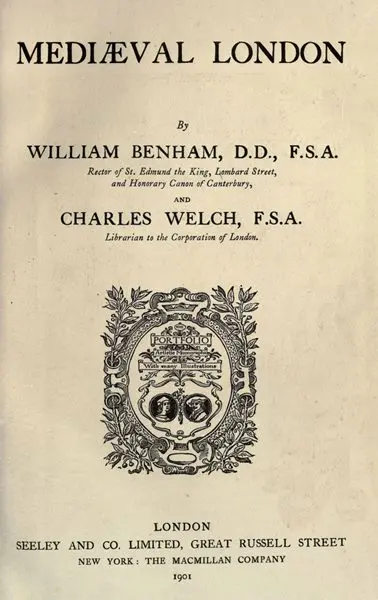
Mediæval London
William Benham & Charles Welch
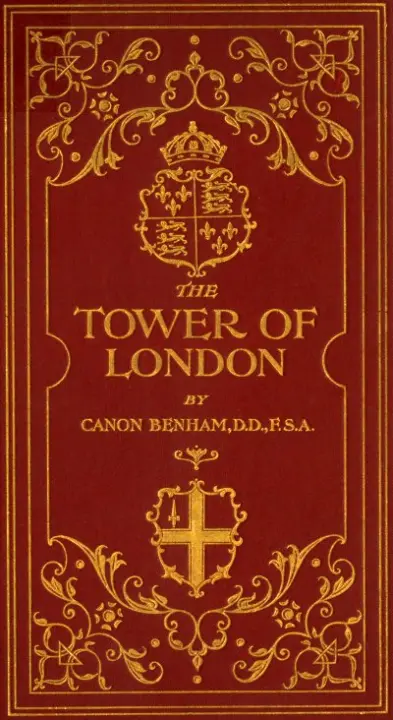
THE CLASSIC COLLECTION · 1906
"The Tower of London" by William Benham is a historical account written in the early 20th century. The book delves into the fascinating history of the Tower of London, exploring its architecture, its use as a royal palace, and its transformation into a state prison over the centuries. At the start of the work, the author sets the tone by establishing the Tower as a prominent fortress in Britain, detailing its ancient origins and significance throughout various historical periods. He discusses its construction during the Roman invasion and subsequent changes during the Saxon and Norman conquests. The narrative highlights significant events, including the role of the Tower during the reigns of prominent monarchs and notable occurrences such as imprisonments, executions, and the Tower's unique position in British history. Through this opening, Benham paints a vivid picture of the Tower's storied past, preparing the reader for a deeper exploration of its historical narrative.
Introduction adapted from the source catalogue; source summaries may be automatically generated.
Free to read · English · 44,067 words · No account needed
MAKE TIME FOR A GOOD BOOK
On by default. Untick to stop anonymous reading totals. Each page counts after 10 seconds in view. How this works.
Anonymous counting is on unless you have switched it off.
Wade, Sir William, 72, 73
Wakefield, Battle of, 23
Wallace, William, 7
Walpole, Horace, 90
Walpole, Sir Robert, 95
Walsingham, Sir Francis, 66
Walworth, Sir William, 25
Warbeck, Perkin, 37, 40, 41
Warwick, Earls of:
Thomas de Beauchamp, 27
Richard de Beauchamp, 32
Richard Neville, 34
Edward, son of Duke of Clarence, 39, 40
John Dudley, afterwards Duke of Northumberland, 51, 59
Wellington, Duke of, 98
Wilkes, John, 96
William I, 2, 17
William II, 3, 18
Wintoun, Earl of, George Seton, 93, 94
Wolsey, Cardinal, 11, 43, 44, 46
Wriothesley, Sir Thomas, 48
Wren, Sir Christopher, 17, 90
Wyatt, Sir Henry, 38, 39
Wyatt, Sir Thomas, 55, 58
Wycliffe, John, 25, 31
Wyndham, Sir John, 41
Yeomen of the Guard, 21, 22
York, Third Duke of, Richard, 33, 37
Butler & Tanner, The Selwood Printing Works, Frome, and London.
THE PORTFOLIO MONOGRAPHS, No. 46
With 4 Illuminations in Colours and Gold, and 33 other Illustrations. Sewed, 5s. nett, or in cloth, gilt top, 7s. nett.
By EDWARD S. PRIOR, M.A., F.S.A.
Author of “A History of Gothic Art in England,” etc.
In this volume Mr. Prior treats of the Great English Mediæval Cathedrals, with special reference to the men by whom they were designed, and the craftsmen by whom they were erected. He thus characterizes the successive periods of Cathedral building in England:—
1. Norman, Benedictine, “Romanesque.” 2. Angevin, Neomonastic, “Transitional to Gothic.” 3. Insular, Episcopal, “Early English.” 4. Continental, Regal, “The Summit of Gothic.” 5. English, Aristocratic, “Decorated.” 6. After the Black Death: Official, “Perpendicular.” 7. Fifteenth Century: Parochial and Trading, “Perpendicular.” 8. Sixteenth to Eighteenth Centuries: the Craftsman and the Architect. 9. Nineteenth Century: the Restorer and Revivalist.
Christ in Glory. From a Missal of the Fourteenth Century. The Angels with the Seven Vials. From an Apocalypse of the Fourteenth Century. Bishop carrying the Sacrament. From a Lectionary of the Fifteenth Century. Group of Bishops. From a Psalter of the Fifteenth Century.
Westminster Abbey. Confessor’s Chapel. BOYCE.
Westminster Abbey. N. Ambulatory. NASH.
Canterbury Cathedral, from the S. HOLLAR.
Durham Cathedral, from the River. DANIELL.
Durham Cathedral from the West. COTMAN.
Winchester Cathedral, N. Transept. BLORE.
Norwich Cathedral, Nave. F. MACKENZIE.
Canterbury Cathedral. N. Aisle of Choir. G. CATTERMOLE.
Wells Cathedral, Arches under the Central Tower. GARLAND.
Wells Cathedral, N.W. Tower. J. H. GIBBONS.
Chichester Cathedral, S.E. View. GARLAND.
Southwark Cathedral, Nave. DIBDEN.
Salisbury Cathedral, Small Transept. F. MACKENZIE.
York Minster, from the North, ED. BLORE.
York Minster, North Transept. GARLAND.
Lincoln Cathedral, from the West, DE WINT.
Lincoln Cathedral, the Chancel. GARLAND.
Lincoln Cathedral, from the East. HOLLAR.
Salisbury Cathedral, the Chapter House. F. MACKENZIE.
Salisbury Cathedral, from Cloisters. TURNER.
Exeter Cathedral, from the S.E. S. RAYNER.
Ely Cathedral, the Octagon. GARLAND.
Gloucester Cathedral, Presbytery. J. HAROLD GIBBONS.
Gloucester Cathedral, Cloisters. GARLAND.
York Minster, East End. F. MACKENZIE.
Winchester Cathedral, West Front. GARLAND.
York Minster, Choir. F. MACKENZIE.
Sherborne Minster. CONSTABLE.
St. George’s Chapel, Windsor, from S. HOLLAR.
St. George’s Chapel, Windsor. Interior of Choir. HOLLAR.
St. Paul’s Cathedral, West Front. T. MALTON.
St. Paul’s Cathedral, Interior of Choir. R. TREVITT.
Truro Cathedral, from the South-East.
Your reading position is saved on this browser. Take it to another device with a library code. Reading pages adapt to text, rather than matching a printed edition.
William Benham & Charles Welch
William Benham
BEHIND THE BOOK
This eBook is for the use of anyone anywhere in the United States and most other parts of the world at no cost and with almost no restrictions whatsoever. You may copy it, give it away or re-use it under the terms of the Project Gutenberg License included with this eBook or online at www.gutenberg.org. If you are not located in the United States, you will have to check the laws of the country where you are located before using this eBook. Read the source licence.
The original source file, including credits and licence, is retained by this library. Request an original-format copy at no charge. Please include the book title and Project Gutenberg identifier #58271.
KEEP YOUR CURIOSITY GOING
Cécile Tormay

Moritz Busch
John L. Ransom
Frances Wright
Cécile Tormay

Mabel Potter Daggett