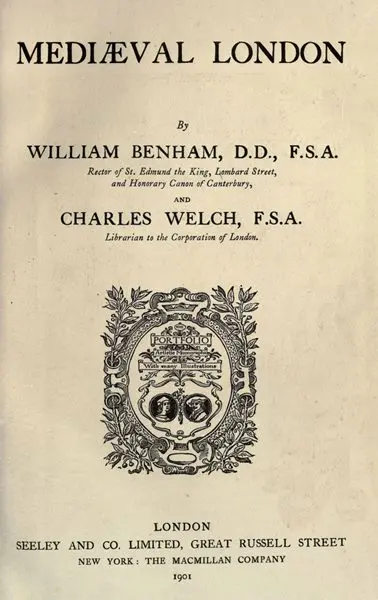
Mediæval London
William Benham & Charles Welch
THE CLASSIC COLLECTION · 1906
"The Tower of London" by William Benham is a historical account written in the early 20th century. The book delves into the fascinating history of the Tower of London, exploring its architecture, its use as a royal palace, and its transformation into a state prison over the centuries. At the start of the work, the author sets the tone by establishing the Tower as a prominent fortress in Britain, detailing its ancient origins and significance throughout various historical periods. He discusses its construction during the Roman invasion and subsequent changes during the Saxon and Norman conquests. The narrative highlights significant events, including the role of the Tower during the reigns of prominent monarchs and notable occurrences such as imprisonments, executions, and the Tower's unique position in British history. Through this opening, Benham paints a vivid picture of the Tower's storied past, preparing the reader for a deeper exploration of its historical narrative.
Introduction adapted from the source catalogue; source summaries may be automatically generated.
Free to read · English · 44,067 words · No account needed
MAKE TIME FOR A GOOD BOOK
On by default. Untick to stop anonymous reading totals. Each page counts after 10 seconds in view. How this works.
Anonymous counting is on unless you have switched it off.
Accession of George I—Impeachment of Harley—The Rebellion of 1715—Execution of Lords Derwentwater and Kenmuir—Escape of Nithisdale—Plots of Atterbury and others in 1722—Imprisonment of Lord Macclesfield—The “45”—Execution of Lords Kilmarnock, Balmerino, Charles Retcliff, and Lord Lovat—Imprisonment and Trial of Wilkes and his Friends on the Charge of Treason—of Alderman Oliver and Lord Mayor Crosby for alleged Condonation of Misdemeanour—of Horne Tooke and his Companions for Treason—of Sir Francis Burdett for Breach of Privilege—Of the Cato Street Conspirators—The Fire of 1841—The Fenian Conspiracy of 1885—Conclusion.
The accession of George I was at once marked by the ascendency of the Whigs, and they lost no time in showing this. Robert Harley, whom Queen Anne had made Earl of Oxford, and who had been a favourite minister of the nation, was impeached on the charge that during the French wars, in his hatred of the Duke of Marlborough, he had instructed the French king as to the best method of capturing Tournai. On June 10, 1715, the House of Commons, of which but a short time before he had been the idol, sent him to the Tower, where he languished for two years, never losing confidence. His continual petition to be tried was at last conceded, and he was acquitted in July, 1717.
But there was an influential party among the high Tories who were unmistakably anxious to restore the Stuarts, and even the Duke of Marlborough, who all his life through had a passion for intrigue, finding that he was not trusted by King George, seems to have entered into negotiations with the Pretender, “the Chevalier de St. George,” who in August, 1715, published from France a manifesto, asserting his right to the throne. When the Whig Government impeached Bolingbroke and the Duke of Ormond for complicity, they fled to France. But the rising incapable man; and though he was joined by other nobles in the North, and might have won most dangerous successes, he shrank before the Duke of Argyll, who had been sent by the king to oppose him. The result was the rebellion of 1715 and its failure. The most conspicuous character in this ill-starred attempt was James Radcliffe, Earl of Derwentwater, a young man of twenty-six who deserved a better fate, for all accounts describe him as singularly attractive and winning in person and manner. He was the only Englishman of note who joined the enterprize. His mother, Mary Tudor, was a natural daughter of Charles II, who brought him up as a Roman Catholic. He was very rich for those days. His home, from which he took his title, was an island in the most beautiful of English lakes, and his income from mines was nearly £40,000 a year. With him were six Scotch nobles, William Maxwell, Earl of Nithisdale; Robert Dalzell, Earl of Carnwarth; William Gordon, Lord Kenmure, brother-in-law of Carnwarth; George Seton, fifth Earl of Wintoun; William, Lord Nairn; and William, fourth Lord Widdrington. They were brought up to London tightly bound on horseback, and paraded through the streets to the prison. Much interest was made for them in Parliament, and a vote of petition for pardon was carried in the House of Lords. They were tried in February, 1716, and condemned. Wintoun was the only one who refused to plead guilty, but was convicted and sentenced. Next year Widdrington, Carnwarth and Nairn were pardoned, the others were left for death. So greatly was Derwentwater loved in his own home that it is said the peasantry drove his wife out of it because, as they alleged, she had driven him to rebel and so deprived them of a generous landlord. But when the crowds assembled on Tower Hill, they found, to their great amazement, that there were only three victims. For Lord Nithisdale had escaped the night before. His young wife had travelled up, through the winter snow, all the way from their home in Dumfriesshire to beg forgiveness for him. Failing in this, she formed her plans with great skill, and has left the narrative, which reads like an entrancing romance—the taking into the condemned cell a friend to whom she had confided her method as they walked along the street, the double dress which she persuaded the friend to put on at entrance, enduing the prisoner with the outer dress, and so deceiving the sentinels. They got away safely, hid for a few days in London, and then he went away to Rome, disguised as one of the footmen of the Venetian ambassador. Not content with this feat, she resolved to petition for the restoration of the estates, and made her way into St. James’s Palace, and into the king’s presence. He would have gone out without answering her, but she writes, “I caught hold of the skirt of his coat that he might stop and hear me. He endeavoured to escape out of my hands, but I kept such strong hold that he dragged me on my knees from the middle of the room to the very door. At last one of the Blue Ribands who attended his Majesty took me round the waist, while another wrested the coat from my hands.” They lived together at Rome till 1749, when he died, and she not long afterwards. How Wintoun escaped is not precisely known, but the probability seems to be that he bribed a warder and filed through the bars of a window.
Your reading position is saved on this browser. Take it to another device with a library code. Reading pages adapt to text, rather than matching a printed edition.
William Benham & Charles Welch
William Benham
BEHIND THE BOOK
This eBook is for the use of anyone anywhere in the United States and most other parts of the world at no cost and with almost no restrictions whatsoever. You may copy it, give it away or re-use it under the terms of the Project Gutenberg License included with this eBook or online at www.gutenberg.org. If you are not located in the United States, you will have to check the laws of the country where you are located before using this eBook. Read the source licence.
The original source file, including credits and licence, is retained by this library. Request an original-format copy at no charge. Please include the book title and Project Gutenberg identifier #58271.
KEEP YOUR CURIOSITY GOING
Cécile Tormay

Moritz Busch
John L. Ransom
Frances Wright
Cécile Tormay

Mabel Potter Daggett