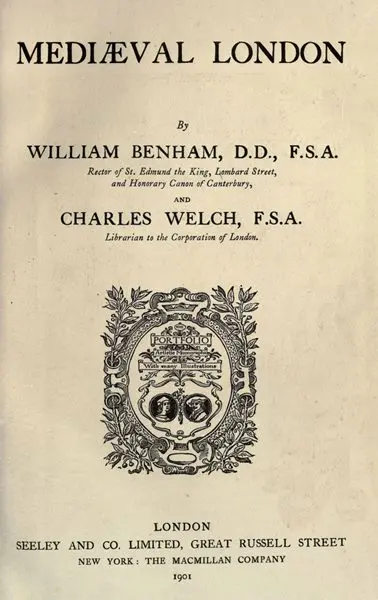
Mediæval London
William Benham & Charles Welch
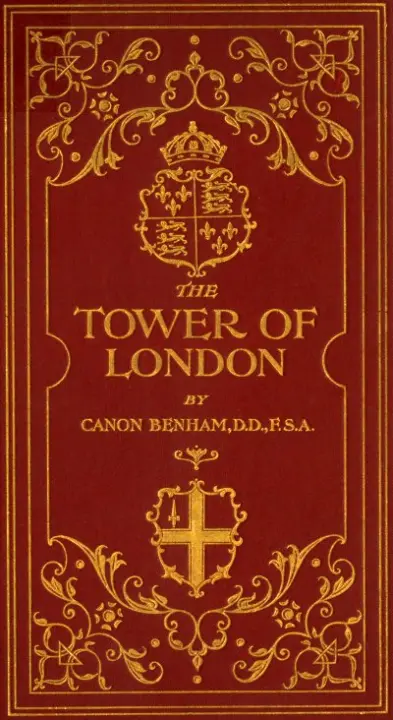
THE CLASSIC COLLECTION · 1906
"The Tower of London" by William Benham is a historical account written in the early 20th century. The book delves into the fascinating history of the Tower of London, exploring its architecture, its use as a royal palace, and its transformation into a state prison over the centuries. At the start of the work, the author sets the tone by establishing the Tower as a prominent fortress in Britain, detailing its ancient origins and significance throughout various historical periods. He discusses its construction during the Roman invasion and subsequent changes during the Saxon and Norman conquests. The narrative highlights significant events, including the role of the Tower during the reigns of prominent monarchs and notable occurrences such as imprisonments, executions, and the Tower's unique position in British history. Through this opening, Benham paints a vivid picture of the Tower's storied past, preparing the reader for a deeper exploration of its historical narrative.
Introduction adapted from the source catalogue; source summaries may be automatically generated.
Free to read · English · 44,067 words · No account needed
MAKE TIME FOR A GOOD BOOK
On by default. Untick to stop anonymous reading totals. Each page counts after 10 seconds in view. How this works.
Anonymous counting is on unless you have switched it off.
An illustrious name comes before us in the annals of 1592. Sir Walter Raleigh was lodged here, having incurred the Queen’s displeasure by his amour with Elizabeth, daughter of Sir Nicholas Throckmorton, the celebrated statesman. He soon regained his liberty, however, by using the most fulsome adulation of his royal mistress. Here is just one specimen, an extract from a letter which he wrote to Cecil, of course in order that it might be shown to her Majesty:—“My heart was never broken till this day, that I hear the Queen goes away so far off [she was about to start on her annual progress], whom I have followed so many years with so great love and desire in so many journeys, and am now left behind her in a dark prison, all alone. While she was yet near at hand, that I might hear of her once in two or three days, my sorrows were the less, but even now my heart is cast into the depth of all misery. I, that was wont to behold her riding like Alexander, hunting like Diana, walking like Venus, the gentle wind blowing her fair hair about her pure face like a nymph, sometimes sitting in the shade like a goddess, sometimes singing like an angel, sometimes playing like Orpheus.”
Elizabeth was always open to flattery, but in this case her “love-stricken swain” was further assisted by the arrival at Dartmouth of his good ship The Roebuck, which had taken a great Spanish treasure ship off Flores, with a treasure which Raleigh estimated at half a million pounds. The Queen gave him his liberty and sent him off to arrange the disposal of his capture, and of course got the lion’s share of it. He returned to Court fresh as ever, and this return was a fatal event in the fortunes of another brilliant courtier, in fact the most brilliant, of Elizabeth’s surrounding, Robert Devereux, Earl of Essex. He and Raleigh were bitter enemies. Ireland was again giving trouble. Raleigh advised that the disturbers should remorselessly be trampled out, Essex that justice and good-will should be shown. The discussion between them was firm on both sides, and when we remember that both men were high-spirited, full of ambition, jealous of each other as to the royal favour, we can understand how their selfwill and egotism proved the ruin of them both. Essex was strikingly handsome, brilliant both at Court and in the field. His father had been a personal friend of the Queen, the Earl of Leicester was his step-father, Sir Francis Knollys his grandfather, Walsingham his father-in-law, Lord Burleigh his guardian, Shakespeare his friend. He was now sent to Ireland with the task before him of subduing the factions which kept the country in continual insurrection, and he failed, whilst his enemies traduced him at home. Enraged at learning this, and in despair at his continued illfortune, he returned after two years to England unbidden, hoping to justify his actions in the presence of the Queen. But several charges of misconduct were proved against him, and he was deprived of his offices and banished from Court. The Queen had said that an unruly horse must be kept short of provender, and when this was repeated to him he retorted that the Queen’s mind was as crooked as her body, and it is difficult to imagine a speech which would anger her more. Then, instigated by his secretary, Cuffe, he formed the desperate resolution of breaking in upon the Court, removing by force the courtiers, and so ruling the Queen by force. A terrible blunder to make. He was perhaps the most popular noble in London, but the citizens had no idea of imperilling their lives and fortunes by countenancing such a harum-scarum idea as this. Nobody came to his call, and after a short siege in his own house in the Strand he was captured, along with the Earl of Southampton, and conveyed through the fatal Traitors’ Gate. This was on February 6, 1601; on the 19th he was adjudged a traitor, and on the 25th beheaded. The execution took place within the Tower, some say because Essex was so popular that there was a fear of a demonstration in his favour if it had been on Tower Hill, others that it was his own wish to die within the walls. He was buried in St. Peter’s Chapel. He was only thirty-five years of age! There is a story that the Queen expected a ring which he was to send her when in trouble, and which was to win him forgiveness; that he had entrusted it to Lady Nottingham, who kept it back; but this story is certainly untrue. Elizabeth, as one can quite understand, was unwilling to sign the warrant, considering the favour in which she had once held him, and after its execution she fell into a terrible fit of despondency, from which in fact she never recovered. Raleigh, who was never popular with the Londoners, was hooted in the streets for his enmity towards Essex, so was Bacon as one of his judges. Four of Essex’s fellow-conspirators were beheaded; Cuffe was hanged at Tyburn. Southampton was kept in close confinement, but liberated by special command of James I in 1603. Essex’s son, born 1593, lived to lead the Parliamentary army against Charles I.
Your reading position is saved on this browser. Take it to another device with a library code. Reading pages adapt to text, rather than matching a printed edition.
William Benham & Charles Welch
William Benham
BEHIND THE BOOK
This eBook is for the use of anyone anywhere in the United States and most other parts of the world at no cost and with almost no restrictions whatsoever. You may copy it, give it away or re-use it under the terms of the Project Gutenberg License included with this eBook or online at www.gutenberg.org. If you are not located in the United States, you will have to check the laws of the country where you are located before using this eBook. Read the source licence.
The original source file, including credits and licence, is retained by this library. Request an original-format copy at no charge. Please include the book title and Project Gutenberg identifier #58271.
KEEP YOUR CURIOSITY GOING
Cécile Tormay

Moritz Busch
John L. Ransom
Frances Wright
Cécile Tormay

Mabel Potter Daggett