THE CLASSIC COLLECTION✦The trail of the Golden HornCLASSIC FREE BOOKS
The trail of the Golden Horn
H. A. (Hiram Alfred) Cody
THE CLASSIC COLLECTION · 1919
"The Touch of Abner" by H. A. Cody is a novel written in the early 20th century. The story is centered around Abner Andrews, a rather humorous and outspoken countryman with simple yet profound thoughts on life, societal norms, and the struggles of rural living. As he interacts with various characters in his community, particularly concerning the well-being of orphans and the realities of poverty, the narrative unfolds his adventures and misadventures, driven by his charm, gall, and a hint of stubbornness. The opening of the novel introduces us to Abner at a town meeting discussing the establishment of an orphanage. His dramatic and impulsive pledge of a thousand dollars sparks reactions from the attendees, prompting debates about generosity and social responsibilities. Accompanied by his wife Tildy, Abner displays an unapologetic demeanor, questioning the sincerity of others' contributions to community causes. We get a glimpse of his character through his candid discussions with Tildy about their financial struggles, his humorous takes on society, and his sentimental connections to the orphans, indicating that while he often appeared foolish, there is wisdom and depth to his observations on human nature and societal norms. His character, laden with charm and comedic relief, sets the stage for what promises to be an engaging exploration of rural life's challenges and social commentary.
Introduction adapted from the source catalogue; source summaries may be automatically generated.
Free to read · English · 77,604 words · No account needed
MAKE TIME FOR A GOOD BOOK
On by default. Untick to stop anonymous reading totals. Each page counts after 10 seconds in view. How this works.
Anonymous counting is on unless you have switched it off.
"If he wasn't crazy then, he was a few minutes later. Tom, the office boy, said it was terrible. Abner gave a roar like thunder and sailed into Joe. When the police arrived there wasn't much of Joe left, according to Tom. He was unconscious, and the office was badly damaged."
"Did the police have any trouble with Abner?" Whittles asked almost
breathlessly.
"No, I guess not. He went like a lamb, though Tom said he had a wild
look in his eyes."
Whittles suddenly gasped; his face turned deathly pale, and his hands
trembled.
"What's wrong, Hen?" the lawyer asked, noting his companion's agitation. "I didn't know you were subject to nervous trouble. This story has upset you a bit. You need a stimulant. Why in thunder doesn't that express team show up!"
"Say, Tom," and Whittles leaned over the table, "suppose it had been you
or me instead of Joe?"
"You or me! What do you mean?"
"Abner loves us about as much as he loved Joe this morning, doesn't he?"
"Oh, I see," and the lawyer rubbed his chin in a thoughtful manner. "I
never thought of that."
"I know you didn't. Now, suppose Abner gets out of jail and learns who gave Joe that information, what then?"
Rackshaw shifted somewhat uneasily in his chair, and glanced down at the dog. Then he laughed and picked up the cards he had dropped upon the table.
"I guess Abner won't do any more of his wild stunts for a while," he remarked. "He's in deep enough water now. He'll need a lawyer to defend him, and I'm the only one in town."
"He won't come to you."
"Just you wait. He's in a trap and knows very well that I can get him out; that is, if I want to."
"Want to! Won't you want to get him out? Won't you do everything for him that you can if he engages you to defend him?"
"That all depends. If he comes to me I'll do all I can under certain
conditions."
"What are the conditions?"
The lawyer bit savagely at his cigar, but offered no explanation.
"D--n that express team!" he growled. "What can have happened to it?"
"Abner can't afford to engage a lawyer, can he?" Whittles asked, noting
Rackshaw's silence.
"Why not?"
"He hasn't any way of paying, has he?"
"He hasn't? What about his farm?"
"Farm! Why, that's nothing but a bed of gravel. I wouldn't have it as a
gift."
"You wouldn't, eh? But suppose the Government should want that same bed of gravel for ballast, what then?"
Your reading position is saved on this browser. Take it to another device with a library code. Reading pages adapt to text, rather than matching a printed edition.
H. A. (Hiram Alfred) Cody
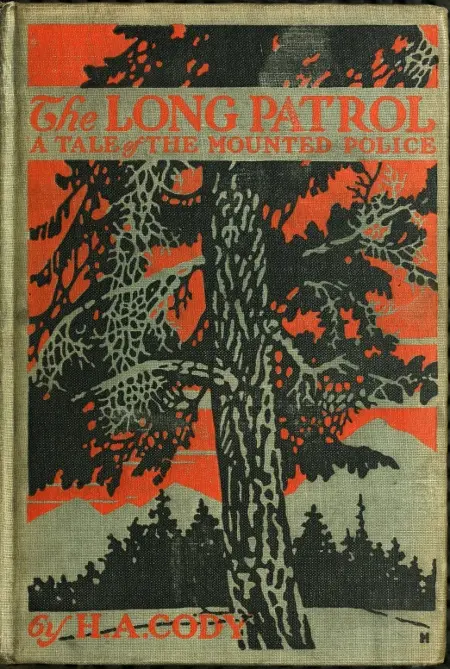
H. A. (Hiram Alfred) Cody
H. A. (Hiram Alfred) Cody
H. A. (Hiram Alfred) Cody
BEHIND THE BOOK
This eBook is for the use of anyone anywhere in the United States and most other parts of the world at no cost and with almost no restrictions whatsoever. You may copy it, give it away or re-use it under the terms of the Project Gutenberg License included with this eBook or online at www.gutenberg.org. If you are not located in the United States, you will have to check the laws of the country where you are located before using this eBook. Read the source licence.
The original source file, including credits and licence, is retained by this library. Request an original-format copy at no charge. Please include the book title and Project Gutenberg identifier #53604.
KEEP YOUR CURIOSITY GOING
Coulson Kernahan

Maurice Baring
Frances Wright
Cécile Tormay

Frederic Jesup Stimson

W. H. P. (William Henry Pope) Jarvis