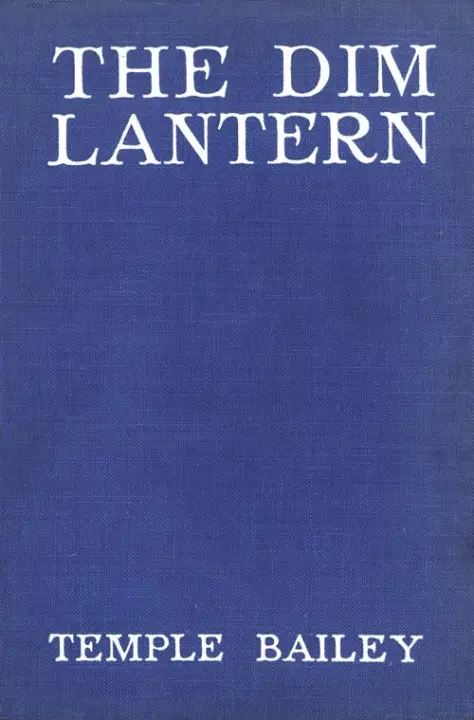
The Dim Lantern
Temple Bailey
THE CLASSIC COLLECTION · 1918
"The Tin Soldier" by Temple Bailey is a novel written in the late 1910s. The story begins in a toy shop where a shabby old gentleman makes an appearance, revealing themes of longing and melancholy as he seeks tin soldiers to buy for his son and expresses a desire to be part of the war. Key characters include Jean, a young woman who works at the shop, and Derry Drake, the son of the old gentleman, whose lives intertwine in unexpected ways against the backdrop of war and societal expectations. At the start of the narrative, the atmosphere is set with the arrival of the old gentleman at the toy shop amidst a rainy evening, contrasted with the youthful energy of Jean and her colleague, Emily. The old man’s somewhat tragic demeanor draws sympathy from the women, particularly as he recalls the urgency of acquiring soldiers amid the war. Meanwhile, Jean's home life is interjected with her dynamic with her father, Dr. McKenzie, highlighting her aspirations and reflections shaped by the war—a pivotal theme that unfolds as the story progresses. The opening portrays a poignant look at how a world embroiled in conflict touches the lives of its characters, especially through the motif of a tin soldier representing both valiance and vulnerability.
Introduction adapted from the source catalogue; source summaries may be automatically generated.
Free to read · English · 95,165 words · No account needed
MAKE TIME FOR A GOOD BOOK
On by default. Untick to stop anonymous reading totals. Each page counts after 10 seconds in view. How this works.
Anonymous counting is on unless you have switched it off.
The end of April brought much rain; torrents swept down the smooth streets, and the beauty of the carefully kept flower beds in the parks was blurred by the wet.
The General, limping from window to window, chafed. He wanted to get out, to go over the hills and far away; with the coming of the spring the wander-hunger gripped him, and with this restless mood upon him he stormed at Bronson.
"It's a dog's life."
"Yes, sir," said Bronson, dutifully.
"It is dead lonesome, Bronson, and I can't keep Jean tied here all of the time. She is looking pale, don't you think she is looking pale?"
"Yes, sir. I think she misses Mr. Derry."
"Well, she'll miss him a lot more before she gets him back," grimly. "He'll be going over soon--"
"Yes, sir."
"I wish I were going," the old man was wistful. "Think of it, Bronson, to be over there--in the thick of it, playing the game, instead of rotting here--"
It was, of course, the soldier's point of view. Bronson, being hopelessly civilian, did his best to rise to what was expected of him. "You like it then, sir?"
"Like it? It is the only life. We've lost something since men took up the game of business in place of the game of fighting."
"But you see, sir, there's no blood--in business." Bronson tried to
put it delicately.
"Isn't there? Why, more men are killed in accidents in factories than are killed in war--murdered by money-greedy employers."
"Oh, sir, not quite that."
"Yes, quite," was the irascible response. "You don't know what you are talking about, Bronson. Read statistics and find out."
"Yes, sir. Will you have your lunch up now, sir?"
"I'll get it over and then you can order the car for me."
"But the rain--?"
"I like rain. I'm not sugar or salt."
Bronson, much perturbed, called up Jean. "The General's going out."
"Oh, but he mustn't, Bronson."
"I can't say 'mustn't' to him, Miss," Bronson reported dismally. "You'd better see what you can do--"
But when Jean arrived, the General was gone!
"We'll drive out through the country," the old man had told his chauffeur, and had settled back among his cushions, his cane by his side, his foot up on the opposite seat to relieve him of the weight.
And it was as he rode that he began to have a strange feeling about that foot which no longer walked or bore him lightly.
Your reading position is saved on this browser. Take it to another device with a library code. Reading pages adapt to text, rather than matching a printed edition.
Temple Bailey
Temple Bailey
Temple Bailey
Temple Bailey
BEHIND THE BOOK
This eBook is for the use of anyone anywhere in the United States and most other parts of the world at no cost and with almost no restrictions whatsoever. You may copy it, give it away or re-use it under the terms of the Project Gutenberg License included with this eBook or online at www.gutenberg.org. If you are not located in the United States, you will have to check the laws of the country where you are located before using this eBook. Read the source licence.
The original source file, including credits and licence, is retained by this library. Request an original-format copy at no charge. Please include the book title and Project Gutenberg identifier #18056.
KEEP YOUR CURIOSITY GOING
Coulson Kernahan

Maurice Baring
Frances Wright
Cécile Tormay

Frederic Jesup Stimson

W. H. P. (William Henry Pope) Jarvis