
Elsie’s Friends at Woodburn
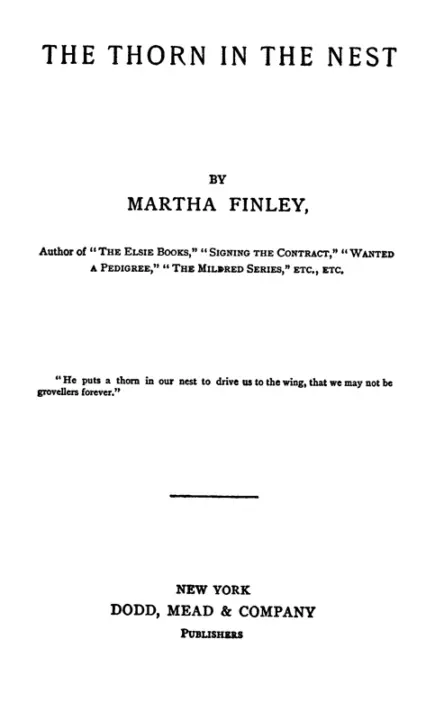
Martha Finley
THE CLASSIC COLLECTION · 1886
"The Thorn in the Nest" by Martha Finley is a historical novel written in the late 19th century. Set in the late 18th century, the story centers around Kenneth Clendenin, a recently graduated doctor preparing for a journey to the Northwestern Territory, which is the area that later becomes Ohio. The narrative explores themes of family bonds, courage, and the challenges of pioneer life, particularly through the relationships Kenneth has with his family, especially with his mother and younger sister, Marian. At the start of the novel, we are introduced to Kenneth as he returns home after completing a significant phase of his medical training. The opening chapter provides a vivid description of his home and family life, showcasing the strong emotional ties and impending separation that arise as he prepares to embark on a journey to fulfill his aspirations as a physician. The interactions among Kenneth, his loving mother, and sister reveal the warmth of their family relationship, yet are tinged with sadness as they face the challenges of his departure. Overall, the beginning sets the stage for Kenneth's adventures and the trials he will confront in both his professional and personal life as he navigates the complexities of building a new future in a frontier environment.
Introduction adapted from the source catalogue; source summaries may be automatically generated.
Free to read · English · 79,374 words · No account needed
MAKE TIME FOR A GOOD BOOK
On by default. Untick to stop anonymous reading totals. Each page counts after 10 seconds in view. How this works.
Anonymous counting is on unless you have switched it off.
It was long past noon: the sun shone, but as through a veil, a soft October haze mellowing the brightness of the beautiful woods where a solitary figure, that of a tall Indian, was following the trail with long, rapid strides.
It was the Shawnee chief Wawillaway; not on the war path, for though armed as usual with gun, tomahawk and scalping knife, no war club was in his hand, no paint on his face.
He had been on a peaceful errand to Old Town, to dispose of his
baskets, game and peltries, and was now quietly wending his homeward
way.
No report of Herrod's death, and the consequent excitement and alarm among the settlers in the Scioto valley, had reached Wawillaway, and when he saw three white men, Wolf and two men whom he had hired to assist him on his farm, coming toward him, no thought of hostile intention on their part or his own was in his heart.
They met him in the trail and he shook hands cordially with them, inquiring about their health and that of their families.
A little talk followed and Wolf proposed to the chief to exchange guns, took Wawillaway's on a pretence of examining it with a view to purchase, slyly blew out the priming, and handing it back, said he did not care to swap.
Wawillaway had seen his treacherous act, but still unsuspicious, took his own gun handing back the other.
"Have the Indians begun war?" asked one of Wolf's companions.
"No, no," said the chief, "the Indians and white men are all one; all
brothers now."
"Why, haven't you heard that the Indians have killed Captain Herrod?"
asked Wolf.
Wawillaway looked astonished, and incredulous.
"No, no! Indian not kill Captain Herrod," he said. "Captain Herrod
not dead?"
"Yes, he is; it's certain that he was found dead and scalped in the woods a few days ago," said Wolf.
"Maybe fire water; too much drink make fight."
"No, Herrod hadn't any quarrel with the Indians; and we don't know
which of them killed him."
"Maybe some bad white man killed Captain Herrod," suggested Wawillaway; then shaking hands all round again, he turned to go on his way, when the dastardly Wolf shot him in the back, mortally wounding him.
The brave chieftain, wounded as he was, and deprived of the use of his gun, turned upon his cowardly assailants with his tomahawk, and spite of the superiority of numbers, killed one, and severely wounded Wolf and the others.
A distant sound of horses' hoofs sent them flying into the woods, leaving the lifeless body of their comrade, and the bleeding, dying chief lying in the trail.
Your reading position is saved on this browser. Take it to another device with a library code. Reading pages adapt to text, rather than matching a printed edition.
Martha Finley

Martha Finley

Martha Finley

Martha Finley
BEHIND THE BOOK
This eBook is for the use of anyone anywhere in the United States and most other parts of the world at no cost and with almost no restrictions whatsoever. You may copy it, give it away or re-use it under the terms of the Project Gutenberg License included with this eBook or online at www.gutenberg.org. If you are not located in the United States, you will have to check the laws of the country where you are located before using this eBook. Read the source licence.
The original source file, including credits and licence, is retained by this library. Request an original-format copy at no charge. Please include the book title and Project Gutenberg identifier #46250.
KEEP YOUR CURIOSITY GOING
Cécile Tormay

Moritz Busch
Coulson Kernahan
John L. Ransom

Maurice Baring
Frances Wright