
Portrait of a Man with Red Hair: A Romantic Macabre
Hugh Walpole
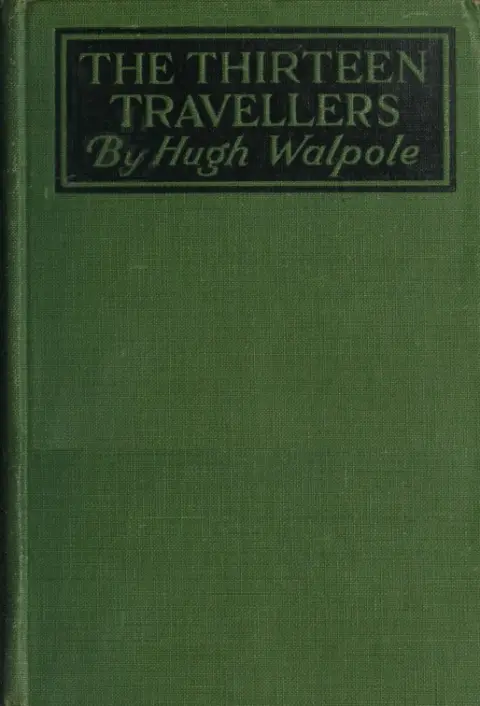
THE CLASSIC COLLECTION · 1921
"The Thirteen Travellers" by Hugh Walpole is a novel written in the early 20th century. The book seems to explore themes of social class, personal identity, and the transformative effects of war on individuals and society. The opening section introduces Absalom Jay, a once-prominent figure in London society, who now faces the challenges posed by the post-war world. The beginning of the novel focuses on Absalom Jay, painting a vivid portrait of his life and character as he navigates the drastic changes brought on by the Great War. Once a social butterfly, Absalom is characterized by his fastidiousness regarding his appearance and his strong desire for the approval of the upper class. However, as the war alters the social landscape, he finds himself increasingly isolated and struggling with his sense of purpose and identity. The narrative delves into his declining circumstances, particularly after losing his long-time servant, and reflects on his loneliness and denial of the changing world around him. Through Absalom's eyes, readers are invited to contemplate the fragility of social status and the impact of historical events on individual lives.
Introduction adapted from the source catalogue; source summaries may be automatically generated.
Free to read · English · 70,078 words · No account needed
MAKE TIME FOR A GOOD BOOK
On by default. Untick to stop anonymous reading totals. Each page counts after 10 seconds in view. How this works.
Anonymous counting is on unless you have switched it off.
"Well, for once you haven't," said Tom shortly. "Here, driver, help me
lift her in."
"Where's she going?" he repeated.
"If you don't help me at once I'll see that a policeman is here. I've got your number. You'll hear from me in the morning."
The man got off his box, cursing. He hesitated a moment, then came across. Together he and Tom lifted the inert mass, pushed it through the door of the cab and settled it in the seat.
"Makin' my cab dirty and all," growled the driver.
"Well," said Tom to the old man, "are you going to see your sister home? If not, I shall take her to the nearest hospital."
For a moment the old man remained perched up against the wall, his top hat flaunting defiance to the whole world. Suddenly, as though he had been pushed, he came across to the driver.
"Eleven D Porker's Buildings, Victoria," he said.
"B?" asked the driver.
"D, you damned fool," the old man almost shouted.
"Thought you said B," remarked the driver very amiably.
The old man got in. He was on one side of the motionless Maria, Tom on
the other.
That was a remarkable and even romantic ride. The roads were slippery, and the driver, it appeared, a little drunk. The cab rocked like a drunken boat, and the watery moon, now triumphant over the clouds, the gleaming pavement, the houses, gaunt in the uncertain moonlight, and thin as though they had been cut from black paper, seemed to be inebriated too. Maria shared in the general irresponsibility, lurching from side to side, and revealing, now that her hat was on Tom's lap, an ancient peeked face with as many lines on it as an Indian's, and grey, untidy hair. She seemed a lifeless thing enough, and yet Tom had a strange notion that one eye was open, and not only watching, but winking as well.
It would have been the natural thing to have opened her dress and given her air, to have poured whisky or brandy down her throat, to have tickled her with feathers! Tom did none of these things: afterwards he imagined that his inaction was due to the fact that he knew all the time that she had not really fainted.
Not a word was exchanged during the journey. They drove down Victoria Street, turned off on the right of Westminster Cathedral, and drew up in a narrow, dirty street.
A high block had "Porker's Buildings" printed in large, ugly letters on the fanlight near the door.
"You'd better help me lift her in," Tom said to the driver. "The old man's not good for anything."
Your reading position is saved on this browser. Take it to another device with a library code. Reading pages adapt to text, rather than matching a printed edition.
Hugh Walpole

Hugh Walpole
Hugh Walpole
Hugh Walpole
BEHIND THE BOOK
This eBook is for the use of anyone anywhere in the United States and most other parts of the world at no cost and with almost no restrictions whatsoever. You may copy it, give it away or re-use it under the terms of the Project Gutenberg License included with this eBook or online at www.gutenberg.org. If you are not located in the United States, you will have to check the laws of the country where you are located before using this eBook. Read the source licence.
The original source file, including credits and licence, is retained by this library. Request an original-format copy at no charge. Please include the book title and Project Gutenberg identifier #60278.
KEEP YOUR CURIOSITY GOING
Cécile Tormay

Moritz Busch
Coulson Kernahan
John L. Ransom

Maurice Baring
Frances Wright