
Portrait of a Man with Red Hair: A Romantic Macabre
Hugh Walpole
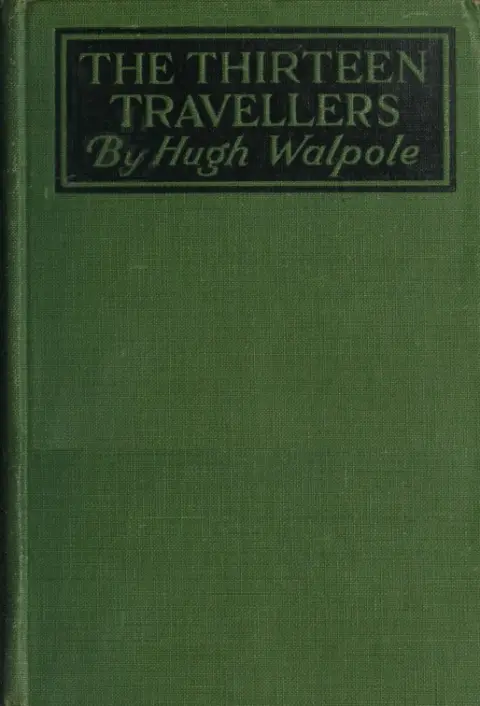
THE CLASSIC COLLECTION · 1921
"The Thirteen Travellers" by Hugh Walpole is a novel written in the early 20th century. The book seems to explore themes of social class, personal identity, and the transformative effects of war on individuals and society. The opening section introduces Absalom Jay, a once-prominent figure in London society, who now faces the challenges posed by the post-war world. The beginning of the novel focuses on Absalom Jay, painting a vivid portrait of his life and character as he navigates the drastic changes brought on by the Great War. Once a social butterfly, Absalom is characterized by his fastidiousness regarding his appearance and his strong desire for the approval of the upper class. However, as the war alters the social landscape, he finds himself increasingly isolated and struggling with his sense of purpose and identity. The narrative delves into his declining circumstances, particularly after losing his long-time servant, and reflects on his loneliness and denial of the changing world around him. Through Absalom's eyes, readers are invited to contemplate the fragility of social status and the impact of historical events on individual lives.
Introduction adapted from the source catalogue; source summaries may be automatically generated.
Free to read · English · 70,078 words · No account needed
MAKE TIME FOR A GOOD BOOK
On by default. Untick to stop anonymous reading totals. Each page counts after 10 seconds in view. How this works.
Anonymous counting is on unless you have switched it off.
"She's not my wife," said the old man. "She's my sister, if you want to
know."
"I don't want to know especially," said Tom. "Well, good-night: I see
the rain's dropped."
He stepped out into Bond Street, and then (on looking back he could
never define precisely the impulse that drove him) he hurried back to
them.
"You'd better let me get you a cab or something," he said. "You really
ought to go home."
The old man snarled at him. "You let us alone," he said. "We haven't
done you any harm."
The impulse persisted.
"I'm going to get you a cab," he said. "Whether you like it or no."
"None of your bloody philanthropy," said the old man. "I know you.
M'rier and me's all right."
It was Maria then who took the next step in the affair. Tom, although he was afterwards to have a very considerable knowledge of that old lady, could never definitely determine as to whether the step that she took was honest or no. What she did was to collapse into the sodden pavement in a black and grimy heap. The feather stood out from the collapse with a jaunty, ironical gesture.
"'Ere, M'rier," said the old man, very much as though he were addressing a recalcitrant horse, "you get hup."
No sound came from the heap. Tom bent down. He touched her soiled velvet coat, lifted an arm, felt the weight sink beneath him. "Well," he said, almost defiantly, to the old man, "what are you going to do now?"
"She's always doing it," he answered, "and at the most aggravating moments." Then with something that looked suspiciously like a kick, he repeated: "You get hup, M'rier."
"Look here, you can't do that," Tom cried. "What an old devil you are! We've got to get her out of this."
A voice addressed them from the street: "Anything the matter?" it said.
Tom turned and found that the driver of a taxi had pulled up his machine and was peering into the shadow.
"Yes. There's been an accident," Tom said. "This lady's fainted. We'd
better get her home."
"Where's she going to?" said the driver suspiciously.
"What business is that of yours?" cried the old man furiously. "You
just leave us alone."
"No, you couldn't do that," Tom answered. "There'll be a policeman here in a moment, and he'll have you home whether you want it or not. You never can lift her yourself, and you can't leave her there. You'd better help me get her into the cab!"
The old man began to gargle strangely in his throat.
"Policeman!" he seemed to say. "If I 'ad my way----"
Your reading position is saved on this browser. Take it to another device with a library code. Reading pages adapt to text, rather than matching a printed edition.
Hugh Walpole

Hugh Walpole
Hugh Walpole
Hugh Walpole
BEHIND THE BOOK
This eBook is for the use of anyone anywhere in the United States and most other parts of the world at no cost and with almost no restrictions whatsoever. You may copy it, give it away or re-use it under the terms of the Project Gutenberg License included with this eBook or online at www.gutenberg.org. If you are not located in the United States, you will have to check the laws of the country where you are located before using this eBook. Read the source licence.
The original source file, including credits and licence, is retained by this library. Request an original-format copy at no charge. Please include the book title and Project Gutenberg identifier #60278.
KEEP YOUR CURIOSITY GOING
Cécile Tormay

Moritz Busch
Coulson Kernahan
John L. Ransom

Maurice Baring
Frances Wright