THE CLASSIC COLLECTION✦A dead man’s diaryCLASSIC FREE BOOKS
A dead man’s diary
Coulson Kernahan
THE CLASSIC COLLECTION · 1899
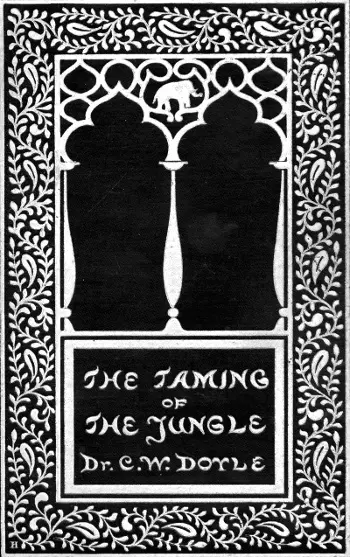
"The Taming of the Jungle" by C. W. Doyle is a fictional narrative likely written in the late 19th century. This book offers an exploration of life in the Terai region of India, focusing on the culture and complexities of its inhabitants, particularly the Kumaon Padhans. Central characters include Ram Deen, a mail-cart driver, and Biroo, a young boy who faces various challenges and adventures in the jungle setting. The opening of the narrative introduces readers to the Padhans, a simple and migratory people who live in harmony with the rustic and wild beauty of their environment. Ram Deen shares a gripping story around a fire, detailing his personal struggle with a debt to a local shopkeeper, leading to acts of desperation that culminate in tragedy and vengeance. This sets the stage for a tale marked by themes of survival, justice, and the harsh realities of jungle life, while also hinting at the deeper societal issues and rich cultural backdrop that will unfold throughout the story.
Introduction adapted from the source catalogue; source summaries may be automatically generated.
Free to read · English · 33,117 words · No account needed
MAKE TIME FOR A GOOD BOOK
On by default. Untick to stop anonymous reading totals. Each page counts after 10 seconds in view. How this works.
Anonymous counting is on unless you have switched it off.
"So she called aloud in her own tongue, and there came forth into the night, from the other dooli, a young lad rubbing the sleep from his eyes and yawning; and whilst he parleyed with his mother, the curtain of her dooli was lifted, and a young mem-sahib rose from it and stood beside the boy, and we could see they were brother and sister, but she was the older and taller by a span, and in the budding of her womanhood. The hair, that fell to her waist, was as spun gold in the light of the torches; rings and stones flashed in her ears and on her fingers, but they were nothing to the glances of her eyes, which met four-square the eyes of those to whom she spoke; and she looked at those who were present as though they were there to do her bidding.
"When the sick mem-sahib in the dooli had finished speaking, the younger one addressed the masalchi (torch-bearer), saying, 'How far is it to the next chowki, and what do you ask for taking us there?'
"'Two kos (six miles), mem-sahib, and the hire of my men is fifty
rupees,' answered Lakhoo.
"'And what did you get for bringing us here?' asked she, turning to the dooli-bearers who stood round them.
"'They are poor men, missy baba, and know nothing,' said Lakhoo, at whom the dooli-bearers looked for instructions.
"'Son of a Pig!' exclaimed the young lad, taking a leather bag from his sister's hand and throwing the money, a rupee at a time, on the ground; 'there are fifty rupees. Proceed, for the mem-sahib, my mother, is sick, and must be on the hills ere the morning sun give heat,' and his face flushed in the torchlight.
"So Lakhoo tied the money in his waistband, and, without further speech, sat down and smoked the hookah that was passed to him.
"And after awhile the baba (boy), who had been walking to and fro with the young woman, his sister, stopped opposite Lakhoo, and spoke, saying, 'Why do you not proceed, dooli-wallah?'
"'Because I am waiting for my hire, baba ji,' replied Lakhoo.
"'I paid you but now,' exclaimed the young sahib.
"'The sahib is scarce awake,' said Lakhoo, in a bantering tone, 'and hath been dreaming.' And his men who formed the outer circle laughed insolently.
"'Liar!' shouted the young sahib, bursting into tears and clinching his hand; but his sister laid a restraining finger on his arm, and whispered in his ear.
"'We will give thee thy due, masalchi,' she said, as she went to her
mother's dooli.
Your reading position is saved on this browser. Take it to another device with a library code. Reading pages adapt to text, rather than matching a printed edition.
BEHIND THE BOOK
This eBook is for the use of anyone anywhere in the United States and most other parts of the world at no cost and with almost no restrictions whatsoever. You may copy it, give it away or re-use it under the terms of the Project Gutenberg License included with this eBook or online at www.gutenberg.org. If you are not located in the United States, you will have to check the laws of the country where you are located before using this eBook. Read the source licence.
The original source file, including credits and licence, is retained by this library. Request an original-format copy at no charge. Please include the book title and Project Gutenberg identifier #35644.
KEEP YOUR CURIOSITY GOING
Coulson Kernahan

Maurice Baring
Frances Wright
Cécile Tormay

Frederic Jesup Stimson

W. H. P. (William Henry Pope) Jarvis