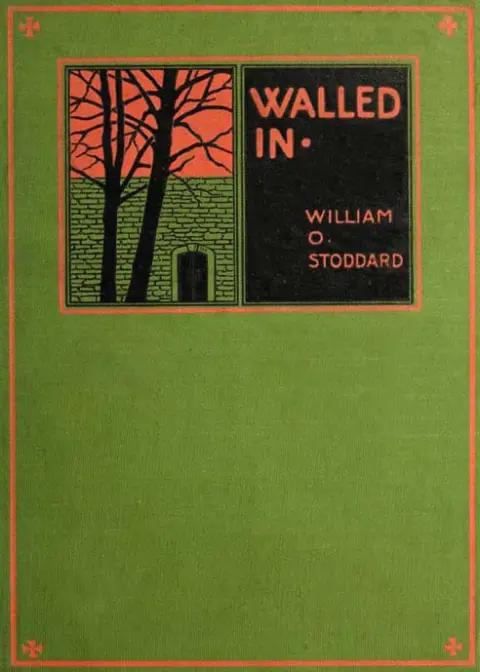
Walled In: A True Story of Randall’s Island
William O. Stoddard
THE CLASSIC COLLECTION · 1882
"The Talking Leaves: An Indian Story" by William O. Stoddard is a historical novel written in the late 19th century. Set against the backdrop of Native American life and the encroachment of white settlers, it focuses on characters like Ni-ha-be, the daughter of an Apache chief, and her adopted sister Rita, who explore themes of cultural identity and the impact of outside influences on indigenous communities. At the start of the story, we are introduced to Ni-ha-be and Rita as they witness a gathering of Apache warriors while on a ride in the mountains. The excitement builds when they discover “talking leaves” (magazines) left behind by a group of white soldiers, igniting Rita’s curiosity and stirring entrenched feelings regarding their identities. The girls must navigate the complexities of their connection with both the Apache culture and their white origins, which sets the stage for their unfolding adventure amid the tensions between the two worlds. As they present the talking leaves to Ni-ha-be’s father, Many Bears, their discovery hints at larger conflicts and cultural intersections that are central to the narrative.
Introduction adapted from the source catalogue; source summaries may be automatically generated.
Free to read · English · 66,194 words · No account needed
MAKE TIME FOR A GOOD BOOK
On by default. Untick to stop anonymous reading totals. Each page counts after 10 seconds in view. How this works.
Anonymous counting is on unless you have switched it off.
There was not a great deal farther to go before a sharp string of exclamations ran along the line.
"See there!"
"Camp-fires yonder!"
"That's the Apache village!"
"It's on the other shore!"
"Hark, boys! Hear that--off to the northward? There's a fight going on. Ride now. We're away in behind it."
Captain Skinner was right again. By pushing on along the bank of the river he was soon in full view of the village, but there was very little of it to be seen at that time of night.
At the same time, just because he was so near it, he ran almost no risk at all of meeting any strong force of Apaches. The sound of far-away fighting had somehow ceased, but the Captain did not care to know any more about it.
"Silence, boys. Forward. Our chance has come."
He never dreamed of looking for a ford there by the village, and there were no squaws to find it for him or point it out. More than a mile below he came to the broad, rippling shallow the Apache warriors had reported to their chief, and into this he led his men without a moment's hesitation.
"Steady, boys; pick your tracks. Where the ripples show, the bottom isn't far down, but it may be a little rough."
A large part of it was rough enough, but Captain Skinner seemed to be able to steer clear of anything really dangerous, and in a few minutes more he was leading them out on the southerly shore.
"Now, boys," he said, "do you see what we've done?"
"We've got across the river," said Bill, "without any more of us
gettin' drownded."
"That's so; but we've done a heap more than that. We've put the Apache village between us and the Lipans, and all we've got to do is to strike for the Mexican line."
That was all, and yet at least half of them had something to urge in favor of a night prowl around the Apache village, to see if they could not steal a few ponies.
"My load's gettin' powerful heavy, Cap," said one.
"We want pack ponies for our provisions," said another.
"After we get some."
"Boys," said Captain Skinner, "if that band of Apaches once gets on our track we won't need many more provisions. I'm going to give 'em as wide a berth as ever I can."
Again the Captain showed his superior wisdom, and he hardly permitted them to halt until the sun was rising. Just then the foremost man sent back a loud shout of,
"Here's another river!"
"That's all right," said Captain Skinner. "Now I know where we are."
Your reading position is saved on this browser. Take it to another device with a library code. Reading pages adapt to text, rather than matching a printed edition.
William O. Stoddard
William O. Stoddard
William O. Stoddard
William O. Stoddard
BEHIND THE BOOK
This eBook is for the use of anyone anywhere in the United States and most other parts of the world at no cost and with almost no restrictions whatsoever. You may copy it, give it away or re-use it under the terms of the Project Gutenberg License included with this eBook or online at www.gutenberg.org. If you are not located in the United States, you will have to check the laws of the country where you are located before using this eBook. Read the source licence.
The original source file, including credits and licence, is retained by this library. Request an original-format copy at no charge. Please include the book title and Project Gutenberg identifier #21913.
KEEP YOUR CURIOSITY GOING
Cécile Tormay

Moritz Busch
Coulson Kernahan
John L. Ransom

Maurice Baring
Frances Wright