
Last letters from the living dead man
David Patterson (Spirit) Hatch
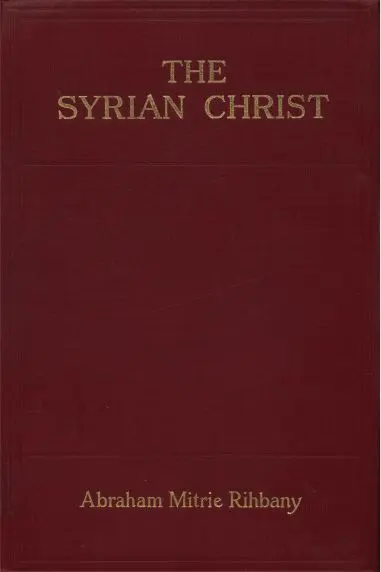
THE CLASSIC COLLECTION · 1916
"The Syrian Christ" by Abraham Mitrie Rihbany is a reflective work written in the early 20th century. This book explores the life and teachings of Jesus Christ from an Oriental perspective, aiming to provide readers, particularly those in the West, with insights into the cultural and social contexts of his time. It endeavors to bridge the gap between Eastern and Western understandings of spirituality, emphasizing the richness of the Oriental background that shaped many biblical narratives. The opening of the text introduces the author's intentions and background, as he seeks to offer an intimate view of Christ's life, explaining that his insights are drawn from personal experience as a Syrian born in close proximity to Jesus' birthplace. Rihbany reflects on how the customs, language, and social values of contemporary Syria illuminate biblical stories, presenting the idea that understanding these elements is crucial to truly grasping the spiritual teachings of Christ. The initial chapters set the stage for a nuanced discussion, leading the reader through culturally specific interpretations of familiar Biblical narratives while highlighting the enduring significance of these stories.
Introduction adapted from the source catalogue; source summaries may be automatically generated.
Free to read · English · 73,596 words · No account needed
MAKE TIME FOR A GOOD BOOK
On by default. Untick to stop anonymous reading totals. Each page counts after 10 seconds in view. How this works.
Anonymous counting is on unless you have switched it off.
To us 'aroos esshi'ar (the bride, or spouse of the poet) is purely an imaginary creature. It is {355} the poet's spirit of inspiration objectified in a female form. He does not describe a woman, but an angelic creature whose body and soul are both pure. Only the very commonplace versifier gets demoralized and infects his reader with the same feeling. The true poet soars far above "the things that perish," and is perfectly safe to follow. His infatuation is known as el howa el'adhry (pure, or aspirational love). Here, then, without the slightest attempt to excuse his phraseology, I find at least a partial justification for the Eastern poet, and for the writer of Solomon's Song.
The simple, eloquent, and fully inclusive description of the "virtuous woman," in the thirty-first chapter of the Book of Proverbs, is rather a composite than an individual picture. It expresses the Syrian's noblest idea of the true wife and the real home-maker:--
Who can find a virtuous woman? for her price is far above rubies.
The heart of her husband doth safely trust in her, so that he shall
have no need for spoil.
She will do him good and not evil all the days of her life.
She seeketh wool, and flax, and worketh willingly with her hands.
She is like the merchant's ships; she bringeth her food from afar.
She riseth also while it is yet night, and giveth meat to her household, and a portion to her maidens.
She considereth a field, and buyeth it: with the fruits of her hands
she planteth a vineyard.
She girdeth her loins with strength, and strengtheneth her arms.
She perceiveth that her merchandise is good: her candle goeth not out
by night.
She layeth her hands to the spindle, and her hands hold the distaff.
She stretcheth out her hands to the poor; yea, she reacheth forth her
hands to the needy.
She is not afraid of the snow for her household: for all her household
are clothed with scarlet.
She maketh herself coverings of tapestry; her clothing is silk and
purple.
Her husband is known in the gates, when he sitteth among the elders of
the land.
She maketh fine linen, and selleth it; and delivereth girdles unto the
merchant.
Strength and honor are her clothing; and she shall rejoice in time to
come.
She openeth her mouth with wisdom; and in her tongue is the law of
kindness.
She looketh well to the ways of her household, and eateth not the bread
of idleness.
Her children arise up, and call her blessed; her husband also, and he
praiseth her.
Many daughters have done virtuously, but thou excellest them all.
Your reading position is saved on this browser. Take it to another device with a library code. Reading pages adapt to text, rather than matching a printed edition.
BEHIND THE BOOK
This eBook is for the use of anyone anywhere in the United States and most other parts of the world at no cost and with almost no restrictions whatsoever. You may copy it, give it away or re-use it under the terms of the Project Gutenberg License included with this eBook or online at www.gutenberg.org. If you are not located in the United States, you will have to check the laws of the country where you are located before using this eBook. Read the source licence.
The original source file, including credits and licence, is retained by this library. Request an original-format copy at no charge. Please include the book title and Project Gutenberg identifier #40285.
KEEP YOUR CURIOSITY GOING
David Patterson (Spirit) Hatch

David Patterson (Spirit) Hatch

David Patterson (Spirit) Hatch
John L. Ransom

Herman W. Mudgett

Harriet Monroe