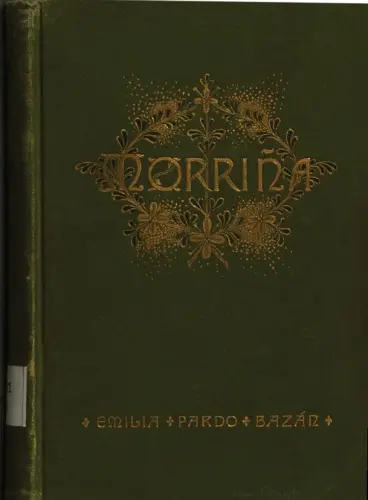
Morriña (Homesickness)
Emilia, condesa de Pardo Bazán
THE CLASSIC COLLECTION · 1891
"The Swan of Vilamorta" by Emilia Pardo Bazán is a novel written in the late 19th century. It explores themes of love, ambition, and social dynamics through the experiences of its main characters, Segundo García, a young poet, and Leocadia Otero, a schoolmistress. The narrative is situated in the fictional town of Vilamorta, where personal aspirations intertwine with a backdrop of societal expectations and complex relationships. At the start of the story, Segundo descends a rugged path near the town, reveling in the peaceful ambiance as he engages in an imaginative conversation with an echo. His poetic sensibilities catch the attention of passing muleteers, who mock him, prompting him to retreat into the nearby pine grove, where he eventually encounters Leocadia, with whom he shares a close and affectionate bond. As the narrative unfolds, Leocadia's profound feelings for Segundo are highlighted, juxtaposed against the social constraints and the weight of her past that she carries. The opening thus sets the stage for the exploration of their emotional entanglements, ambitions, and the contrasting backdrop of the town.
Introduction adapted from the source catalogue; source summaries may be automatically generated.
Free to read · English · 60,118 words · No account needed
MAKE TIME FOR A GOOD BOOK
On by default. Untick to stop anonymous reading totals. Each page counts after 10 seconds in view. How this works.
Anonymous counting is on unless you have switched it off.
Agonde rose early on the following morning, and descended shortly afterward to his shop, leaving his guests wrapped in their slumbers, and Carmen charged, the moment they should stir, to pour the chocolate into their mouths. The apothecary desired to enjoy the effect produced in the town by Don Victoriano's sojourn in his house. He was reclining in his leather-covered easy-chair when he saw Tropiezo riding past on his gray mule, and called out to him:
"Hello! Hello! Where are you bound for so early?"
"For Doas, man. I have not a minute to spare." And saying this the doctor alighted from his mule, which he tied to an iron ring fastened in the wall.
"Is the case so urgent?"
"Urgent? That it is. The old woman, the grandmother of Ramon, the
confectioner. It appears she has already received the last
sacrament."
"And it is only now they have sent for you?"
"No; I went to see her yesterday, and I applied two dozen leeches, that drew their fill of blood from her. She looked like a dying kid; she was very weak, and as thin as a wafer. Perhaps if I had given her something that I thought of, instead of applying leeches----"
"Ah! a trip," interrupted Agonde maliciously.
"Life is a series of trips," responded the doctor, shrugging his shoulders. "And upstairs?" he added, raising his eyes interrogatively to the ceiling.
"Snoring like princes."
"And he--how does he look?" asked Don Fermin, lowering his voice
and dwelling on every word.
"He?" repeated Agonde, following his example. "So-so. Oldish. And
very gray."
"But what is the matter with him? Let us hear. For as to being
sick, he is that."
"He has--a new disease--a very strange one, one of the latest fashion." And Agonde smiled maliciously.
"New?"
Agonde half-closed his eyes, bent toward Tropiezo, and whispered
something in his ear.
Tropiezo burst into a laugh; suddenly he looked very serious, and tapping his nose repeatedly with his forefinger:
"I know, I know," he said emphatically. "And the waters here, and some others in France, are the only cure for that disease. If he drinks a few glasses from the spring, he will be himself again."
Tropiezo emitted his dictamen leaning on the counter, forgetful of the mule that was stamping impatiently at the door.
"And the Señora--what does she say of her husband's state of health?" he suddenly asked, with a wink.
"What should she say of it, man? Probably she does not know that
it is serious."
A look of derision lighted up the inexpressive features of the
physician; he glanced at Agonde and smothering another burst of
laughter, began:
"The Señora--"
Your reading position is saved on this browser. Take it to another device with a library code. Reading pages adapt to text, rather than matching a printed edition.
Emilia, condesa de Pardo Bazán
Emilia, condesa de Pardo Bazán
BEHIND THE BOOK
This eBook is for the use of anyone anywhere in the United States and most other parts of the world at no cost and with almost no restrictions whatsoever. You may copy it, give it away or re-use it under the terms of the Project Gutenberg License included with this eBook or online at www.gutenberg.org. If you are not located in the United States, you will have to check the laws of the country where you are located before using this eBook. Read the source licence.
The original source file, including credits and licence, is retained by this library. Request an original-format copy at no charge. Please include the book title and Project Gutenberg identifier #54105.
KEEP YOUR CURIOSITY GOING
Coulson Kernahan

Maurice Baring
Frances Wright
Cécile Tormay

Frederic Jesup Stimson

W. H. P. (William Henry Pope) Jarvis