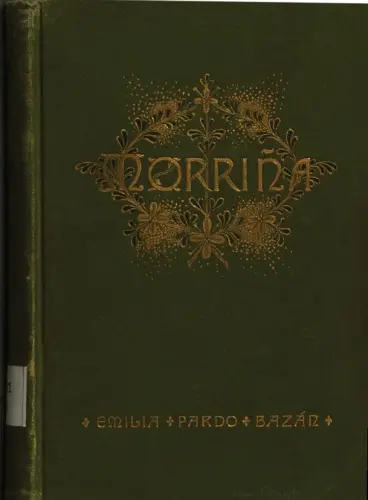
Morriña (Homesickness)
Emilia, condesa de Pardo Bazán
THE CLASSIC COLLECTION · 1891
"The Swan of Vilamorta" by Emilia Pardo Bazán is a novel written in the late 19th century. It explores themes of love, ambition, and social dynamics through the experiences of its main characters, Segundo García, a young poet, and Leocadia Otero, a schoolmistress. The narrative is situated in the fictional town of Vilamorta, where personal aspirations intertwine with a backdrop of societal expectations and complex relationships. At the start of the story, Segundo descends a rugged path near the town, reveling in the peaceful ambiance as he engages in an imaginative conversation with an echo. His poetic sensibilities catch the attention of passing muleteers, who mock him, prompting him to retreat into the nearby pine grove, where he eventually encounters Leocadia, with whom he shares a close and affectionate bond. As the narrative unfolds, Leocadia's profound feelings for Segundo are highlighted, juxtaposed against the social constraints and the weight of her past that she carries. The opening thus sets the stage for the exploration of their emotional entanglements, ambitions, and the contrasting backdrop of the town.
Introduction adapted from the source catalogue; source summaries may be automatically generated.
Free to read · English · 60,118 words · No account needed
MAKE TIME FOR A GOOD BOOK
On by default. Untick to stop anonymous reading totals. Each page counts after 10 seconds in view. How this works.
Anonymous counting is on unless you have switched it off.
The name of the other shop produced a storm of exclamations,
jests, and stamping of feet.
"Have you heard the news?" asked the waggish Tropiezo. "It seems that Nocedal has written a very flattering letter to Doña Eufrasia, saying that as he represents Don Carlos in Madrid so she, by reason of her merits, ought to represent him in Vilamorta."
Homeric bursts of laughter and a general huzza greeted this
remark.
"Well, that may be an invention; but it is true, true as gospel, that Doña Eufrasia sent Don Carlos her likeness with a complimentary inscription."
"And the regiment? Have they fixed on the day on which it is to
take the field?"
"Of course. They say that the Abbot of Lubrego is to command it."
The hilarity of the assembly was redoubled, for the Abbot of Lubrego was nearing his seventieth year, and was so feeble that he could scarcely hold himself on his mule. A boy at this moment entered the shop, swinging in his hand a glass bottle.
"Don Saturnino!" he cried, in a shrill voice.
"What is it you want?" answered the druggist, mimicking his
tones.
"Give me some of what this smells like."
"All right," said Agonde, putting the bottle to his nose. "What does this smell like, Don Fermin?"
"Let me see--it smells something like--laudanum, eh?--or arnica?"
"Arnica let it be, it is less dangerous. I hope it will have a
good effect."
"It is time to retire, gentlemen," said the Lawyer García,
consulting his silver timepiece.
Genday stood up and Segundo followed his example.
The tresillo party proceeded to settle accounts; calculating winnings and losses, centavo by centavo, by means of white counters and yellow counters. After the close atmosphere of the shop the cool air of the street was grateful; the night was mild and clear; the stars shone with a friendly light and Segundo, who was quick to perceive the poetic aspect of things, felt tempted to leave his father and his uncle without ceremony and walk along the road, alone, according to his custom, to enjoy the beauty of the night. But his Uncle Genday linked his arm through his, saying:
"You are to be congratulated, my boy."
"Congratulated, uncle?"
"Weren't you crazy to get away from here? Didn't you want to take
your flight to some other place? Haven't you a hatred for office
work?"
"Good man," interposed the lawyer; "he is crazy enough as it is, and you want to unsettle his mind still more----"
Your reading position is saved on this browser. Take it to another device with a library code. Reading pages adapt to text, rather than matching a printed edition.
Emilia, condesa de Pardo Bazán
Emilia, condesa de Pardo Bazán
BEHIND THE BOOK
This eBook is for the use of anyone anywhere in the United States and most other parts of the world at no cost and with almost no restrictions whatsoever. You may copy it, give it away or re-use it under the terms of the Project Gutenberg License included with this eBook or online at www.gutenberg.org. If you are not located in the United States, you will have to check the laws of the country where you are located before using this eBook. Read the source licence.
The original source file, including credits and licence, is retained by this library. Request an original-format copy at no charge. Please include the book title and Project Gutenberg identifier #54105.
KEEP YOUR CURIOSITY GOING
Coulson Kernahan

Maurice Baring
Frances Wright
Cécile Tormay

Frederic Jesup Stimson

W. H. P. (William Henry Pope) Jarvis