THE CLASSIC COLLECTION✦An outlaw’s diary: the CommuneCLASSIC FREE BOOKS
An outlaw’s diary: the Commune
Cécile Tormay
THE CLASSIC COLLECTION · 1918
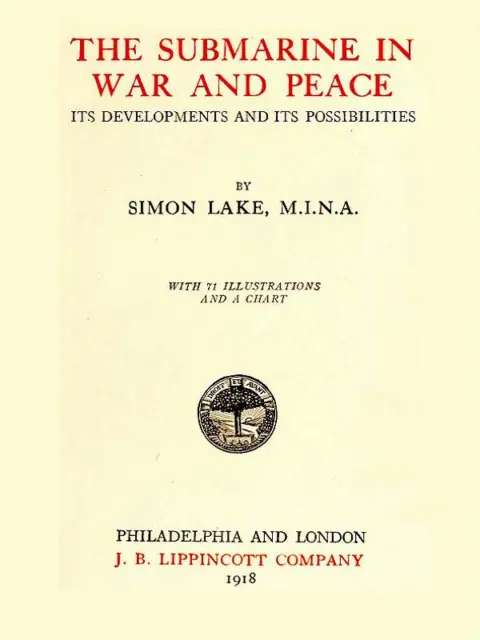
"The Submarine in War and Peace: Its Development and its Possibilities" by Simon Lake is a scientific publication written in the early 20th century. The work primarily focuses on the technology and conceptual evolution of submarines, exploring their mechanical principles, historical developments, and potential future applications in both military and peacetime contexts. The author provides insights into the submarine's role as an influential instrument in naval warfare, reflecting the changing perceptions of this technology during World War I. At the start of the text, Lake introduces his motivation for writing the book, emphasizing the lack of accessible information on submarines during his early research years. He contrasts the widespread misunderstanding in public discourse about submarines with the actual technological advancements made since their inception. Lake aims to clarify the complexity and operational capabilities of submarines, addressing misconceptions while also detailing the various components that constitute modern submarines. He emphasizes not only the practical application of submarines in warfare but also their broader implications for political and industrial domains, suggesting that their continued evolution is essential in the context of modern naval strategy.
Introduction adapted from the source catalogue; source summaries may be automatically generated.
Free to read · English · 90,015 words · No account needed
MAKE TIME FOR A GOOD BOOK
On by default. Untick to stop anonymous reading totals. Each page counts after 10 seconds in view. How this works.
Anonymous counting is on unless you have switched it off.
Offensively the submarine will be of little value when brought to its highest point of development, for when every nation is fully equipped with submarines the menace of these vessels will keep enemy surface ships from venturing on the sea. There will be nothing for the submarines to attack except ships of their own kind, and that, of course, will be impossible. Thus wars between maritime nations will come to be nothing more than a mutual check; no surface ships or transports will dare to move in any direction. Offensive warfare will thus end, and each nation will be playing a waiting game, relying upon her submarines for defence.
This is the destiny of the submarine. This has been the aim and the prophecy of the pioneers in submarine development. There is nothing which will stand in the way of the accomplishment of this happy result. The success of the submarine in the present war has at last forced those in power--and among them many who bitterly opposed its development--to recognize the value of this weapon. Submarine designers and submarine inventors will from now on receive the encouragement and the attention of naval authorities throughout the world. Hence we may expect to see the submarine developed and improved until it has many times the efficiency, speed, and destructive power which is possessed by it to-day. We may also expect to see the industrial possibilities of the submarine developed to a high degree within a few years. Travel will be made safer, rich cargoes will be recovered, and the ocean will be forced to give up its wealth and its products to the uses of man in greater quantity than ever before. Thus, instead of following a career of murder and of piracy, the submarine is destined to protect the weak, to strengthen the strong, and to serve humanity in general as an agent for prosperity and for peace.
A-8, English submarine, 47
A-1, English submarine, 48
Abbott, Leon, 123
Aerial torpedoes, 240
Aeroplanes, 234ff
Air supply, question of, 49-51
"Alligator," Russian submarine, 67
"American Turtle," 79, 80, 149ff
"Amphibious" submarines, 202ff
Anchoring weights, 20, 21
Appropriation, U. S., 1893, requirements, 161ff
Appropriation, U. S., 1915, requirements, 175
"Argonaut," 1, 7, 10, 36, 41, 50, 55, 58, 60, 70, 125, 177ff, 264,
270, 276
"Argonaut, Junior," 125, 127, 176ff
Asphyxiation, 32, 70
Baker, G. F., 121, 161, 163
Ballast tanks, 9
"Battle of the Kegs," 81
Becklemechief, Capt., 65
Berg, H. O., 137
Blinding the submarine, 244
Board on Submarine Defense, report of, 209ff, 215ff
Bombs, 248
Bonaparte, Napoleon, 81
Bottom wheels, 216, 219
Bourgois and Brun, 153
Brayton engines, 94
Bubonoff, Constructor, 65
Buoyancy, negative, 18-19
Buoyancy, positive, 18-19
Buoyancy, reserve of, 9
Bushnell, Dr. David, 79, 149
Your reading position is saved on this browser. Take it to another device with a library code. Reading pages adapt to text, rather than matching a printed edition.
BEHIND THE BOOK
This eBook is for the use of anyone anywhere in the United States and most other parts of the world at no cost and with almost no restrictions whatsoever. You may copy it, give it away or re-use it under the terms of the Project Gutenberg License included with this eBook or online at www.gutenberg.org. If you are not located in the United States, you will have to check the laws of the country where you are located before using this eBook. Read the source licence.
The original source file, including credits and licence, is retained by this library. Request an original-format copy at no charge. Please include the book title and Project Gutenberg identifier #46382.
KEEP YOUR CURIOSITY GOING
Cécile Tormay

Moritz Busch
John L. Ransom
Frances Wright
Cécile Tormay

Mabel Potter Daggett