THE CLASSIC COLLECTION✦An outlaw’s diary: the CommuneCLASSIC FREE BOOKS
An outlaw’s diary: the Commune
Cécile Tormay
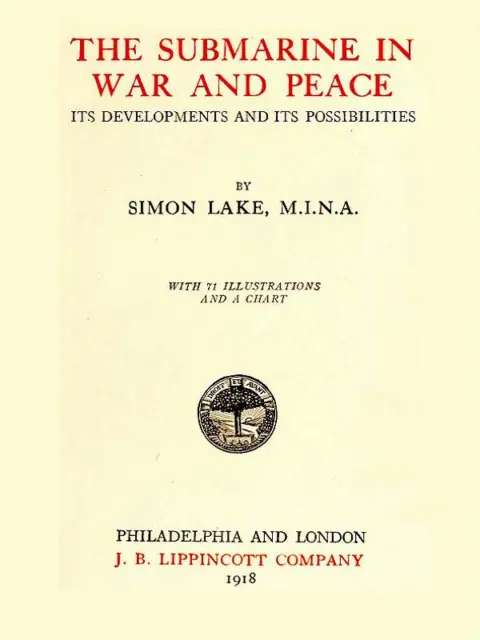
THE CLASSIC COLLECTION · 1918
"The Submarine in War and Peace: Its Development and its Possibilities" by Simon Lake is a scientific publication written in the early 20th century. The work primarily focuses on the technology and conceptual evolution of submarines, exploring their mechanical principles, historical developments, and potential future applications in both military and peacetime contexts. The author provides insights into the submarine's role as an influential instrument in naval warfare, reflecting the changing perceptions of this technology during World War I. At the start of the text, Lake introduces his motivation for writing the book, emphasizing the lack of accessible information on submarines during his early research years. He contrasts the widespread misunderstanding in public discourse about submarines with the actual technological advancements made since their inception. Lake aims to clarify the complexity and operational capabilities of submarines, addressing misconceptions while also detailing the various components that constitute modern submarines. He emphasizes not only the practical application of submarines in warfare but also their broader implications for political and industrial domains, suggesting that their continued evolution is essential in the context of modern naval strategy.
Introduction adapted from the source catalogue; source summaries may be automatically generated.
Free to read · English · 90,015 words · No account needed
MAKE TIME FOR A GOOD BOOK
On by default. Untick to stop anonymous reading totals. Each page counts after 10 seconds in view. How this works.
Anonymous counting is on unless you have switched it off.
Convoying a merchant fleet.
Zigzag course.
Smoke screen.
Cargo submarine.
High speed.
In considering the practicability or value of these devices, we must first consider the capabilities of the submarine and the proper tactics for her commander to pursue. In a paper read before the Institution of Naval Architects in London, in 1905, I described, illustrated by diagrams, the proper method to be pursued in attacking a surface ship, in which I contended that the commander of a submarine, on sighting an enemy, should always keep the hull of his own boat below the horizon in its relation to the enemy vessel, and try to intercept the approaching vessel by taking frequent observations of her course and speed. When the two vessels approach sufficiently near to make it possible for the larger surface vessel to observe the smaller submarine (the comparative range of visibility being proportionate to the exposed surfaces of the two vessels above the horizon), the submarine should then entirely submerge, with her telescopic periscope withdrawn below the surface of the water to avoid the making of a "wake"--which looks like a white streak on the water. When the commander wishes to make an observation he should first bring his submarine to rest and then extend the periscope above the surface for a brief instant only, and thus avoid the chance of being seen. Earlier in the war it was common to detect the submarine by her wake, but now, since the fitting of merchantmen with guns, the above tactics are usually pursued, and the first intimation the crew has of the presence of the submarine is the shock of the explosion caused by the torpedo "striking home."
=Aeroplanes and Dirigibles.=--These are undoubtedly valuable near land in shallow water, providing the water is clear and has a bottom in striking contrast to the hull of the submarine. I should consider the dirigible likely to prove of more value than the aeroplane, owing to its ability to hover directly over and regulate its speed to that of the submarine and thus enable itself to drop depth bombs more accurately. Experience has shown that it is almost impossible to calculate where a bomb will strike when dropped from a swiftly moving aeroplane. The chance of its striking the submarine would be very slight. The use of aeroplanes has, however, forced the submarines away from shoal clear water and probably has been instrumental, also, in causing them to become equipped with high-angle rapid-firing guns. In a battle between swiftly moving aeroplanes and submarines with high-powered guns firing shrapnel, the chances are nearly all in favor of the submarine, as they can carry the most powerful guns and are firing from a much more stable platform; in fact, the best analogy I can think of is that of a gunner in a "blind" firing at a flock of ducks passing overhead. Aeroplanes have been used, however, as scouts, merely to detect a submarine and direct surface ships to the attack; also, aeroplanes have directed trawlers to a submarine lying submerged at a shallow depth. This method of attack has undoubtedly been successful in some instances, but where success might have been met with in this manner with the earlier submarine boats, which were not provided with guns, it is now a problem easily met by submarine architects. Submarine boats may be built which have no fear of this combination. One of my earliest designs provided for a revolving armored turret to carry heavy-calibre guns; this revolvable armored turret would extend only above the surface and would carry guns of sufficient calibre to sink any trawler, destroyer, or other craft except an armored ship. It has recently been reported that the Germans are bringing out ships fitted with turrets of this type, and as they are familiar with my designs from the Patent Office specifications, and also have my working drawings of a large cruiser submarine mounted with guns, in 1905, I have no doubt that the report is true, as they have consistently been the first to adopt such new devices as may be needed to offset any attack against their submarines, or to increase their means of offence against surface craft without relying upon torpedoes alone. As far back as 1902 the Protector was fitted with a small gun on top of her conning tower, with the breech extended into the sighting hood and a tampon controlled from within the turret for closing the muzzle, so that no water would enter the barrel when the vessel was submerged, thus permitting a new cartridge and shell to be inserted into the breech when submerged; then, by momentarily bringing the conning tower above the surface, we could fire, then submerge and reload, rest and fire again, etc., thus providing a disappearing gun on a very stable platform.
Your reading position is saved on this browser. Take it to another device with a library code. Reading pages adapt to text, rather than matching a printed edition.
BEHIND THE BOOK
This eBook is for the use of anyone anywhere in the United States and most other parts of the world at no cost and with almost no restrictions whatsoever. You may copy it, give it away or re-use it under the terms of the Project Gutenberg License included with this eBook or online at www.gutenberg.org. If you are not located in the United States, you will have to check the laws of the country where you are located before using this eBook. Read the source licence.
The original source file, including credits and licence, is retained by this library. Request an original-format copy at no charge. Please include the book title and Project Gutenberg identifier #46382.
KEEP YOUR CURIOSITY GOING
Cécile Tormay

Moritz Busch
John L. Ransom
Frances Wright
Cécile Tormay

Mabel Potter Daggett