THE CLASSIC COLLECTION✦An outlaw’s diary: the CommuneCLASSIC FREE BOOKS
An outlaw’s diary: the Commune
Cécile Tormay
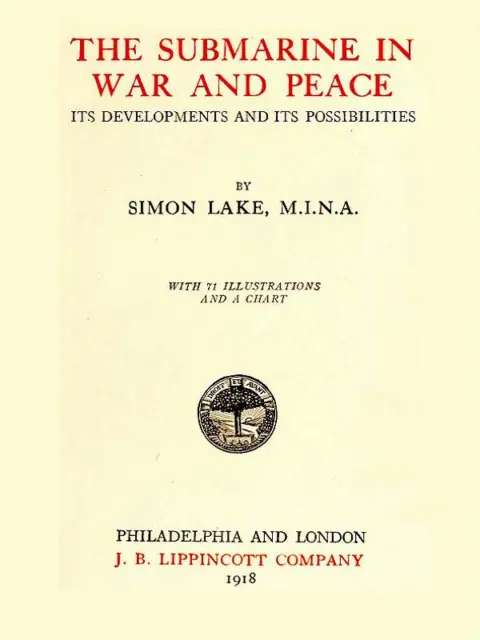
THE CLASSIC COLLECTION · 1918
"The Submarine in War and Peace: Its Development and its Possibilities" by Simon Lake is a scientific publication written in the early 20th century. The work primarily focuses on the technology and conceptual evolution of submarines, exploring their mechanical principles, historical developments, and potential future applications in both military and peacetime contexts. The author provides insights into the submarine's role as an influential instrument in naval warfare, reflecting the changing perceptions of this technology during World War I. At the start of the text, Lake introduces his motivation for writing the book, emphasizing the lack of accessible information on submarines during his early research years. He contrasts the widespread misunderstanding in public discourse about submarines with the actual technological advancements made since their inception. Lake aims to clarify the complexity and operational capabilities of submarines, addressing misconceptions while also detailing the various components that constitute modern submarines. He emphasizes not only the practical application of submarines in warfare but also their broader implications for political and industrial domains, suggesting that their continued evolution is essential in the context of modern naval strategy.
Introduction adapted from the source catalogue; source summaries may be automatically generated.
Free to read · English · 90,015 words · No account needed
MAKE TIME FOR A GOOD BOOK
On by default. Untick to stop anonymous reading totals. Each page counts after 10 seconds in view. How this works.
Anonymous counting is on unless you have switched it off.
While Captain Lauboeuf and the Krupps have taken out several patents on detail mechanisms for use on submarine boats, they have never--so far as I am aware or the patent records show--attempted to claim to be the original inventors of the type of submarine with buoyant ship-shaped form of hull consisting of a pressure-resisting body surmounted by a watertight, non-pressure-resisting body which gives suitable form for surface speed and seaworthiness, which is the principal characteristic of vessels built by them. I feel, therefore, that certain misinformed authors should, in the interests of the truth, correct their statements if they issue new editions of their work or write further on the development of the submarine.
During the years of practical experimental work with the Argonaut, Mr. Holland continued in his efforts to get the Plunger--building under the 1893 appropriation--in shape for submerged trials, but without success.
The large steam installation, sixteen hundred horsepower, was largely responsible for this. As I remember, there was only about eighteen inches between the main engines, with large steam supply and exhaust pipes overhead and under foot. These engines were designed to run at over four hundred revolutions per minute. The boiler was located nearly in the centre of the vessel and so nearly filled the ship that there was barely room between the top of the boiler and ship to creep from "forward to aft."
The heat was so intense that the trial crew found it impossible to live in the boat, so for their full power dock trials valve stems were run up through the deck to enable the engines to be started from there. Arrangements were made also to take the indicator cards from the deck. She was also fitted with a heavy armored conning tower, as per Mr. Holland's description previously quoted. This, combined with the high position of the boiler and engines, together with her cigar-shaped form, which gives a diminishing water plane, reduced her stability almost to zero. I was informed that when the attempt was first made to start up one of her engines her stability was so little that the turning effort on her propeller shaft nearly caused her to "turn turtle," and that she rolled over on her side to such an extent that the conning tower struck the dock stringer. The constructor at the Columbian Iron Works then put heavy chains on her so that she could not turn over. Every inducement was made to the Holland Company to enable it to make this vessel satisfactory, as Congress, in 1896, authorized the Secretary of the Navy to contract for two more "submarine torpedo boats of the Holland type, provided that the Holland boat now being built for the Department shall be accepted by the Department as fulfilling all the requirements of the Contract." She was finally abandoned in 1900 without ever making a submerged run or fulfilling any of her guarantees of performance under which the award was secured. Mr. Holland as early as 1897 must have concluded that the Plunger was destined to failure. In fact, no submarine, even up to the present day, has ever equalled the performance guaranteed under the Plunger's contract. He therefore built a much smaller boat, called the Holland. This vessel was fitted with internal-combustion engines instead of steam, and was finally accepted by the United States Government in lieu of the Plunger, and placed in commission in 1900. She was the first submarine torpedo boat to go into commission in the United States Navy. Her characteristics were: Length, fifty-three feet four inches; beam, ten feet three inches; displacement, sixty-four tons surface, seventy-five tons submerged; power, internal-combustion engines, fifty horsepower; surface speed, six to seven knots claimed; submerged speed, five knots claimed. The only official report I have seen gave her a surface speed of five and two-thirds knots. I believe she was purchased by the authority of the Act of June 7, 1900, which read as follows: "The Secretary of the Navy is hereby authorized and directed to contract for five submarine torpedo boats of the 'Holland' type of the most improved design, at a price not to exceed one hundred and seventy thousand dollars (£35,000) each: Provided, That such boats shall be similar in dimensions to the proposed new 'Holland,' plans and specifications of which were submitted to the Navy Department by the Holland Torpedo Boat Company, November twenty-third, eighteen hundred and ninety-nine."
Your reading position is saved on this browser. Take it to another device with a library code. Reading pages adapt to text, rather than matching a printed edition.
BEHIND THE BOOK
This eBook is for the use of anyone anywhere in the United States and most other parts of the world at no cost and with almost no restrictions whatsoever. You may copy it, give it away or re-use it under the terms of the Project Gutenberg License included with this eBook or online at www.gutenberg.org. If you are not located in the United States, you will have to check the laws of the country where you are located before using this eBook. Read the source licence.
The original source file, including credits and licence, is retained by this library. Request an original-format copy at no charge. Please include the book title and Project Gutenberg identifier #46382.
KEEP YOUR CURIOSITY GOING
Cécile Tormay

Moritz Busch
John L. Ransom
Frances Wright
Cécile Tormay

Mabel Potter Daggett