THE CLASSIC COLLECTION✦English grammarCLASSIC FREE BOOKS
English grammar
Lillian Kimball Stewart
THE CLASSIC COLLECTION · 1900
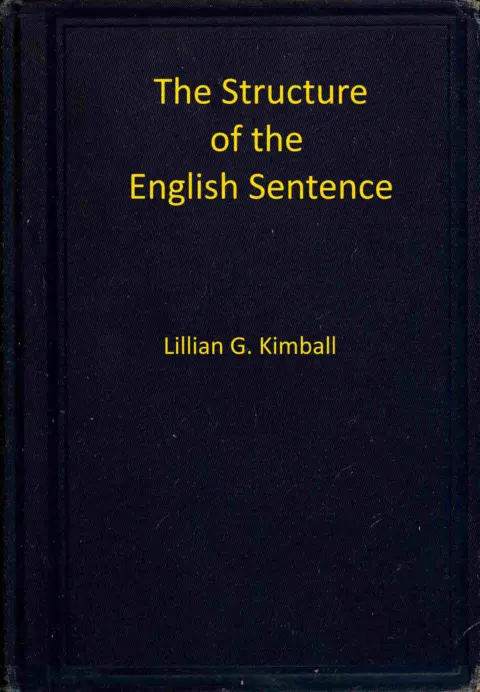
"The Structure of the English Sentence" by Lillian G. Kimball is an instructional textbook focused on English grammar written in the late 19th century. The book aims to enhance readers' understanding of English sentence structure and grammar with an emphasis on the importance of communication and clarity in expressing thoughts. It seeks to transform the often dry study of grammar into a more engaging exploration of language use. At the start of the text, the author outlines a clear vision for how English grammar should be approached, emphasizing that it is not merely a collection of rules but a study of thought and expression. Kimball advocates for analyzing sentences as whole units that convey ideas, encouraging readers to understand the relationships between different components such as subjects and predicates. This foundation sets the stage for examining various aspects of sentence structure, aiming to equip students with the analytical tools necessary for effective writing and communication.
Introduction adapted from the source catalogue; source summaries may be automatically generated.
Free to read · English · 70,429 words · No account needed
MAKE TIME FOR A GOOD BOOK
On by default. Untick to stop anonymous reading totals. Each page counts after 10 seconds in view. How this works.
Anonymous counting is on unless you have switched it off.
6. “If my friend was not a genius, he was certainly a monomaniac.”--H. James. This sentence does not mean that my friend was a monomaniac provided he was not a genius, but is a brief way of saying,--If you assert that my friend was not a genius, you will then have to admit that he was certainly a monomaniac.
7. “She has met the equinoctials before, if it is the equinoctials that are beginning.”--Black. Here the clause does not state a condition for the principal proposition, but for some thought not expressed,--this, perhaps: and can meet this storm.
In these sentences we have by no means shown all that may be accomplished by the conditional clause. We have only indicated the types of sentences most frequently met with in which this clause occurs.
=What the Conditional Clause modifies.=--The conditional clause is usually brought into the sentence by the predicate of the principal proposition, and so must be looked upon as an adjunct of that predicate. Sometimes, however, it modifies a gerund, participle, or infinitive. In the sentence;--“She must have a story, well, ill, or indifferently told, so there be life stirring in it, and plenty of good or evil accidents,” the clause modifies the participle told after it has been modified by the adverbs well, ill, and indifferently.
=Introductory Word.=--1. The subordinating conjunctions if, so,
unless (= if not).
2. The phrases on condition that, conditionally that, in case that, provided that, but that, so that. These should be considered as one word.
3. The imperatives say, let, suppose; as, “Suppose you were going to carpet a room, would you use a carpet having representations of flowers upon it?”--Dickens. Here the condition seems to be actual and present, not imaginary.
4. The participles providing, provided, supposing. The first two are especially useful in introducing a restriction.
Sometimes there is no connective, but the subordination and the nature of the clause are indicated by the order of the words, the verb or its auxiliary being placed before the subject; thus, “Had I twenty girls, they should be brought up exactly in this fashion.”--Lamb.
Exercise 16
Dispose of all clauses of condition in the following sentences:
1. If I had my will, every idiot who goes about with ‘Merry Christmas’ on his lips should be boiled with his own pudding and buried with a stake of holly through his heart.--Dickens.
2. Despotism is a legitimate mode of government in dealing with barbarians, provided the end be their improvement, and the means justified by actually effecting that end.--Mill.
3. Education will not make people happy, unless it is directed into
useful channels.--Lord.
Your reading position is saved on this browser. Take it to another device with a library code. Reading pages adapt to text, rather than matching a printed edition.
Lillian Kimball Stewart
BEHIND THE BOOK
This eBook is for the use of anyone anywhere in the United States and most other parts of the world at no cost and with almost no restrictions whatsoever. You may copy it, give it away or re-use it under the terms of the Project Gutenberg License included with this eBook or online at www.gutenberg.org. If you are not located in the United States, you will have to check the laws of the country where you are located before using this eBook. Read the source licence.
The original source file, including credits and licence, is retained by this library. Request an original-format copy at no charge. Please include the book title and Project Gutenberg identifier #75077.
KEEP YOUR CURIOSITY GOING

Charles G. (Charles Griffith) Ross
Hannah Webster Foster

Emily Lawless
Edwin Hamlin Carr

Charles De Lano Hine
Andrew Ure