THE CLASSIC COLLECTION✦English grammarCLASSIC FREE BOOKS
English grammar
Lillian Kimball Stewart
THE CLASSIC COLLECTION · 1900
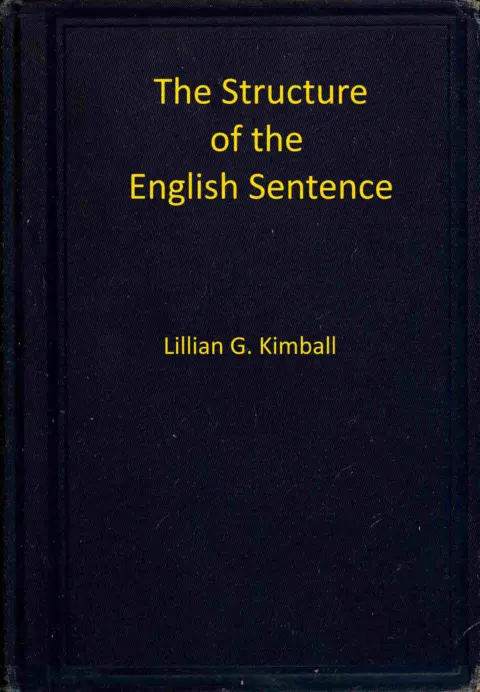
"The Structure of the English Sentence" by Lillian G. Kimball is an instructional textbook focused on English grammar written in the late 19th century. The book aims to enhance readers' understanding of English sentence structure and grammar with an emphasis on the importance of communication and clarity in expressing thoughts. It seeks to transform the often dry study of grammar into a more engaging exploration of language use. At the start of the text, the author outlines a clear vision for how English grammar should be approached, emphasizing that it is not merely a collection of rules but a study of thought and expression. Kimball advocates for analyzing sentences as whole units that convey ideas, encouraging readers to understand the relationships between different components such as subjects and predicates. This foundation sets the stage for examining various aspects of sentence structure, aiming to equip students with the analytical tools necessary for effective writing and communication.
Introduction adapted from the source catalogue; source summaries may be automatically generated.
Free to read · English · 70,429 words · No account needed
MAKE TIME FOR A GOOD BOOK
On by default. Untick to stop anonymous reading totals. Each page counts after 10 seconds in view. How this works.
Anonymous counting is on unless you have switched it off.
=Function.=--Just as all events occur at some time, so do they also occur in some place. We have not many adverbs of place in English, and few of these are very definite; for example, here, there, yonder, somewhere, anywhere, hither, thither, up, down, in. Hence we usually tell place by means of prepositional phrases, and we have many prepositions of place, such as above, across, along, amid, among, around, at, before, behind, below, beneath, beside, between, beyond, in, on, over, up. The value of the prepositional phrase denoting place is seen in the following sentence from Longfellow, which contains three such phrases:
“It stood upon the brink of a little glassy pool whose tranquil bosom was the image of a quiet and secluded life, and stretched its parental arms over a rustic bench that had been constructed beneath it for the accommodation of the foot traveler, or, perchance, some idle dreamer like myself.”
But the prepositional phrase will not always serve our turn, for sometimes we wish to denote a certain place by telling what happens there, and to do this it is usually best to employ a proposition. This gives rise to the adverbial local clause. In the following sentence from Lowell,--
“Where today the martyr stands, On the morrow crouches Judas with the silver in his hands,”
in order to tell the place where Judas crouches, the poet tells what happens in that place, namely, that it is the place where today the martyr stands.
=Introductory Word.=--The local clause is introduced by the subordinating conjunctions of place, where, wherever, whence, whither, whencesoever, whithersoever. Whither conveys the idea of action going toward a place, and whence of action proceeding from a place. These two conjunctions and their compounds as well are not often used by modern writers.
Wherever means in any place; as, “Wherever the Anglo-Saxon race goes, there law, industry, and safety for life and property are certain to arise.”--Dickens.
Just as when in a temporal clause often takes the correlative then, so where or wherever in a local clause is often accompanied by there in the principal proposition, as in the sentence just quoted.
=Peculiarities of the Local Clause.=--Often a local clause denotes condition as well as place; for example, “Wherever money is the principal object of life with either man or nation, it is both got ill and spent ill.”--Ruskin.
Sometimes the idea of time exists along with that of place; for example, “Where one person is really interested by music, twenty are pleased by good reading.”--Hart.
Your reading position is saved on this browser. Take it to another device with a library code. Reading pages adapt to text, rather than matching a printed edition.
Lillian Kimball Stewart
BEHIND THE BOOK
This eBook is for the use of anyone anywhere in the United States and most other parts of the world at no cost and with almost no restrictions whatsoever. You may copy it, give it away or re-use it under the terms of the Project Gutenberg License included with this eBook or online at www.gutenberg.org. If you are not located in the United States, you will have to check the laws of the country where you are located before using this eBook. Read the source licence.
The original source file, including credits and licence, is retained by this library. Request an original-format copy at no charge. Please include the book title and Project Gutenberg identifier #75077.
KEEP YOUR CURIOSITY GOING

Charles G. (Charles Griffith) Ross
Hannah Webster Foster

Emily Lawless
Edwin Hamlin Carr

Charles De Lano Hine
Andrew Ure