THE CLASSIC COLLECTION✦The haunts of menCLASSIC FREE BOOKS
The haunts of men
Robert W. (Robert William) Chambers
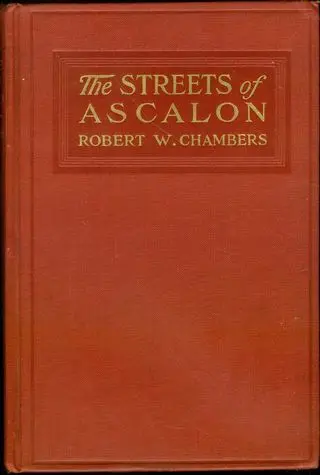
THE CLASSIC COLLECTION · 1912
"The Streets of Ascalon: Episodes in the Unfinished Career of Richard Quarren" by Robert W. Chambers is a novel written in the early 20th century. This work chronicles the life and social entanglements of Richard Quarren, a young man navigating the complexities and distractions of upper-class society in New York City. The theme centers around Quarren's struggles with financial instability and the influence of a glamorous yet superficial social circle that threatens to derail his ambitions. The opening of the novel introduces readers to Quarren's world through a casual gathering of friends at their residence, humorously dubbed the "Irish Legation." Here, his friends Lacy and O'Hara express their concern for Quarren's careless attitude towards finance as they prepare for a tea visit from two women, one of whom is the recently widowed and captivating Strelsa Leeds. The conversation reveals the dynamics of male camaraderie while highlighting Quarren's carefree nature and the growing apprehension of his friends regarding his social choices. The dialogue sets the stage for exploring Quarren’s character and foreshadows his impending relationship with Strelsa, marking the beginning of deeper interpersonal conflicts and societal critiques.
Introduction adapted from the source catalogue; source summaries may be automatically generated.
Free to read · English · 107,952 words · No account needed
MAKE TIME FOR A GOOD BOOK
On by default. Untick to stop anonymous reading totals. Each page counts after 10 seconds in view. How this works.
Anonymous counting is on unless you have switched it off.
O'Hara drank pensively: "I see that Langly Sprowl is messin' about, too. Mrs. Ledwith had better hurry up out there in Reno--or wherever she's gettin' her divorce. I saw Chet Ledwith ridin' in the Park. Dankmere was with him. Funny he doesn't seem to lose any caste by sellin' his wife to Sprowl."
"The whole thing is a filthy mess," growled Westguard; "let it alone."
"Why don't you make a novel about it?" inquired O'Hara.
"Because, you dub! I don't use real episodes or living people!" roared Westguard; "newspapers and a few chumps to the contrary!"
"So!--so-o!" said O'Hara, soothingly--"whoa--steady, boy!" And he
pretended to rub down Westguard, hissing the while as do grooms when
currying.
"Anybody who tells the truth about social conditions in any section of human society is always regarded as a liar," said Westguard. "Not that I have any desire to do it, but if I should ever write a novel dealing with social conditions in any fashionable set, I'd be disbelieved."
"You would be if you devoted your attention to fashionable scandals
only," said Quarren.
"Why? Aren't there plenty of scandalous----"
"Plenty. But no more than in any other set or coterie; not as many as there are among more ignorant people. Virtue far outbalances vice among us: a novel, properly proportioned, ought to show that. If it doesn't, it's misleading."
"Supposing," said Westguard, "that I were indecent enough to show up my aunt in fiction. Nobody would believe her possible."
"I sometimes doubt her even now," observed O'Hara, grinning.
Quarren said: "Count up the unpleasant characters in your own social
vicinity, Karl--just to prove to yourself that there are really very
few."
"There is Langly--and my aunt--and the Lester Calderas--and the
Ledwiths----"
"Go on!"
Westguard laughed: "I guess that ends the list," he said.
"It does. Also I dispute the list," said Quarren.
"Cyrille Caldera is a pippin," remarked O'Hara, sentimentally.
"What about Mary Ledwith? Is anybody here inclined to sit in judgment?"
"I," said Westguard grimly.
"Why?"
"Divorce is a dirty business."
"Oh. You'd rather she put up with Chester?--the sort of man who was weak
enough to let her go?"
"Yes!"
"Get out, you old Roundhead!" said Quarren, laughing. He rose, laid his hand lightly on Westguard's shoulder in passing, and went upstairs to his room, where he wrote a long letter to Strelsa; and then destroyed it. Then he lay down, covering his boyish head with his arms.
When Lacy came in he saw him lying on the bed, and thought he was
asleep.
Your reading position is saved on this browser. Take it to another device with a library code. Reading pages adapt to text, rather than matching a printed edition.
Robert W. (Robert William) Chambers
Robert W. (Robert William) Chambers

Robert W. (Robert William) Chambers
Robert W. (Robert William) Chambers
BEHIND THE BOOK
This eBook is for the use of anyone anywhere in the United States and most other parts of the world at no cost and with almost no restrictions whatsoever. You may copy it, give it away or re-use it under the terms of the Project Gutenberg License included with this eBook or online at www.gutenberg.org. If you are not located in the United States, you will have to check the laws of the country where you are located before using this eBook. Read the source licence.
The original source file, including credits and licence, is retained by this library. Request an original-format copy at no charge. Please include the book title and Project Gutenberg identifier #35233.
KEEP YOUR CURIOSITY GOING
Coulson Kernahan

Maurice Baring
Frances Wright
Cécile Tormay

Frederic Jesup Stimson

W. H. P. (William Henry Pope) Jarvis