THE CLASSIC COLLECTION✦The haunts of menCLASSIC FREE BOOKS
The haunts of men
Robert W. (Robert William) Chambers
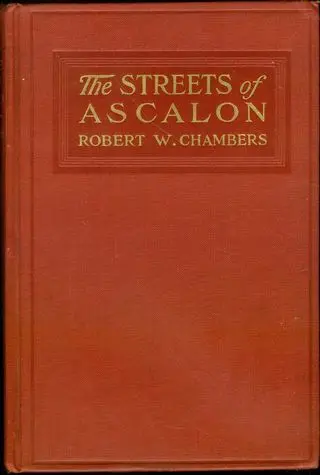
THE CLASSIC COLLECTION · 1912
"The Streets of Ascalon: Episodes in the Unfinished Career of Richard Quarren" by Robert W. Chambers is a novel written in the early 20th century. This work chronicles the life and social entanglements of Richard Quarren, a young man navigating the complexities and distractions of upper-class society in New York City. The theme centers around Quarren's struggles with financial instability and the influence of a glamorous yet superficial social circle that threatens to derail his ambitions. The opening of the novel introduces readers to Quarren's world through a casual gathering of friends at their residence, humorously dubbed the "Irish Legation." Here, his friends Lacy and O'Hara express their concern for Quarren's careless attitude towards finance as they prepare for a tea visit from two women, one of whom is the recently widowed and captivating Strelsa Leeds. The conversation reveals the dynamics of male camaraderie while highlighting Quarren's carefree nature and the growing apprehension of his friends regarding his social choices. The dialogue sets the stage for exploring Quarren’s character and foreshadows his impending relationship with Strelsa, marking the beginning of deeper interpersonal conflicts and societal critiques.
Introduction adapted from the source catalogue; source summaries may be automatically generated.
Free to read · English · 107,952 words · No account needed
MAKE TIME FOR A GOOD BOOK
On by default. Untick to stop anonymous reading totals. Each page counts after 10 seconds in view. How this works.
Anonymous counting is on unless you have switched it off.
"There's nothing to see from horizon to horizon except the monotonous repetition of mules and niggers and evil-looking cypress swamps and a few razor-backs and a buzzard flying very high in the blue.
"Thank you again for my flowers.... I wonder if you understand that my instinct is to be friends with you?
"It was from the very beginning.
"And please don't be absurd enough to think that I am going to forget you--or our jolly escapade at the Wycherly ball. You behaved very handsomely once. I know I can count on your kindness to me.
"Good-bye, and many many thanks--as Jack Lacy says--'f'r the manny booggy-rides, an' th' goom-candy, an' the boonches av malagy grrapes'!
"Sincerely your friend,
That same day Sir Charles Mallison arrived in New York and went directly to Mrs. Sprowl's house. Their interview was rather brief but loudly cordial on the old lady's part:
"How's my sister and Foxy?" she asked--meaning Sir Renard and Lady
Spinney.
Sir Charles regretted he had not seen them.
"And you?"
"Quite fit, thanks." And he gravely trusted that her own health was
satisfactory.
"You haven't changed your mind?" she asked with a smile which the profane might consider more like a grin.
Sir Charles said he had not, and a healthy colour showed under the tan.
"All these years," commented the old lady, ironically.
"Four," said Sir Charles.
"Was it four years ago when you saw her in Egypt?"
"Four years--last month--the tenth."
"And never saw her again?"
"Never."
Mrs. Sprowl shook with asthmatic mirth:
"Such story-book constancy! Why didn't you ask your friend the late Sirdar to have Leeds pitched into the Nile. It would have saved you those four years' waiting? You know you haven't many years to waste, Sir Charles."
"I'm forty-five," he said, colouring painfully.
"Four years gone to hell," said the old lady with that delicate candour which sometimes characterised her.... "And now what do you propose to do with the rest of 'em? Dawdle away your time?"
"Face my fate," he admitted touching his moustache and fearfully
embarrassed.
"Well, if you're in a hurry, you'll have to go down South to face it. She's at Palm Beach for the next three weeks."
"Thank you," he said.
She looked up at him, her little opaque green eyes a trifle softened.
"I am trying to get you the prettiest woman in America," she said. "I'm ready to fight off everybody else--beat 'em to death," she added, her eyes snapping, then suddenly kind again--"because, Sir Charles, I like you. And for no other reason on earth!"
Your reading position is saved on this browser. Take it to another device with a library code. Reading pages adapt to text, rather than matching a printed edition.
Robert W. (Robert William) Chambers
Robert W. (Robert William) Chambers

Robert W. (Robert William) Chambers
Robert W. (Robert William) Chambers
BEHIND THE BOOK
This eBook is for the use of anyone anywhere in the United States and most other parts of the world at no cost and with almost no restrictions whatsoever. You may copy it, give it away or re-use it under the terms of the Project Gutenberg License included with this eBook or online at www.gutenberg.org. If you are not located in the United States, you will have to check the laws of the country where you are located before using this eBook. Read the source licence.
The original source file, including credits and licence, is retained by this library. Request an original-format copy at no charge. Please include the book title and Project Gutenberg identifier #35233.
KEEP YOUR CURIOSITY GOING
Coulson Kernahan

Maurice Baring
Frances Wright
Cécile Tormay

Frederic Jesup Stimson

W. H. P. (William Henry Pope) Jarvis