THE CLASSIC COLLECTION✦The haunts of menCLASSIC FREE BOOKS
The haunts of men
Robert W. (Robert William) Chambers
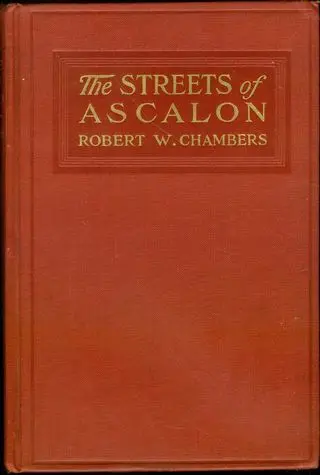
THE CLASSIC COLLECTION · 1912
"The Streets of Ascalon: Episodes in the Unfinished Career of Richard Quarren" by Robert W. Chambers is a novel written in the early 20th century. This work chronicles the life and social entanglements of Richard Quarren, a young man navigating the complexities and distractions of upper-class society in New York City. The theme centers around Quarren's struggles with financial instability and the influence of a glamorous yet superficial social circle that threatens to derail his ambitions. The opening of the novel introduces readers to Quarren's world through a casual gathering of friends at their residence, humorously dubbed the "Irish Legation." Here, his friends Lacy and O'Hara express their concern for Quarren's careless attitude towards finance as they prepare for a tea visit from two women, one of whom is the recently widowed and captivating Strelsa Leeds. The conversation reveals the dynamics of male camaraderie while highlighting Quarren's carefree nature and the growing apprehension of his friends regarding his social choices. The dialogue sets the stage for exploring Quarren’s character and foreshadows his impending relationship with Strelsa, marking the beginning of deeper interpersonal conflicts and societal critiques.
Introduction adapted from the source catalogue; source summaries may be automatically generated.
Free to read · English · 107,952 words · No account needed
MAKE TIME FOR A GOOD BOOK
On by default. Untick to stop anonymous reading totals. Each page counts after 10 seconds in view. How this works.
Anonymous counting is on unless you have switched it off.
"Not in the least," wheezed the old lady. "She is no better than the rest of 'em! And I sent for my nephew Karl, and I brought him up roundly. 'Karl!' said I, 'what the devil do you mean! Do you want that husband of hers dragging you all into court?' And, do you know, my dear, he appeared perfectly astounded--said it wasn't so--just as you said a moment ago. But I can put two and two together, yet; I'm not too old and witless to do that! And I warrant you I gave him a tongue trouncing which he won't forget. ... Probably he retailed it to that O'Hara man, and to young Quarren, too. If he did it won't hurt 'em, either."
She was speaking now so generally that everybody heard her, and Cyrille
Caldera said:
"Ricky is certainly innocuous, anyway."
"Oh, is he!" said Mrs. Sprowl with another wheezy laugh. "I fancy I know that boy. Did you say 'harmless,' Susanne? Well, you ought to know, of course----"
Cyrille Caldera blushed brightly although her affair with Quarren had been of the most innocent description.
"There's probably as much ground for indicting Ricky as there is for indicting me," she protested. "He's merely a nice, useful boy----"
"Rather vapid, don't you think?" observed a thin young woman in sables and an abundance of front teeth.
"Who expects anything serious from Ricky? He possesses good manners, and a sweet alacrity," said Chrysos Lacy, "and that's a rare combination."
"He's clever enough to be wicked, anyway," said Mrs. Sprowl. "Don't tell me that every one of his sentimental affairs have been perfectly harmless."
"Has he had many?" asked Strelsa before she meant to.
"Thousands, child. There was Betty Clyde--whose husband must have been an idiot--and Cynthia Challis--she married Prince Sarnoff, you remember----"
"The Sarnoffs are coming in February," observed Chrysos Lacy.
"I wonder if the Prince has had a tub since he left," said Mrs. Sprowl. "How on earth Cynthia can endure that dried up yellow Tartar----"
"Cynthia was in love with Ricky I think," said Susanne Lannis.
"Most girls are when they come out, but their mothers won't let 'em
marry him. Poor Ricky."
"Poor Ricky," sighed Chrysos; "he is so nice, and nobody is likely to
marry him."
"Why?" asked Strelsa.
"Because he's--why he's just Ricky. He has no money, you know. Didn't
you know it?"
"No," said Strelsa.
"That's the trouble--partly. Then there's no social advantage for any girl in this set marrying him. He'll have to take a lame duck or go out of his circle for a wife. And that means good-bye Ricky--unless he marries a lame duck."
Your reading position is saved on this browser. Take it to another device with a library code. Reading pages adapt to text, rather than matching a printed edition.
Robert W. (Robert William) Chambers
Robert W. (Robert William) Chambers

Robert W. (Robert William) Chambers
Robert W. (Robert William) Chambers
BEHIND THE BOOK
This eBook is for the use of anyone anywhere in the United States and most other parts of the world at no cost and with almost no restrictions whatsoever. You may copy it, give it away or re-use it under the terms of the Project Gutenberg License included with this eBook or online at www.gutenberg.org. If you are not located in the United States, you will have to check the laws of the country where you are located before using this eBook. Read the source licence.
The original source file, including credits and licence, is retained by this library. Request an original-format copy at no charge. Please include the book title and Project Gutenberg identifier #35233.
KEEP YOUR CURIOSITY GOING
Coulson Kernahan

Maurice Baring
Frances Wright
Cécile Tormay

Frederic Jesup Stimson

W. H. P. (William Henry Pope) Jarvis