THE CLASSIC COLLECTION✦The haunts of menCLASSIC FREE BOOKS
The haunts of men
Robert W. (Robert William) Chambers
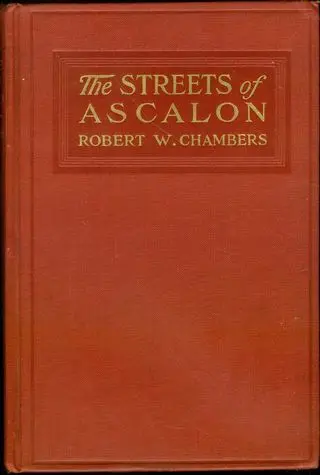
THE CLASSIC COLLECTION · 1912
"The Streets of Ascalon: Episodes in the Unfinished Career of Richard Quarren" by Robert W. Chambers is a novel written in the early 20th century. This work chronicles the life and social entanglements of Richard Quarren, a young man navigating the complexities and distractions of upper-class society in New York City. The theme centers around Quarren's struggles with financial instability and the influence of a glamorous yet superficial social circle that threatens to derail his ambitions. The opening of the novel introduces readers to Quarren's world through a casual gathering of friends at their residence, humorously dubbed the "Irish Legation." Here, his friends Lacy and O'Hara express their concern for Quarren's careless attitude towards finance as they prepare for a tea visit from two women, one of whom is the recently widowed and captivating Strelsa Leeds. The conversation reveals the dynamics of male camaraderie while highlighting Quarren's carefree nature and the growing apprehension of his friends regarding his social choices. The dialogue sets the stage for exploring Quarren’s character and foreshadows his impending relationship with Strelsa, marking the beginning of deeper interpersonal conflicts and societal critiques.
Introduction adapted from the source catalogue; source summaries may be automatically generated.
Free to read · English · 107,952 words · No account needed
MAKE TIME FOR A GOOD BOOK
On by default. Untick to stop anonymous reading totals. Each page counts after 10 seconds in view. How this works.
Anonymous counting is on unless you have switched it off.
The necessity for nervous and physical fatigue drove Sprowl back into the library to tramp up and down over the soft old Saraband rugs, up and down, to and fro, and across sometimes, ranging the four walls with the dull, aimless energy of a creature which long caging is rendering mentally unsound.
Then the monotony of the exercise began to irritate instead of allaying his restlessness; he went to the bay-window again, saw Ledwith still sitting there, stared at him with a ferocity almost expressionless, and strode out into the great hallway and through the servant-watched doors to the veranda.
Ledwith looked up, rose. "How are you, Langly?" he said.
Sprowl nodded, staring him insolently in the face.
There was a pause, then Ledwith's pallid features twitched into a
crooked smile.
"I wanted to talk over one or two matters with you before I leave," he
said.
"When are you leaving?"
"To-night."
"Where are you going?"
"I don't know--to the Acremont Inn for a few days. After that--I don't
know."
Sprowl, perfectly aware that his footman was listening, walked out across the lawn, and Ledwith went with him. Neither spoke. Shadows of tall trees lay like velvet on the grass; the crests of the woods beyond grew golden, their depths dusky and bluish. Everywhere robins were noisily at supper, tilting for earthworms on the lawns; golden-winged woodpeckers imitated them; in the late sunlight the grackles' necks were rainbow tinted.
On distant hillcrests Sprowl could see his brood-mares feeding, switching their tails against the sky; farther away sheep dotted hillside pastures. Farther still the woods of Witch-Hollow lay banded with sunshine and shadow. And Sprowl's protuberant gaze grew fixed and expressionless as he swung on across the meadows and skirted the first grove of oaks, huge outlying pickets of his splendid forest beyond.
"We can talk here," said Ledwith in a voice which sounded hoarse and painful; and, swinging around on him, Sprowl saw that he was in distress, fighting for breath and leaning against the trunk of an oak.
"What do you want to talk about?" said Sprowl.
The struggle for breath left Ledwith mute.
"Can't you walk and talk at the same time?" demanded Sprowl. "I need
exercise."
"I've got to rest."
"Well, then, what have you got to say?--because I'm going on. What's the matter with you, anyway," he added sneeringly; "dope?"
"Partly," said Ledwith without resentment.
"What else?"
"Anxiety."
"Oh. Do you think you have a monopoly of that?"
Ledwith, without heeding the sneering question, went on, still resting on his elbow against the tree-trunk:
"I want to talk to you, Langly. I want straight talk from you. Do I get
it?"
Your reading position is saved on this browser. Take it to another device with a library code. Reading pages adapt to text, rather than matching a printed edition.
Robert W. (Robert William) Chambers
Robert W. (Robert William) Chambers

Robert W. (Robert William) Chambers
Robert W. (Robert William) Chambers
BEHIND THE BOOK
This eBook is for the use of anyone anywhere in the United States and most other parts of the world at no cost and with almost no restrictions whatsoever. You may copy it, give it away or re-use it under the terms of the Project Gutenberg License included with this eBook or online at www.gutenberg.org. If you are not located in the United States, you will have to check the laws of the country where you are located before using this eBook. Read the source licence.
The original source file, including credits and licence, is retained by this library. Request an original-format copy at no charge. Please include the book title and Project Gutenberg identifier #35233.
KEEP YOUR CURIOSITY GOING
Coulson Kernahan

Maurice Baring
Frances Wright
Cécile Tormay

Frederic Jesup Stimson

W. H. P. (William Henry Pope) Jarvis