THE CLASSIC COLLECTION✦The haunts of menCLASSIC FREE BOOKS
The haunts of men
Robert W. (Robert William) Chambers
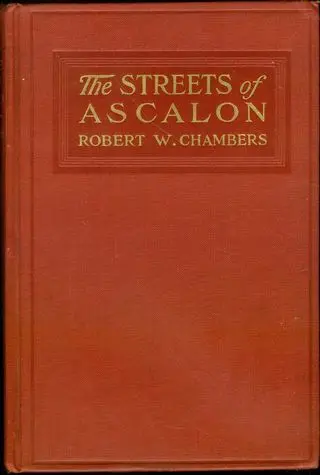
THE CLASSIC COLLECTION · 1912
"The Streets of Ascalon: Episodes in the Unfinished Career of Richard Quarren" by Robert W. Chambers is a novel written in the early 20th century. This work chronicles the life and social entanglements of Richard Quarren, a young man navigating the complexities and distractions of upper-class society in New York City. The theme centers around Quarren's struggles with financial instability and the influence of a glamorous yet superficial social circle that threatens to derail his ambitions. The opening of the novel introduces readers to Quarren's world through a casual gathering of friends at their residence, humorously dubbed the "Irish Legation." Here, his friends Lacy and O'Hara express their concern for Quarren's careless attitude towards finance as they prepare for a tea visit from two women, one of whom is the recently widowed and captivating Strelsa Leeds. The conversation reveals the dynamics of male camaraderie while highlighting Quarren's carefree nature and the growing apprehension of his friends regarding his social choices. The dialogue sets the stage for exploring Quarren’s character and foreshadows his impending relationship with Strelsa, marking the beginning of deeper interpersonal conflicts and societal critiques.
Introduction adapted from the source catalogue; source summaries may be automatically generated.
Free to read · English · 107,952 words · No account needed
MAKE TIME FOR A GOOD BOOK
On by default. Untick to stop anonymous reading totals. Each page counts after 10 seconds in view. How this works.
Anonymous counting is on unless you have switched it off.
Both Dankmere and Miss Vining had gone to lunch, presumably in different directions; Daisy and her youngsters, having been nourished, were asleep; there was not a sound in the house except the soft rubbing of tissue-paper where Quarren was lightly removing the retouching varnish from a relined canvas. Presently the front door-bell rang.
Quarren rinsed his hands and, still wearing overalls and painter's blouse, mounted the basement stairs and opened the front door. And Mrs. Sprowl supported by a footman waddled in, panting.
"Tell your master I want to see him," she said--"I don't mean that fool of an Englishman; I mean Mr. Quar--Good Lord! Ricky, is that you? Here, get me a chair--those front steps nearly killed me. Long ago I swore I'd never enter a house which was not basement-built and had an elevator!... Hand me one of those fans. And if there's any water in the house not swarming with typhoid germs, get me a glass of it."
He brought her a tumbler of spring water; she panted and gulped and fanned and panted, her little green eyes roaming around her.
Presently she dismissed the footman, and turned her heavily flushed face on Quarren. The rolls of fat crowded the lace on her neck, perspiration glistened under her sparklike eyes.
"How are you?" she inquired.
He said, smilingly, that he was well.
"You don't look it. You look gaunt.... Well, I never thought you'd come to this--that you had it in you to do anything useful."
"I believe I've heard you say so now and then," he said with perfect
good-humour.
"Why not? Why should I have thought that your talents amounted to more
than ornaments?"
"No reason to suppose so," he admitted, amused.
"Not the slightest. Talent usually damns people to an effortless
existence. And yours was a pleasant one, too. You had a good time,
didn't you?"
"Oh, very."
"There was nothing to do except to come in, kiss the girls all around, and make faces to amuse them, was there?"
"Not much more," he admitted, laughing.
Mrs. Sprowl's little green eyes travelled all over the walls.
"Umph," she snorted, "I suppose these are some of Dankmere's heirlooms. I never fancied that little bounder----"
"Wait!"
"What!"
"Wait a moment. I like Dankmere, and he isn't a bounder----"
"He is one!"
"Keep that opinion to yourself," he said bluntly.
The old lady's eyes blazed. "I'm damned if I do!" she retorted--"I'll
say what----"
"Not here! You mustn't be uncivil here. You know well enough how to behave when necessary; and if you don't do it I'll call your carriage."
Your reading position is saved on this browser. Take it to another device with a library code. Reading pages adapt to text, rather than matching a printed edition.
Robert W. (Robert William) Chambers
Robert W. (Robert William) Chambers

Robert W. (Robert William) Chambers
Robert W. (Robert William) Chambers
BEHIND THE BOOK
This eBook is for the use of anyone anywhere in the United States and most other parts of the world at no cost and with almost no restrictions whatsoever. You may copy it, give it away or re-use it under the terms of the Project Gutenberg License included with this eBook or online at www.gutenberg.org. If you are not located in the United States, you will have to check the laws of the country where you are located before using this eBook. Read the source licence.
The original source file, including credits and licence, is retained by this library. Request an original-format copy at no charge. Please include the book title and Project Gutenberg identifier #35233.
KEEP YOUR CURIOSITY GOING
Coulson Kernahan

Maurice Baring
Frances Wright
Cécile Tormay

Frederic Jesup Stimson

W. H. P. (William Henry Pope) Jarvis