THE CLASSIC COLLECTION✦The haunts of menCLASSIC FREE BOOKS
The haunts of men
Robert W. (Robert William) Chambers
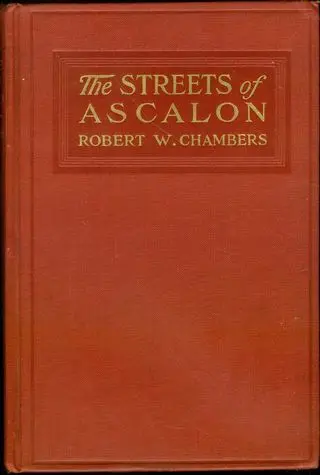
THE CLASSIC COLLECTION · 1912
"The Streets of Ascalon: Episodes in the Unfinished Career of Richard Quarren" by Robert W. Chambers is a novel written in the early 20th century. This work chronicles the life and social entanglements of Richard Quarren, a young man navigating the complexities and distractions of upper-class society in New York City. The theme centers around Quarren's struggles with financial instability and the influence of a glamorous yet superficial social circle that threatens to derail his ambitions. The opening of the novel introduces readers to Quarren's world through a casual gathering of friends at their residence, humorously dubbed the "Irish Legation." Here, his friends Lacy and O'Hara express their concern for Quarren's careless attitude towards finance as they prepare for a tea visit from two women, one of whom is the recently widowed and captivating Strelsa Leeds. The conversation reveals the dynamics of male camaraderie while highlighting Quarren's carefree nature and the growing apprehension of his friends regarding his social choices. The dialogue sets the stage for exploring Quarren’s character and foreshadows his impending relationship with Strelsa, marking the beginning of deeper interpersonal conflicts and societal critiques.
Introduction adapted from the source catalogue; source summaries may be automatically generated.
Free to read · English · 107,952 words · No account needed
MAKE TIME FOR A GOOD BOOK
On by default. Untick to stop anonymous reading totals. Each page counts after 10 seconds in view. How this works.
Anonymous counting is on unless you have switched it off.
"They all have to come across with it," remarked the Mink.
Somebody observed that if the police caught the dago who painted it
they'd pinch him.
To make a diversion, and with her own fair hands, Cyrille Caldera summoned the derelicts to sandwiches and ginger-ale; and De Groot, dashing more unmanly moisture from his monocle, went about resolutely shaking hands, while Westguard and the hirsute young man sang "Comrades" with much feeling.
Quarren, still unrecognised, edged his way out and rejoined Dankmere on the front stoop. Neither made any comment on the proceedings.
Later the derelicts, moodily replete, shuffled forth into the night, herded lovingly by De Groot, still shaking hands.
From the corner of the street opposite, Quarren and Dankmere observed their departure, and, later, they beheld De Groot and Mrs. Caldera slip around the block and discreetly disappear into a 1912 touring-car with silver mountings and two men in livery on the box.
Westguard, truer to his principles, took a tram and Quarren and the Earl returned to their gallery with mixed emotions, and opened every window top and bottom.
"It's all right in its way, I suppose," said Quarren. "Probably De Groot means well, but there's no conversation possible between a man who has just dined rather heavily, and a man who has no chance of dining at all."
"Like preaching Christ to the poor from a Fifth Avenue pulpit," said
Dankmere, vaguely.
"How do you mean?"
"A church on a side street would seem to serve the purpose. And the poor
need the difference."
"I don't know about those matters."
"No; I don't either. It's easy, cheap, and popular to knock the clergy.... Still, somehow or other, I can't seem to forget that the disciples were poor--and it bothers me a lot, Quarren."
Quarren said: "Haven't you and I enough to worry us concerning our own
morals?"
Dankmere, who had been closing up and piling together the Undertaker's camp-chairs, looked around at the younger man.
"What did you say?" he asked.
"I said that probably you and I would find no time left to criticise
either De Groot or the clergy, if we used our leisure in
self-examination."
His lordship went on piling up chairs. When he finished he started wandering around, hands in his pockets. Then he turned out all the electric lamps, drew the bay-window curtains wide so that the silvery radiance from the arc-light opposite made the darkness dimly lustrous.
A little breeze stirred the hair on Quarren's forehead; Dankmere dropped into the depths of an armchair near him. For a while they sat together in darkness and silence, then the Englishman said abruptly:
"You've been very kind to me."
Quarren glanced up surprised.
Your reading position is saved on this browser. Take it to another device with a library code. Reading pages adapt to text, rather than matching a printed edition.
Robert W. (Robert William) Chambers
Robert W. (Robert William) Chambers

Robert W. (Robert William) Chambers
Robert W. (Robert William) Chambers
BEHIND THE BOOK
This eBook is for the use of anyone anywhere in the United States and most other parts of the world at no cost and with almost no restrictions whatsoever. You may copy it, give it away or re-use it under the terms of the Project Gutenberg License included with this eBook or online at www.gutenberg.org. If you are not located in the United States, you will have to check the laws of the country where you are located before using this eBook. Read the source licence.
The original source file, including credits and licence, is retained by this library. Request an original-format copy at no charge. Please include the book title and Project Gutenberg identifier #35233.
KEEP YOUR CURIOSITY GOING
Coulson Kernahan

Maurice Baring
Frances Wright
Cécile Tormay

Frederic Jesup Stimson

W. H. P. (William Henry Pope) Jarvis