THE CLASSIC COLLECTION✦The haunts of menCLASSIC FREE BOOKS
The haunts of men
Robert W. (Robert William) Chambers
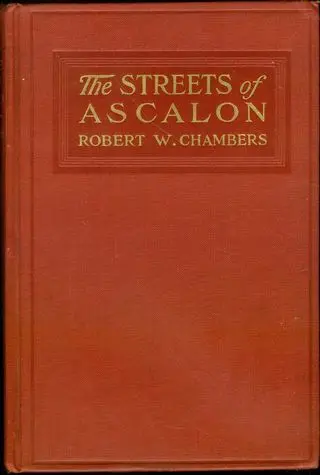
THE CLASSIC COLLECTION · 1912
"The Streets of Ascalon: Episodes in the Unfinished Career of Richard Quarren" by Robert W. Chambers is a novel written in the early 20th century. This work chronicles the life and social entanglements of Richard Quarren, a young man navigating the complexities and distractions of upper-class society in New York City. The theme centers around Quarren's struggles with financial instability and the influence of a glamorous yet superficial social circle that threatens to derail his ambitions. The opening of the novel introduces readers to Quarren's world through a casual gathering of friends at their residence, humorously dubbed the "Irish Legation." Here, his friends Lacy and O'Hara express their concern for Quarren's careless attitude towards finance as they prepare for a tea visit from two women, one of whom is the recently widowed and captivating Strelsa Leeds. The conversation reveals the dynamics of male camaraderie while highlighting Quarren's carefree nature and the growing apprehension of his friends regarding his social choices. The dialogue sets the stage for exploring Quarren’s character and foreshadows his impending relationship with Strelsa, marking the beginning of deeper interpersonal conflicts and societal critiques.
Introduction adapted from the source catalogue; source summaries may be automatically generated.
Free to read · English · 107,952 words · No account needed
MAKE TIME FOR A GOOD BOOK
On by default. Untick to stop anonymous reading totals. Each page counts after 10 seconds in view. How this works.
Anonymous counting is on unless you have switched it off.
No fish broke the absolute stillness of the surface, no breeze ruffled it; only the glitter of some drifting dragon-fly accented the intense calm.
"Are you--offended?" she said at last, her gaze now riveted on the
water.
"Of course not!" he replied cordially.
She lifted her eyes, surveying him in silence.
"Why did you suppose so?" he asked amiably.
"Did you receive my letter?"
"Of course I did."
"You did not answer it."
"I didn't know how--then."
His reply seemed to perplex her--so did his light and effortless
good-humour.
"I know how to answer it now," he added.
She forced a smile:
"Isn't it too late to think of answering that letter, Mr. Quarren?"
"Oh, no," he said pleasantly; "a man who is afraid of being too late seldom dares start.... I wonder if anything could induce you to ask me to be seated?"
She flushed vividly and moved to the extreme edge of the seat. He took
the other end, knocked the ashes from his pipe, and put it in his
pocket.
"Now," he said, smiling, "I am ready to answer your letter."
"Really, Mr. Quarren----"
"Don't you want me to?"
"I--don't think--it matters, now----"
"But it's only civil of me to answer it," he insisted, laughing.
She could not entirely interpret his mood. Of one thing she had been instantly conscious--he had changed since she had seen him--changed radically. There was about him, now, a certain inexplicable air suggesting assurance--an individuality which had not heretofore clearly distinguished him--a hidden hint of strength. Or was she mistaken--abashed--remembering what she had written him in a bitter hour of fear and self-abasement? A thousand times she had regretted writing to him what she had written.
She said, coldly: "I think that my letter may very properly remain
unanswered."
"You think I'm too late?"
She looked at him steadily:
"Yes, you are too late--in every sense."
"You are mistaken," he said, cheerfully.
"What do you mean?"
"I mean that all these superficial details which, under the magnifying glass of fear, you and I have regarded with terrified respect, amount to nothing. Real trouble is something else; the wings of tragedy have never yet even brushed either you or me. But unless you let me answer that letter of yours, and listen very carefully to my answer, you and I are going to learn some day what tragedy really is."
"Mr. Quarren!" she exclaimed, forcing a laugh, "are you trying to make
me take you seriously?"
"I certainly am."
"That in itself is tragic enough," she laughed.
"It really is," he said: "because it has come to a time when you have got to take me seriously."
Your reading position is saved on this browser. Take it to another device with a library code. Reading pages adapt to text, rather than matching a printed edition.
Robert W. (Robert William) Chambers
Robert W. (Robert William) Chambers

Robert W. (Robert William) Chambers
Robert W. (Robert William) Chambers
BEHIND THE BOOK
This eBook is for the use of anyone anywhere in the United States and most other parts of the world at no cost and with almost no restrictions whatsoever. You may copy it, give it away or re-use it under the terms of the Project Gutenberg License included with this eBook or online at www.gutenberg.org. If you are not located in the United States, you will have to check the laws of the country where you are located before using this eBook. Read the source licence.
The original source file, including credits and licence, is retained by this library. Request an original-format copy at no charge. Please include the book title and Project Gutenberg identifier #35233.
KEEP YOUR CURIOSITY GOING
Coulson Kernahan

Maurice Baring
Frances Wright
Cécile Tormay

Frederic Jesup Stimson

W. H. P. (William Henry Pope) Jarvis