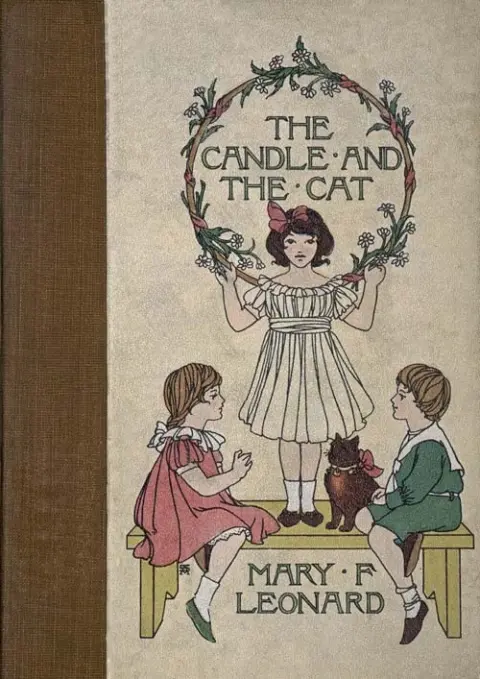
The Candle and the Cat
Mary Finley Leonard
THE CLASSIC COLLECTION · 1898
"The Story of the Big Front Door" by Mary Finley Leonard is a children’s novel written in the late 19th century. The narrative centers around the adventures of a group of children in a quaint neighborhood where they engage in imaginative play, including games inspired by classic stories like Robin Hood. Their interactions are influenced by their relationships with each other and their new neighbor, Miss Brown, who is key to the unfolding of their shared experiences. The opening of the story introduces Ikey Ford, who brings troubling news of new occupants moving into the abandoned "Brown house," which has been the children's playground. This news sparks a series of discussions among the neighborhood kids about their feelings of loss and incites their imaginations as they plot ways to reclaim their space. The initial chapters depict the children's creative games and the camaraderie that blossoms among them, highlighting themes of friendship, exploration, and the impact of community as they navigate the changes brought by their new neighbor and the secrets held by the mysterious front door of her house.
Introduction adapted from the source catalogue; source summaries may be automatically generated.
Free to read · English · 57,105 words · No account needed
MAKE TIME FOR A GOOD BOOK
On by default. Untick to stop anonymous reading totals. Each page counts after 10 seconds in view. How this works.
Anonymous counting is on unless you have switched it off.
Then New Year's Day placed a crown on his head, May-Day gave him a rose, Fourth of July, a flag, Thanksgiving, an apple, Washington's Birthday offered his hatchet, and St. Valentine gave him a sugar heart; and joining hands the children and the Holidays danced around him, singing:
"We all unite in words of praise,
And crown him king of Holidays."
The curtain fell on a tableau: the Holidays, with their flags and banners, old Father Time, and the happy children.
The applause was so vehement it had to rise again for a moment, and then there was an intermission while some of the actors changed their costumes.
When the curtain went up for the last time the cottage was gone, and in its place appeared a row of high-backed chairs on which were seated five little ladies in the quaintest of short-waisted gowns, each with a reticule on her arm, from which she took her needles and began to knit. Then Bess, who sat at one end of the line, looked up, and said in her own sweet little way:
"We're learning to knit, you see, because
We wish to be nice grandmammas;
You would not care, I'm sure, a bit
For a grandmamma who couldn't knit."
Dora, who came next, continued:
"How daintily warm, how soft and sweet,
The tiny socks for baby's feet.
Nothing you'll find in all the land
Fashioned like these by grandma's hand."
Here Elsie took it up:
"All the older children too can tell
How grandma's stockings wear so well,
And how she makes, with greatest pains,
Comforters, afghans, balls, and reins."
Louise had just made a discovery that surprised her, and with shining
eyes she recited:
"There's nothing so good, the children know,
As grandmamma's stories of long ago.
Empty-handed she could not tell
All the dear old stories half so well."
Constance sat at the end of the row, and looking at the others she
said:
"When she was a girl like you and me,
'Twas then she learned to knit, you see.
So like her now we must begin
Carefully putting the stitches in."
Then together they recited:
"Our shining needles we gayly ply,
Getting ready for by and by.
Aren't you glad to know there'll be
Five old ladies as nice as we?"
At the last line they rose, each dropped a profound courtesy and marched from the stage. The enthusiastic audience recalled them half a dozen times, till Mr. Hazeltine was obliged to announce that the entertainment was over.
No one had enjoyed it more than a person who sat in an easy-chair, where without any effort she could see all that went on.
Your reading position is saved on this browser. Take it to another device with a library code. Reading pages adapt to text, rather than matching a printed edition.
Mary Finley Leonard
Mary Finley Leonard
Mary Finley Leonard
Mary Finley Leonard
BEHIND THE BOOK
This eBook is for the use of anyone anywhere in the United States and most other parts of the world at no cost and with almost no restrictions whatsoever. You may copy it, give it away or re-use it under the terms of the Project Gutenberg License included with this eBook or online at www.gutenberg.org. If you are not located in the United States, you will have to check the laws of the country where you are located before using this eBook. Read the source licence.
The original source file, including credits and licence, is retained by this library. Request an original-format copy at no charge. Please include the book title and Project Gutenberg identifier #19340.
KEEP YOUR CURIOSITY GOING
Coulson Kernahan

Maurice Baring
Frances Wright
Cécile Tormay

Frederic Jesup Stimson

W. H. P. (William Henry Pope) Jarvis