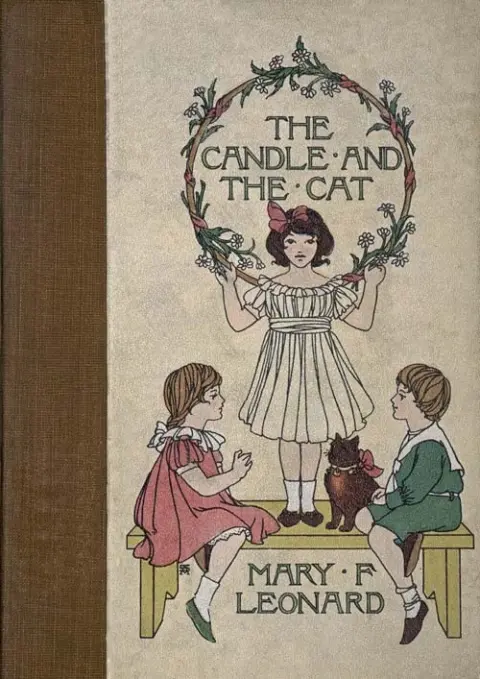
The Candle and the Cat
Mary Finley Leonard
THE CLASSIC COLLECTION · 1898
"The Story of the Big Front Door" by Mary Finley Leonard is a children’s novel written in the late 19th century. The narrative centers around the adventures of a group of children in a quaint neighborhood where they engage in imaginative play, including games inspired by classic stories like Robin Hood. Their interactions are influenced by their relationships with each other and their new neighbor, Miss Brown, who is key to the unfolding of their shared experiences. The opening of the story introduces Ikey Ford, who brings troubling news of new occupants moving into the abandoned "Brown house," which has been the children's playground. This news sparks a series of discussions among the neighborhood kids about their feelings of loss and incites their imaginations as they plot ways to reclaim their space. The initial chapters depict the children's creative games and the camaraderie that blossoms among them, highlighting themes of friendship, exploration, and the impact of community as they navigate the changes brought by their new neighbor and the secrets held by the mysterious front door of her house.
Introduction adapted from the source catalogue; source summaries may be automatically generated.
Free to read · English · 57,105 words · No account needed
MAKE TIME FOR A GOOD BOOK
On by default. Untick to stop anonymous reading totals. Each page counts after 10 seconds in view. How this works.
Anonymous counting is on unless you have switched it off.
One Saturday afternoon, about three weeks before Christmas, the boys marched triumphantly into Miss Brown's sitting-room with a large tissue-paper parcel. When this was undone, before the eager eyes of the M.Ks., there were four beautiful fragrant little baskets with tops of bright-colored silk.
"How pretty!"--"How lovely!"--"Where did you get them?"--"Surely you did not make them?"--"What are you going to do with them?"
"Why didn't we make them, I'd like to know?" asked Ikey proudly.
Certainly the boys had reason to be satisfied at the praise their work
received.
"I know you did not sew on the silk," said Dora, examining one
closely.
"Oh, well, Aunt Zelie and Cousin Helen did the sewing, of course, but we did all the rest," said Carl.
"And what do you mean to do with them?" asked Elsie.
"Sell them and give the money to the harp man."
They were so pretty there proved to be no trouble in disposing of them. Aunt Marcia, who was superintending a Christmas bazaar, offered to put them on one of her tables, where they sold the first evening for a dollar and a half apiece.
After this the meetings of the G.N. club had to give way to rehearsals for what Cousin Helen called "The Harp Man's Benefit," which was to occur on New Year's eve. In the meantime Uncle William had interested himself in the matter, and, through a friend who was a music dealer, a harp was lent to Mr. Finnelli till his own could be repaired.
"So we feel more comfortable about it now," said Louise, "and we think we'll make at least ten dollars at our entertainment."
Late in the afternoon of the day before Christmas Aunt Zelie sat alone in the library taking a moment's rest.
The sound of happy voices came through the open door. It was a custom in the family to decorate the hall on Christmas eve, and the children had been making wreaths and festoons of cedar, and having any amount of fun. They were now having a merry time over Ikey's suggestion to hang a holly wreath above the Big Front Door. From the top of the ladder Carl began:
"'Twas the night before Christmas,"
and the others chimed in:
"and all through the house
Not a creature was stirring, not even a mouse."
A moment later Aunt Zelie's quiet was invaded.
"Nothing makes me feel more like Christmas than that old rhyme," she said, as the laughing children gathered around her.
"Talk to us about Christmas, Auntie, please," said Louise.
Your reading position is saved on this browser. Take it to another device with a library code. Reading pages adapt to text, rather than matching a printed edition.
Mary Finley Leonard
Mary Finley Leonard
Mary Finley Leonard
Mary Finley Leonard
BEHIND THE BOOK
This eBook is for the use of anyone anywhere in the United States and most other parts of the world at no cost and with almost no restrictions whatsoever. You may copy it, give it away or re-use it under the terms of the Project Gutenberg License included with this eBook or online at www.gutenberg.org. If you are not located in the United States, you will have to check the laws of the country where you are located before using this eBook. Read the source licence.
The original source file, including credits and licence, is retained by this library. Request an original-format copy at no charge. Please include the book title and Project Gutenberg identifier #19340.
KEEP YOUR CURIOSITY GOING
Coulson Kernahan

Maurice Baring
Frances Wright
Cécile Tormay

Frederic Jesup Stimson

W. H. P. (William Henry Pope) Jarvis