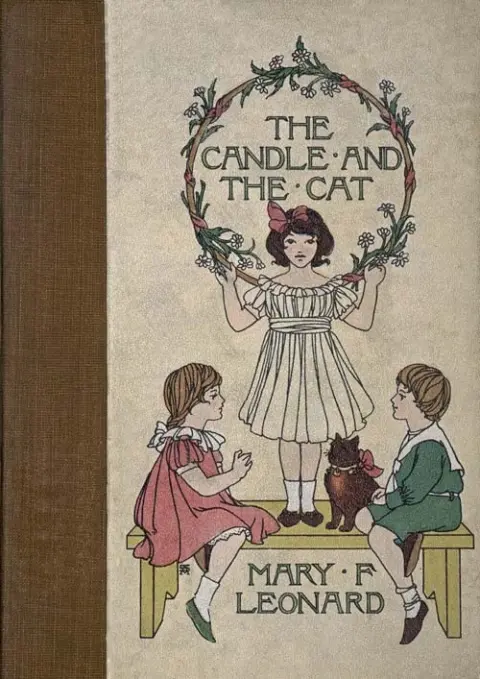
The Candle and the Cat
Mary Finley Leonard
THE CLASSIC COLLECTION · 1898
"The Story of the Big Front Door" by Mary Finley Leonard is a children’s novel written in the late 19th century. The narrative centers around the adventures of a group of children in a quaint neighborhood where they engage in imaginative play, including games inspired by classic stories like Robin Hood. Their interactions are influenced by their relationships with each other and their new neighbor, Miss Brown, who is key to the unfolding of their shared experiences. The opening of the story introduces Ikey Ford, who brings troubling news of new occupants moving into the abandoned "Brown house," which has been the children's playground. This news sparks a series of discussions among the neighborhood kids about their feelings of loss and incites their imaginations as they plot ways to reclaim their space. The initial chapters depict the children's creative games and the camaraderie that blossoms among them, highlighting themes of friendship, exploration, and the impact of community as they navigate the changes brought by their new neighbor and the secrets held by the mysterious front door of her house.
Introduction adapted from the source catalogue; source summaries may be automatically generated.
Free to read · English · 57,105 words · No account needed
MAKE TIME FOR A GOOD BOOK
On by default. Untick to stop anonymous reading totals. Each page counts after 10 seconds in view. How this works.
Anonymous counting is on unless you have switched it off.
"Do you remember Aunt Zelie's wedding?" asked Louise. "Cousin Helen says she was the prettiest bride she ever saw."
"Not very well. I don't remember how she looked, but I think she is the most beautiful person in the world now."
"Oh, yes, so do I!"
The wedding then went on without interruption for a while.
"Lucy is tall and stately, her eyes are blue as the sky, and her hair is long and golden. She speaks very softly, and has the sweetest smile, and she walks like a queen. Her dress is white silk and beautiful lace, with a long, long train, and she wears diamonds and carries a bunch of roses."
"Now tell about Edwin Graves, Bess."
"Men are a great deal harder to do," said the story-teller with a
sigh.
"Let me, then, for I know exactly how he looks," and, clasping her hands around her knees and gazing upwards, Louise began: "He is very tall and grand-looking, his eyes are black, and his voice is very deep."
At this interesting point Bess exclaimed, "Louise, here comes Uncle William, and I know he is going to take us driving!"
The listener, who had forgotten everything but the story, came to herself with a start. "How dreadful of me!" she said, walking away very rapidly, while the story-tellers ran out of the gate to greet a tall gentleman who had just driven up.
"I suppose they are sisters," she thought, looking back once more
before she turned the corner.
"How nice it must be to live in a house like that. Bess and Louise; I wonder what their last name is."
Louise was busy with her drawing one morning, comfortably established in a shady corner of the porch, when her aunt called to her:
"I wish you would keep an eye on Carie while Joanna goes on an errand
for me."
"I will, Aunt Zelie," she responded promptly.
It was not likely her charge would give her much trouble, for Carie was quite capable of entertaining herself, and was at that moment promenading back and forth with an old parasol over her head, pretending she was going to market.
"Don't go on the grass, baby; it is wet," cautioned Louise, by way of showing her authority, and then returned to the new mansion for the Carletons upon which she was working. She soon became so absorbed in this that she forget to look up now and then.
Your reading position is saved on this browser. Take it to another device with a library code. Reading pages adapt to text, rather than matching a printed edition.
Mary Finley Leonard
Mary Finley Leonard
Mary Finley Leonard
Mary Finley Leonard
BEHIND THE BOOK
This eBook is for the use of anyone anywhere in the United States and most other parts of the world at no cost and with almost no restrictions whatsoever. You may copy it, give it away or re-use it under the terms of the Project Gutenberg License included with this eBook or online at www.gutenberg.org. If you are not located in the United States, you will have to check the laws of the country where you are located before using this eBook. Read the source licence.
The original source file, including credits and licence, is retained by this library. Request an original-format copy at no charge. Please include the book title and Project Gutenberg identifier #19340.
KEEP YOUR CURIOSITY GOING
Coulson Kernahan

Maurice Baring
Frances Wright
Cécile Tormay

Frederic Jesup Stimson

W. H. P. (William Henry Pope) Jarvis