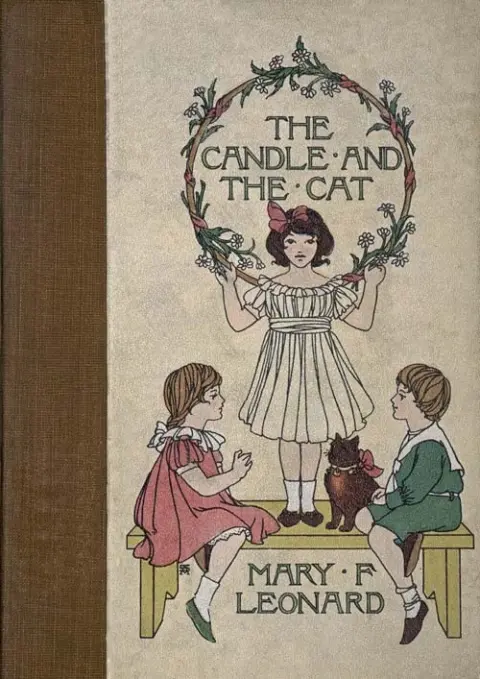
The Candle and the Cat
Mary Finley Leonard
THE CLASSIC COLLECTION · 1898
"The Story of the Big Front Door" by Mary Finley Leonard is a children’s novel written in the late 19th century. The narrative centers around the adventures of a group of children in a quaint neighborhood where they engage in imaginative play, including games inspired by classic stories like Robin Hood. Their interactions are influenced by their relationships with each other and their new neighbor, Miss Brown, who is key to the unfolding of their shared experiences. The opening of the story introduces Ikey Ford, who brings troubling news of new occupants moving into the abandoned "Brown house," which has been the children's playground. This news sparks a series of discussions among the neighborhood kids about their feelings of loss and incites their imaginations as they plot ways to reclaim their space. The initial chapters depict the children's creative games and the camaraderie that blossoms among them, highlighting themes of friendship, exploration, and the impact of community as they navigate the changes brought by their new neighbor and the secrets held by the mysterious front door of her house.
Introduction adapted from the source catalogue; source summaries may be automatically generated.
Free to read · English · 57,105 words · No account needed
MAKE TIME FOR A GOOD BOOK
On by default. Untick to stop anonymous reading totals. Each page counts after 10 seconds in view. How this works.
Anonymous counting is on unless you have switched it off.
"I don't approve of this move at all," Mrs. Hazeltine announced; "Mrs. Warner must have lost her mind to consent."
"It is a great deal nicer than you imagine, Aunt Marcia," urged Bess.
"Dora doesn't care about being fashionable, and you can have more fun if you don't," observed Louise.
"You seem to care for nothing but fun," said her aunt, with dignity.
"At any rate we all admire Dora's energy and good sense, and would like to do something to help her," said Mr. Frank Hazeltine.
So they put their heads together and made their plans.
It was arranged that Mrs. Warner should come to her new quarters on Saturday morning, and Dora lingered long on Friday afternoon putting a few last touches here and there, arranging her little sideboard with some pretty glass and china, relics of her mother's early housekeeping, till everything was in dainty order.
"I do hope Mamma will think it pleasant," she said to Louise, who was
helping.
"She will, I'm sure," Louise answered, looking around the room, which was indeed very attractive with the afternoon sunshine streaming in through the windows draped in their pretty muslin curtains.
"Everything is so sweet and cosey I almost envy you," she added, dusting the top of the clock with a tiny feather duster.
"Louise Hazeltine, how could you envy anybody?" Dora exclaimed. "There are two things I ought to have, and mean to sometime," she went on, "and they are some plants and a canary."
Louise looked out of the window to hide a smile.
One more peep had to be taken at the other room, where two snowy beds looked restful and inviting; then she locked the doors, leaving the key with Mrs. Smith that the fires might be made in the morning.
"I hope you will like it, Mamma," were her last words that night and her first thought next morning.
Mr. Hazeltine sent his carriage for Mrs. Warner, and short as the drive was it seemed tiresomely long to Dora.
"I am glad it is pleasant so that the sunshine will be in your windows; it is always there by eleven o'clock," she said.
Mrs. Smith was at the door to welcome them, with her small son Tommy
to carry up any bundles.
"I declare," she remarked to her husband, "it doesn't look right for a
woman that has a daughter like Miss Dora to be so terrible
down-hearted."
In her eagerness to see how her mother was pleased, Dora hardly noticed anything herself when she opened the door.
Your reading position is saved on this browser. Take it to another device with a library code. Reading pages adapt to text, rather than matching a printed edition.
Mary Finley Leonard
Mary Finley Leonard
Mary Finley Leonard
Mary Finley Leonard
BEHIND THE BOOK
This eBook is for the use of anyone anywhere in the United States and most other parts of the world at no cost and with almost no restrictions whatsoever. You may copy it, give it away or re-use it under the terms of the Project Gutenberg License included with this eBook or online at www.gutenberg.org. If you are not located in the United States, you will have to check the laws of the country where you are located before using this eBook. Read the source licence.
The original source file, including credits and licence, is retained by this library. Request an original-format copy at no charge. Please include the book title and Project Gutenberg identifier #19340.
KEEP YOUR CURIOSITY GOING
Coulson Kernahan

Maurice Baring
Frances Wright
Cécile Tormay

Frederic Jesup Stimson

W. H. P. (William Henry Pope) Jarvis