THE CLASSIC COLLECTION✦An outlaw’s diary: the CommuneCLASSIC FREE BOOKS
An outlaw’s diary: the Commune
Cécile Tormay
THE CLASSIC COLLECTION · 1903
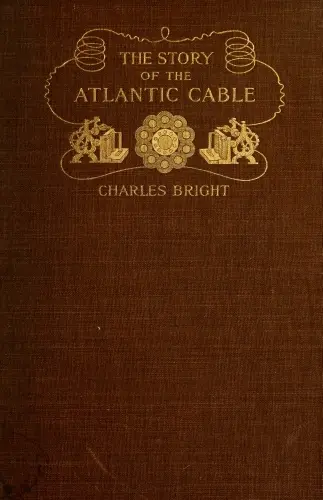
"The Story of the Atlantic Cable" by Sir Charles Bright is a historical account written in the early 20th century. The book chronicles the ambitious and groundbreaking efforts to establish telegraphic communication across the Atlantic Ocean, exploring the technological challenges and the key figures involved in this monumental undertaking. At the start of the book, the author introduces the evolution of electric telegraphy, detailing its significance in modern civilization and the enormous technical challenges these pioneers faced in spanning the vast Atlantic. The opening chapters discuss early experiments with submarine cables, breakthroughs in insulation materials like gutta-percha, and the eventual conception of the Atlantic telegraph project initiated by notable figures such as Cyrus West Field, John Watkins Brett, and Charles Bright himself. This sets the stage for an in-depth exploration of the engineering marvels and struggles that characterized the laying of the transatlantic cable, which would ultimately change global communications forever.
Introduction adapted from the source catalogue; source summaries may be automatically generated.
Free to read · English · 49,517 words · No account needed
MAKE TIME FOR A GOOD BOOK
On by default. Untick to stop anonymous reading totals. Each page counts after 10 seconds in view. How this works.
Anonymous counting is on unless you have switched it off.
At 4 A.M. sail was shortened to close-reefer fore and main topsails and reefed foresail--a long and tedious job, for the wind so roared and howled and the hiss of the boiling sea was so deafening that words of command were useless, and the men aloft, holding on with all their might to the yards as the ship rolled over and over almost to the water, were quite incapable of struggling with the masses of wet canvas that flapped and plunged as if men and yards and everything were going away together. The ship was almost as wet inside as out, and so things wore on till eight or nine o'clock, everything getting adrift and being smashed, and every one on board jamming themselves up in corners or holding on to beams to prevent their going adrift likewise. At ten o'clock the Agamemnon was rolling and laboring fearfully, with the sky getting darker, and both wind and sea increasing every minute. At about half-past ten o'clock three or four gigantic waves were seen approaching the ship, coming slowly on through the mist nearer and nearer, rolling on like hills of green water, with a crown of foam that seemed to double their height. The Agamemnon rose heavily to the first, and then went down quickly into the deep trough of the sea, falling over as she did so, so as almost to capsize completely on the port side. There was a fearful crashing as she lay over this way, for everything broke adrift, whether secured or not, and the uproar and confusion were terrific for a minute, then back she came again on the starboard beam in the same manner, only quicker, and still deeper than before. Again there was the same noise and crashing, and the officers in the ward-room, who knew the danger of the ship, struggled to their feet and opened the door leading to the main deck. Here, for an instant, the scene almost defies description. Amid loud shouts and efforts to save themselves, a confused mass of sailors, boys, and marines, with deck-buckets, ropes, ladders, and everything that could get loose, and which had fallen back again to the port side, were being hurled again in a mass across the ship to starboard. Dimly, and only for an instant, could this be seen, with groups of men clinging to the beams with all their might, with a mass of water, which had forced its way in through ports and decks, surging about, and then, with a tremendous crash, as the ship fell still deeper over, the coals stowed on the main deck broke loose, and smashing everything before them, went over among the rest to leeward. The coal-dust hid everything on the main deck in an instant, but the crashing could still be heard going on in all directions, as the lumps and sacks of coal, with stanchions, ladders, and mess-tins, went leaping about the decks, pouring down the hatchways, and crashing through the glass skylights into the engine-room below. Still it was not done, and, surging again over another tremendous wave, the Agamemnon dropped down still more to port, and the coals on the starboard side of the lower deck gave way also, and carried everything before them. Matters now became serious, for it was evident that two or three more lurches and the masts would go like reeds, while half the crew might be maimed or killed below. Captain Preedy was already on the poop, with Lieutenant Gibson, and it was "Hands, wear ship," at once, while Mr. Brown, the indefatigable chief engineer, was ordered to get up steam immediately. The crew gained the deck with difficulty, and not till after a lapse of some minutes, for all the ladders had been broken away; the men were grimed with coal-dust, and many bore still more serious marks upon their faces of how they had been knocked about below. There was some confusion at first, for the storm was fearful. The officers were quite inaudible, and a wild, dangerous sea, running mountains high, heeled the great ship backward and forward, so that the crew were unable to keep their feet for an instant, and in some cases were thrown across the decks in a fearful manner. Two marines went with a rush head foremost into the paying-out machine, as if they meant to butt it over the side, yet, strange to say, neither the men nor the machine suffered. What made matters worse, the ship's barge, though lashed down to the deck, had partly broken loose, and dropping from side to side as the vessel lurched, it threatened to crush any who ventured to pass it. The regular discipline of the ship, however, soon prevailed, and the crew set to work to wear round the ship on the starboard tack, while Lieutenants Robinson and Murray went below to see after those who had been hurt, and about the number of whom extravagant rumors prevailed among the men. There were, however, unfortunately but too many. The marine sentry outside the ward-room door on the main deck had not had time to escape, and was completely buried under the coals. Some time elapsed before he could be got out, for one of the beams used to shore up the sacks, which had crushed his arm very badly, still lay across the mangled limb, jamming it in such a manner that it was found impossible to remove it without risking the man's life. Saws, therefore, had to be sent for, and the timber sawn away before the poor fellow could be extricated. Another marine on the lower deck endeavored to save himself by catching hold of what seemed a ledge in the planks, but, unfortunately, it was only caused by the beams straining apart, and, of course, as the Agamemnon righted they closed again, and crushed his fingers flat. One of the assistant engineers was also buried among the coals on the lower deck, and sustained some severe internal injuries. The lurch of the ship was calculated at forty-five degrees each way for five times in rapid succession. The galley-coppers were only half filled with soup; nevertheless, it nearly all poured out, and scalded some of the poor fellows who were extended on the decks, holding on to anything in reach. These, with a dislocation, were the chief casualties, but there were others of bruises and contusions, more or less severe, and, of course, a long list of escapes more marvelous than any injury. One poor fellow went head first from the main deck into the hold without being hurt, and one on the orlop-deck was "chevied" about for some ten minutes by three large casks of oil which had got adrift, and any one of which would have flattened him like a pancake had it overtaken him.
Your reading position is saved on this browser. Take it to another device with a library code. Reading pages adapt to text, rather than matching a printed edition.
BEHIND THE BOOK
This eBook is for the use of anyone anywhere in the United States and most other parts of the world at no cost and with almost no restrictions whatsoever. You may copy it, give it away or re-use it under the terms of the Project Gutenberg License included with this eBook or online at www.gutenberg.org. If you are not located in the United States, you will have to check the laws of the country where you are located before using this eBook. Read the source licence.
The original source file, including credits and licence, is retained by this library. Request an original-format copy at no charge. Please include the book title and Project Gutenberg identifier #46105.
KEEP YOUR CURIOSITY GOING
Cécile Tormay

Moritz Busch
John L. Ransom
Frances Wright
Cécile Tormay

Mabel Potter Daggett