THE CLASSIC COLLECTION✦An outlaw’s diary: the CommuneCLASSIC FREE BOOKS
An outlaw’s diary: the Commune
Cécile Tormay
THE CLASSIC COLLECTION · 1903
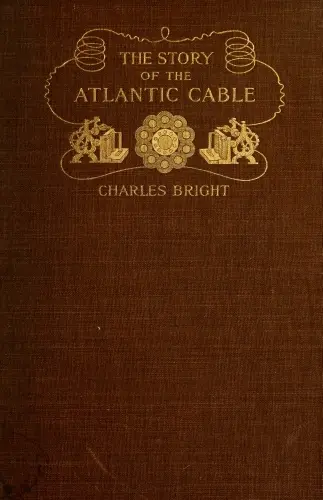
"The Story of the Atlantic Cable" by Sir Charles Bright is a historical account written in the early 20th century. The book chronicles the ambitious and groundbreaking efforts to establish telegraphic communication across the Atlantic Ocean, exploring the technological challenges and the key figures involved in this monumental undertaking. At the start of the book, the author introduces the evolution of electric telegraphy, detailing its significance in modern civilization and the enormous technical challenges these pioneers faced in spanning the vast Atlantic. The opening chapters discuss early experiments with submarine cables, breakthroughs in insulation materials like gutta-percha, and the eventual conception of the Atlantic telegraph project initiated by notable figures such as Cyrus West Field, John Watkins Brett, and Charles Bright himself. This sets the stage for an in-depth exploration of the engineering marvels and struggles that characterized the laying of the transatlantic cable, which would ultimately change global communications forever.
Introduction adapted from the source catalogue; source summaries may be automatically generated.
Free to read · English · 49,517 words · No account needed
MAKE TIME FOR A GOOD BOOK
On by default. Untick to stop anonymous reading totals. Each page counts after 10 seconds in view. How this works.
Anonymous counting is on unless you have switched it off.
The barometer was lower--and, as a matter of course, the wind and sea were infinitely higher--than the day before. It was singular, but at twelve o'clock the sun pierced through the pall of clouds and shone brilliantly for half an hour, and during that brief time it blew as it had not often blown before. So fierce was this gust that its roar drowned every other sound, and it was almost impossible to give the watch the necessary orders for taking in the close-reefer foresail, which, when furled, almost left the Agamemnon under bare poles, though still surging through the water at speed. This gust passed, the usual gale set in, now blowing steadily from the southwest, and taking us more and more out of our course each minute. Every hour the storm got worse, till toward five in the afternoon, when it seemed at its height--and raged with such a violence of wind and sea--that matters really looked "desperate" even for such a strong and large ship as the Agamemnon. The upper-deck coil had strained her decks throughout excessively, and though this mass in theory was supposed to prevent her rolling so quickly and heavily as she would have done without it, yet still she heeled over to such an alarming extent that fears of the coil itself shifting again occupied every mind, and it was accordingly strengthened with additional shores bolted down to the deck. The space occupied by the main coil below had deprived the Agamemnon of several of her coal-bunkers, and in order to make up for this deficiency, as well as to endeavor to counterbalance the immense mass which weighed her down by the head, a large quantity of coals had been stowed on the deck aft. On each side of her main deck were thirty-five tons, secured in a mass, while on the lower deck ninety tons were stowed away in the same manner. The precautions taken to secure these huge masses also required attention as the great ship surged from side to side. But these coals seemed secure, and were so, in fact, unless the vessel should almost capsize--an unpleasant alternative which no one certainly anticipated then. Everything, therefore, was made "snug," as sailors call it, though their efforts by no means resulted in the comfort which might have been expected from the term. The night, however, passed over without any mischance beyond the smashing of all things incautiously left loose and capable of rolling, and one or two attempts which the Agamemnon made in the middle watch to turn bottom upward. In all other matters it was the mere ditto of Sunday night, except, perhaps, a little worse, and certainly much more wet below. Tuesday the gale continued with almost unabated force, though the barometer had risen to 29.30, and there was sufficient sun to take a clear observation, which showed our distance from the rendezvous to be 563 miles. During this afternoon the Niagara joined company, and the wind going more ahead, the Agamemnon took to violent pitching, plunging steadily into the trough of the sea as if she meant to break her back and lay the Atlantic cable in a heap. This change in her motion strained and taxed every inch of timber near the coils to the very utmost. It was curious to see how they worked and bent as the Agamemnon went at everything she met head first. One time she pitched so heavily as to break one of the main beams of the lower deck, which had to be shored with screw-jacks forthwith. Saturday, the 19th of June, things looked a little better. The barometer seemed inclined to go up and the sea to go down; and for the first time that morning since the gale began, some six days previous, the decks could be walked with tolerable comfort and security. But alas! appearances are as deceitful in the Atlantic as elsewhere; and during a comparative calm that afternoon the glass fell lower, while a thin line of black haze to windward seemed to grow up into the sky, until it covered the heavens with a somber darkness, and warned us that, after all, the worst was yet to come. There was much heavy rain that evening, and then the wind began, not violently, nor in gusts, but with a steadily increasing force, as if the gale was determined to do its work slowly but do it well. The sea was "ready-built to hand," as sailors say, so at first the storm did little more than urge on the ponderous masses of water with redoubled force, and fill the air with the foam and spray it tore from their rugged crests. By and by, however, it grew more dangerous, and Captain Preedy himself remained on deck throughout the middle watch, for the wind was hourly getting worse and worse, and the Agamemnon, rolling thirty degrees each way, was straining to a dangerous extent.
Your reading position is saved on this browser. Take it to another device with a library code. Reading pages adapt to text, rather than matching a printed edition.
BEHIND THE BOOK
This eBook is for the use of anyone anywhere in the United States and most other parts of the world at no cost and with almost no restrictions whatsoever. You may copy it, give it away or re-use it under the terms of the Project Gutenberg License included with this eBook or online at www.gutenberg.org. If you are not located in the United States, you will have to check the laws of the country where you are located before using this eBook. Read the source licence.
The original source file, including credits and licence, is retained by this library. Request an original-format copy at no charge. Please include the book title and Project Gutenberg identifier #46105.
KEEP YOUR CURIOSITY GOING
Cécile Tormay

Moritz Busch
John L. Ransom
Frances Wright
Cécile Tormay

Mabel Potter Daggett