THE CLASSIC COLLECTION✦The Story of ChartresCLASSIC FREE BOOKS
The Story of Chartres
Cecil Headlam
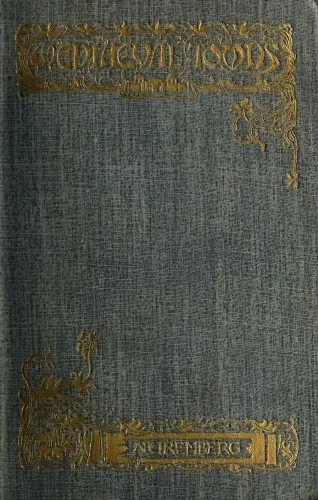
THE CLASSIC COLLECTION · 1899
"The Story of Nuremberg" by Cecil Headlam is a historical account written in the late 19th century. The book explores the rich history of Nuremberg, a medieval town renowned for its art and commerce, aiming to revive readers' affinity for this historic site and encourage visits. It discusses the evolution of the city, its significant figures like Albert Dürer, and its role in various historical events, providing insights into the cultural and architectural heritage of Nuremberg. The opening of the book sets the stage for a detailed exploration of Nuremberg, emphasizing its historical and aesthetic significance. It describes the city as both enchanting and complex, juxtaposed against its gradual transformation from a humble settlement to a bustling center of art and trade. Headlam hints at the vast scope of Nuremberg's past, touching upon the obscurity of its origins and the legends that weave through its history. Through a blend of anecdotal and factual narrative, the author captivates the reader's imagination, suggesting that Nuremberg's allure lies not only in its architectural beauty but also in the historical memories and associations that continue to resonate today.
Introduction adapted from the source catalogue; source summaries may be automatically generated.
Free to read · English · 79,975 words · No account needed
MAKE TIME FOR A GOOD BOOK
On by default. Untick to stop anonymous reading totals. Each page counts after 10 seconds in view. How this works.
Anonymous counting is on unless you have switched it off.
So bitterly were these knights hated and feared that even the great tourneys, such as the one recorded in 1446,[20] when all the neighbouring nobles came in from the surrounding country and tilted and displayed their skill and valour in the market-place, were very unpopular with the peace-loving burghers.
Nuremberg, then, joined the Swabian League to suppress such knights as chose still to indulge in the forbidden Club Law or Faustrecht. It was not long before she came into direct collision with Götz von Berlichingen of the Iron Hand. Götz, who had a fine gift for chastising the gutter-blooded citizens of a free town, had long been anxious to try conclusions with the men of Nuremberg. He carried out his intention on a very futile pretext. The Nurembergers, it seems, had pursued and fought in the adjacent woods some unknown knights, who had refused, when challenged, to give their names as honest knights and fled. Now, some years after, Hans von Geislingen, brother of one George, who was the Squire of Eustace of Lichtenstein and was killed on this occasion, demanded blood-money for his brother, and on being refused, he seized some Nuremberg citizens and merchants' caravans. He was outlawed, but this did not prevent Götz von Berlichingen from helping him. George, he declared, had been his page (a statement that had the defect of being untrue), and he demanded a large sum of money in compensation. When this was refused Götz did not send an Absagebrief, or letter of notice of war, but merely a note saying that he was considering, with his friends, how to get compensation. His bitterness was further increased by the action of the Council, who shortly afterwards decapitated Sebastian von Seckendorf, a knight who had long been a source of annoyance, and whom they had at last been successful in catching. Suddenly, and without warning, Götz and his friends swooped down on a party of fifty-five Nuremberg merchants who were travelling back from the fair at Leipzig, under the escort of the Bishop of Bamberg. These he plundered and took prisoners as they were crossing the Rednitz, near Forcheim. Götz did not treat his prisoners too gently, but used the art of torture to persuade them to offer huge ransoms. The news of this seizure caused consternation and surprise in Nuremberg. Götz's letter of notice came only nine days later to the Council. Spies were sent out to discover his whereabouts: the town was prepared for a siege, and 800 mercenary soldiers were hired. Götz was outlawed. But the Council were accused of being slack to avenge, what they called "a handful of small merchants, not of patrician families," and Maximilian was not willing to be plunged into an Imperial war "to recover a merchant's sack of pepper." What he did do was to attempt to bring about one of his favourite compromises. The Markgraf was appointed to arbitrate, and his award was that Nuremberg should pay a certain sum. As is not unusual in the case of arbitrations, the money was not paid. Götz, laughing at the sentence of outlawry that had been passed upon him, protected by the princes who resented peace and order in an Empire, continued to ravage, burn and pillage, until the Swabian League was renewed, at the end of 1512, to keep the "eternal peace," at which Maximilian aimed. Nuremberg once more joined the League, on Maximilian's injunction, though she distrusted the alliance with the Markgraf thereby involved. The League, however, decided in January 1513 to take strong measures to repress the outlawed nobles and to destroy the castles of the robber-knights. But the Emperor objected, and said that he wanted to arrive at a peaceful compromise with Götz. The Nurembergers replied that they would be content if the latter paid over a sum of money sufficient to compensate the merchants for the losses they had suffered. At the same time they took prisoner a robber-knight who was a friend of the Markgraf, and to procure his release the Markgraf promised to arrange peace for them with Hans von Geislingen. This he succeeded in doing. Götz, however, remained at war, proud and obstinate in spite of all mediation. Again and again the League threatened war, the Emperor temporised, and Götz plundered, until at last Maximilian got it arranged that Götz should pay 14000 florins damages. These were subscribed chiefly by his supporters, such as the Bishop of Würzburg, who also persuaded him to cease from his career of robbery.
Your reading position is saved on this browser. Take it to another device with a library code. Reading pages adapt to text, rather than matching a printed edition.
BEHIND THE BOOK
This eBook is for the use of anyone anywhere in the United States and most other parts of the world at no cost and with almost no restrictions whatsoever. You may copy it, give it away or re-use it under the terms of the Project Gutenberg License included with this eBook or online at www.gutenberg.org. If you are not located in the United States, you will have to check the laws of the country where you are located before using this eBook. Read the source licence.
The original source file, including credits and licence, is retained by this library. Request an original-format copy at no charge. Please include the book title and Project Gutenberg identifier #46401.
KEEP YOUR CURIOSITY GOING
Wilfrid Scawen Blunt
Wilfrid Scawen Blunt

E. W. (Edgar Watson) Howe
Cécile Tormay

Moritz Busch
John L. Ransom