THE CLASSIC COLLECTION✦The Story of ChartresCLASSIC FREE BOOKS
The Story of Chartres
Cecil Headlam
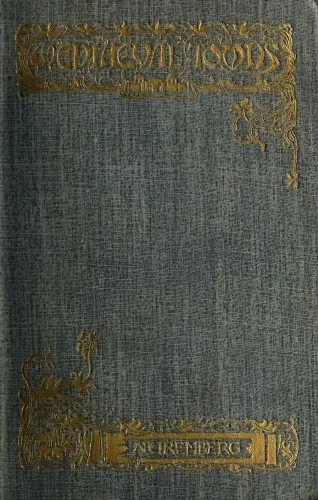
THE CLASSIC COLLECTION · 1899
"The Story of Nuremberg" by Cecil Headlam is a historical account written in the late 19th century. The book explores the rich history of Nuremberg, a medieval town renowned for its art and commerce, aiming to revive readers' affinity for this historic site and encourage visits. It discusses the evolution of the city, its significant figures like Albert Dürer, and its role in various historical events, providing insights into the cultural and architectural heritage of Nuremberg. The opening of the book sets the stage for a detailed exploration of Nuremberg, emphasizing its historical and aesthetic significance. It describes the city as both enchanting and complex, juxtaposed against its gradual transformation from a humble settlement to a bustling center of art and trade. Headlam hints at the vast scope of Nuremberg's past, touching upon the obscurity of its origins and the legends that weave through its history. Through a blend of anecdotal and factual narrative, the author captivates the reader's imagination, suggesting that Nuremberg's allure lies not only in its architectural beauty but also in the historical memories and associations that continue to resonate today.
Introduction adapted from the source catalogue; source summaries may be automatically generated.
Free to read · English · 79,975 words · No account needed
MAKE TIME FOR A GOOD BOOK
On by default. Untick to stop anonymous reading totals. Each page counts after 10 seconds in view. How this works.
Anonymous counting is on unless you have switched it off.
Conrad Zeninger, 1480-1482.
Fratres Vitæ Communis, 1479-1491.
Georg Stuchs, 1484-1515.
Johann Petrejus, 1526-1550.
Alexander Kaufmann (Greek types).
Konrad Bauer, 1601. Polyglot Bible.
Leonhard Heussler, 1596. Joachim Lochner's Chronicle.
Endter, 1668. Fugger's Österreichischer Ehrenspiegel (case xxviii.).
In this case also is Grimmelshausen's Simplicissimus (Nuremberg, 1685). In the next case (xxix.) is a copy of the pamphlet "Deutschland in seiner tiefen Erniederung," 1806, which occasioned the execution of the publisher Palm (see p. 269), "who fell a victim to the tyranny of Napoleon."
Near this case are two old printing presses, and in case xxx. are the bust, some manuscripts, and the collected works of Hans Sachs the cobbler-poet.
Ship models, etc.
ROOM 60 (gallery of the Church).
Old weights and scales.
Scientific instruments, dials, early watches and watch-cocks. Durer's Reissfeder. Regiomontanus' astronomical instruments.
Old drugs and drug-stores, etc. The old apothecary's shop, decorated with crocodiles and so forth, suggests the familiar scene in Romeo and Juliet.
Technical models, globes, maps, etc.
Banners of old Nuremberg guilds, signs of inns, trade-marks, etc.
Early Nuremberg toys, dolls' houses, etc. We now come to the
which, if not of great size or of first-rate importance, is eminently interesting to those who care to study the development of Nuremberg art. The pictures are unfortunately numbered and arranged in a somewhat eccentric fashion.
In the small room on the right, as we enter Room 71, are some early pictures which would seem to be the forerunners of the system of epitaphs which obtained so largely in the later Middle Ages. Besides these there are two Byzantine pictures.
The first two sections of Room 71 are taken up with some examples of the Rhenish and old Netherland School up to the end of the sixteenth century.
To Meister Wilhelm of Cologne is attributed the charming Madonna with the pea-blossom (No. 7). Of the same school are Nos. 9, 10, and 17.
Stephan Lockner, Nos. 11, 12, 13, 14, 15.
Rogier van der Weyden (copy), No. 20.
Hugo van der Goes. Cardinal Bourbon. No. 19.
The "Master of the Life of Mary." Nos. 24, 25, 26.
Jan Scorel. Two portraits. Nos. 50, 51.
The "Master of the Death of Mary." Nos. 63, 64, 65.
Bartholomew Bruyns. No. 72.
With the third section of this room begins the collection of Franconian and Nuremberg paintings. As I have already on more than one occasion sketched the characteristics of this school, it would be superfluous to add anything here. But perhaps one may be allowed to express the conviction that no one who studies these pictures will fail to be impressed by the comparative merits of Wolgemut, or go away without ranking the master of Durer higher in his estimation than he was wont to do before he came.
Your reading position is saved on this browser. Take it to another device with a library code. Reading pages adapt to text, rather than matching a printed edition.
BEHIND THE BOOK
This eBook is for the use of anyone anywhere in the United States and most other parts of the world at no cost and with almost no restrictions whatsoever. You may copy it, give it away or re-use it under the terms of the Project Gutenberg License included with this eBook or online at www.gutenberg.org. If you are not located in the United States, you will have to check the laws of the country where you are located before using this eBook. Read the source licence.
The original source file, including credits and licence, is retained by this library. Request an original-format copy at no charge. Please include the book title and Project Gutenberg identifier #46401.
KEEP YOUR CURIOSITY GOING
Wilfrid Scawen Blunt
Wilfrid Scawen Blunt

E. W. (Edgar Watson) Howe
Cécile Tormay

Moritz Busch
John L. Ransom