THE CLASSIC COLLECTION✦The Story of ChartresCLASSIC FREE BOOKS
The Story of Chartres
Cecil Headlam
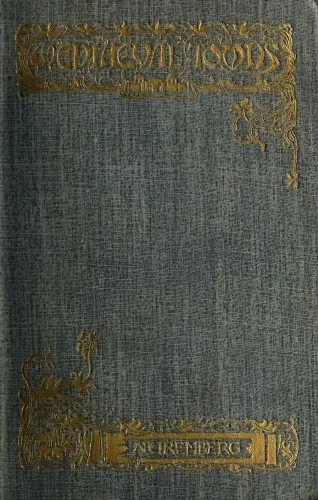
THE CLASSIC COLLECTION · 1899
"The Story of Nuremberg" by Cecil Headlam is a historical account written in the late 19th century. The book explores the rich history of Nuremberg, a medieval town renowned for its art and commerce, aiming to revive readers' affinity for this historic site and encourage visits. It discusses the evolution of the city, its significant figures like Albert Dürer, and its role in various historical events, providing insights into the cultural and architectural heritage of Nuremberg. The opening of the book sets the stage for a detailed exploration of Nuremberg, emphasizing its historical and aesthetic significance. It describes the city as both enchanting and complex, juxtaposed against its gradual transformation from a humble settlement to a bustling center of art and trade. Headlam hints at the vast scope of Nuremberg's past, touching upon the obscurity of its origins and the legends that weave through its history. Through a blend of anecdotal and factual narrative, the author captivates the reader's imagination, suggesting that Nuremberg's allure lies not only in its architectural beauty but also in the historical memories and associations that continue to resonate today.
Introduction adapted from the source catalogue; source summaries may be automatically generated.
Free to read · English · 79,975 words · No account needed
MAKE TIME FOR A GOOD BOOK
On by default. Untick to stop anonymous reading totals. Each page counts after 10 seconds in view. How this works.
Anonymous counting is on unless you have switched it off.
The reputation of the Nuremberg school of poetry and singing was greatly enhanced by Hans Sachs. Remarkable for his own personality and literary fertility, he was also famous for reducing all the rules of the Meistersingers to writing, in a code which lasted till 1735. But, in spite of his attention to rules, he, at any rate, showed some poetic and original talent. It is for this reason that Wagner makes him, in "Die Meistersinger," recognise the real poetry in Walter, though the latter's impassioned song does not conform with all the artificial rules of the Guild, mere paper rules which added nothing to the sound or rhythm of the words. For, as all the world knows, Hans Sachs has achieved a second lease of life on men's lips, through the genius of Richard Wagner, dramatist, poet, satirist, and wonderful musician, who, in this opera, laughs at the conceit of the Incorporated Poets in assigning an extravagant antiquity to their Guilds, and at their pedantic sacrifice of matter to form. No more vivid and humorous picture of mediæval German life and of the people of quaint old Nuremberg has ever been drawn. Though "Die Meistersinger von Nürnberg" was not published till 1867, Wagner had already as early as 1851 sketched out the plan of an opera which was to display the triumph of genius and genuine passion over pedantry and conventionalism in art.
The passage[51] from "Eine Mittheilung an meine Freunde" is worth
quoting here.
"Immediately after the completion of this work" (Tannhäuser), he writes, "I was permitted to visit some baths in Bohemia to restore my strength. Here, as always, when I have been able to withdraw from the atmosphere of the foot-lights and my duties in the theatre, I soon found myself in a light and joyous humour. For the first time, and with artistic significance, a gaiety peculiar to my character declared itself. Capriciously, and yet not without some premeditation, I had determined a little time previously to write as my next work a comic opera. I call to mind that I had been influenced in arriving at this decision by the well-meant advice of good friends, who wished to see an opera of a 'lighter kind' composed by me, because this, they said, would open the German theatres to my work, and so bring about that success, the invincible want of which had undoubtedly begun to threaten my worldly circumstances with serious embarrassment. As, with the Athenians, a gay satirical piece followed on a tragedy, so suddenly there appeared to me, on that holiday journey, the picture of a comic play, which might suitably be attached as a satirical sequel to my 'Battle of the Bards at Wartburg.' This was 'Die Meistersinger zu Nürnberg,' with Hans Sachs at their head. Hans Sachs I conceived as embodying the last appearance of the artistically productive folk's-spirit, and as such I opposed him to the vulgar narrow-mindedness of the master-singers, whose very droll, rule-of-thumb pedantry I personified in the character of the 'Marker.' This Marker, as is well-known (or as is perhaps not known to our critics), was the overseer appointed by the Singers' Guild to 'mark' with strokes the faults against the rules committed by the performers, especially if they were candidates for admission to the Guild. Whoever received a certain number of strokes had versungen--failed in his singing." (The singer sat in a chair before the assembly: the marker was ensconced behind curtains, and gave his attention chiefly to marking mistakes in singing, in Biblical history, in Lutheran German, in rhymes, music and syllables.) "Now the eldest of the Guild offered the hand of his young daughter to that master who should win the prize at an approaching public singing-competition. The marker, who has already been wooing the maiden, finds a rival in the person of a young knight, who, fired by reading the 'Book of Heroes' and the old Minnesingers, leaves the poor and decaying castle of his ancestors to learn in Nuremberg the art of the master-singers. He announces his candidature for admission to the Guild, being inspired thereto by a sudden passion for the Prize-Maiden, 'whom only a Master of the Guild may win.' He submits himself for examination, and sings an enthusiastic song in praise of women, which, however, provokes such incessant disapprobation on the part of the marker that ere his song is half-sung he has 'failed in his singing.' Sachs, who is pleased with the youth and wishes him well, baffles a desperate attempt to carry off the maiden, and thereby finds an opportunity of deeply annoying the marker. The latter, who, with a view to humbling him, has already been turning rudely on Sachs about a pair of shoes not yet finished, plants himself at night before the maiden's window, in order to make trial of the song with which he hopes to win her by singing it as a serenade. By so doing he hopes to secure her voice in his favour at the adjudication of the prize. Sachs, whose cobbler's shop is opposite the house thus serenaded, begins singing loudly as soon as the marker strikes up, because, as he informs the infuriated lover, this is necessary if he must keep awake to work so late: that the work is pressing nobody knows better than the marker himself, who has dunned him so mercilessly for the shoes! At last he promises the poor wretch to stop singing on condition that whatever faults he may find, in his judgment, in the marker's song, he may be allowed to mark according to his shoemaker's art--namely, with a blow of the hammer upon the shoe stretched on the last. Then the marker sings: Sachs strikes on the last again and again. The marker jumps up indignantly. Sachs asks him nonchalantly whether his song is finished. 'Not nearly,' he cries. Then Sachs laughingly holds up the shoes outside his shop, and declares that they are now quite finished, thanks to the 'marker's strokes.' With the rest of his song, which in desperation he screams out without a pause, the marker fails lamentably before the lady, who appears at the window violently shaking her head. Disconsolate, he asks Sachs next day for a new song for his wooing. Sachs gives him a poem by the young knight, pretending not to know its source: only he warns him to secure an appropriate tune to which it may be sung. The conceited marker thinks he has nothing to fear in that respect, and sings the song before the public assembly of masters and people to a quite inappropriate tune, which so disfigures it that he once more and this time decisively fails altogether. In his mortification he accuses Sachs of having cheated him by providing so base a song. But Sachs declares the song is a very good one, only it must be sung to a suitable tune. It is then agreed that whoever knows the right tune shall be the victor. The young knight does this and wins the bride: but rejects with disdain the admission to the Guild now offered to him. Sachs humorously defends the Master-Singers' Guild, and closes with the rhyme--
Your reading position is saved on this browser. Take it to another device with a library code. Reading pages adapt to text, rather than matching a printed edition.
BEHIND THE BOOK
This eBook is for the use of anyone anywhere in the United States and most other parts of the world at no cost and with almost no restrictions whatsoever. You may copy it, give it away or re-use it under the terms of the Project Gutenberg License included with this eBook or online at www.gutenberg.org. If you are not located in the United States, you will have to check the laws of the country where you are located before using this eBook. Read the source licence.
The original source file, including credits and licence, is retained by this library. Request an original-format copy at no charge. Please include the book title and Project Gutenberg identifier #46401.
KEEP YOUR CURIOSITY GOING
Wilfrid Scawen Blunt
Wilfrid Scawen Blunt

E. W. (Edgar Watson) Howe
Cécile Tormay

Moritz Busch
John L. Ransom