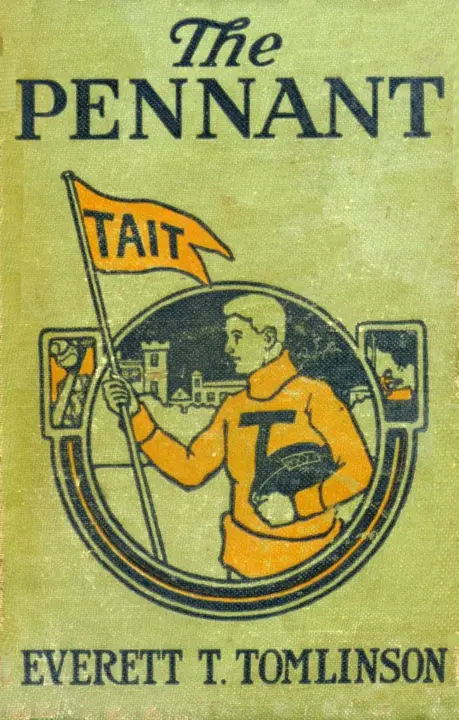
The pennant
Everett T. (Everett Titsworth) Tomlinson
THE CLASSIC COLLECTION · 1919
"The Story of General Pershing" by Everett T. Tomlinson is a historical account written in the early 20th century. The book chronicles the life and military career of General John Joseph Pershing, particularly focusing on his role as the commander of the American Expeditionary Forces during World War I. Tomlinson aims to shed light on Pershing’s early life and the factors that shaped him into a prominent military leader, providing an overview that serves to inspire and inform readers about this significant figure in American history. The opening of the work sets a momentous tone by describing the historic landing of General Pershing in France on June 13, 1917, marking the first time U.S. troops were sent to fight in Europe. It depicts the scene at the Boulogne docks, showcasing the anticipation and solemnity felt by military officials and soldiers as they awaited the arrival of the American general. The narrative highlights Pershing’s character—his modesty, strength, and reluctant rise through military ranks—while foreshadowing the extraordinary achievements that defined his leadership during the war. The author emphasizes Pershing’s role not only as a military leader but as a representation of the American spirit and dedication to freedom and justice.
Introduction adapted from the source catalogue; source summaries may be automatically generated.
Free to read · English · 48,434 words · No account needed
MAKE TIME FOR A GOOD BOOK
On by default. Untick to stop anonymous reading totals. Each page counts after 10 seconds in view. How this works.
Anonymous counting is on unless you have switched it off.
THE complete Military Record of General Pershing as it has been kept by the War Department of the United States is here presented. To the facts obtained from this Department are added a few later items, which the Acting Adjutant General kindly has provided.
Cadet Military Academy July 1, 1882 2nd Lt. 6th Cavalry July 1, 1886 1st Lt, 10th Cavalry Oct. 20, 1892 Captain, 1st Cavalry Feb. 2, 1901 Trs. to 15th Cavalry Aug. 20, 1901 Brigadier General Sept. 20, 1906 Accepted Sept. 20, 1906 Major General Sept. 25, 1916 General Oct. 6, 1917
Maj. Chief Ord. Officer Aug. 18, 1898 Honorably discharged May 12, 1899 Maj. A. A. G. June 6, 1899 Honorably discharged June 30, 1901
Served with regiment on the frontier from September, 1886 to 1891; Professor of Military Science and Tactics at University of Nebraska, September, 1891 to October, 1895; was Instructor of Tactics at the Military Academy at West Point, N. Y., June, 1897 to May, 1898; served throughout the Santiago Campaign in Cuba, June to August, 1898; on duty in War Department, August, 1898 to September, 1899, when he left for Philippine Islands; served in Philippine Islands until 1903; member General Staff Corps 1903 to 1906; and also Military Attache at Tokio, Japan; served again in Philippine Islands from 1906 to 1914; commanded Punitive Expedition in Mexico from March, 1916 to February, 1917; commanded Southern Department to May, 1917, and United States Forces in France since that date.
Sioux Indian Campaign, South Dakota, September, 1890 to January, 1891; action near mouth of Little Grass Creek, South Dakota, January 1, 1891; Las Quasimas, Cuba, June 24, 1898; San Juan, Cuba, July 1, 1898, and was recommended by his regimental commander for brevet commission for personal gallantry, untiring energy and faithfulness; and by the brevet board convened that year for the brevet of Captain for gallantry at Santiago de Cuba, July 1, 1898; in the field in Philippine Islands, November, 1900 to March, 1901, against General Capistrano, commander of insurrectionary forces; in command of an expedition against the hostile Moros of Maciu, starting from Camp Vicars, Mindanao, September 18, 1902; action at Gauan, September 18, and Bayabao, September 19, 1902; captured Fort Moro, September 29, 1902, driving the Moros from Maciu Peninsula on that date. He attacked the Moros at Maciu September 30, 1902, capturing their two forts, and returned to Camp Vicars, October 3, 1902; was in action at Bacolod, April 6 to 8, 1903; Calahui, April 9, 1903, and Taraca River, May 4, 1903. He commanded the first military force that ever encircled Lake Lanao; Punitive Expedition in Mexico, 1916 and 1917; and since June, 1917, commanding the Expeditionary Force in France.
An additional statement by the War Department:
Your reading position is saved on this browser. Take it to another device with a library code. Reading pages adapt to text, rather than matching a printed edition.
Everett T. (Everett Titsworth) Tomlinson
Everett T. (Everett Titsworth) Tomlinson

Everett T. (Everett Titsworth) Tomlinson
Everett T. (Everett Titsworth) Tomlinson
BEHIND THE BOOK
This eBook is for the use of anyone anywhere in the United States and most other parts of the world at no cost and with almost no restrictions whatsoever. You may copy it, give it away or re-use it under the terms of the Project Gutenberg License included with this eBook or online at www.gutenberg.org. If you are not located in the United States, you will have to check the laws of the country where you are located before using this eBook. Read the source licence.
The original source file, including credits and licence, is retained by this library. Request an original-format copy at no charge. Please include the book title and Project Gutenberg identifier #31914.
KEEP YOUR CURIOSITY GOING
Cécile Tormay

Moritz Busch
John L. Ransom
Frances Wright
Cécile Tormay

Mabel Potter Daggett