THE CLASSIC COLLECTION✦The story of Keedon BluffsCLASSIC FREE BOOKS
The story of Keedon Bluffs
Charles Egbert Craddock
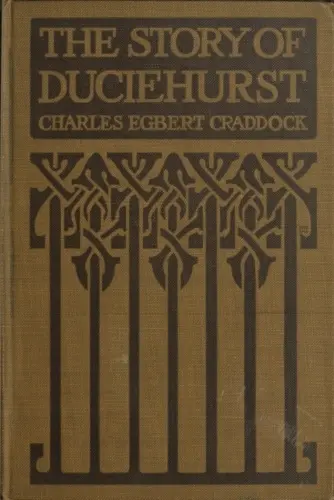
THE CLASSIC COLLECTION · 1914
"The Story of Duciehurst: A Tale of the Mississippi" by Charles Egbert Craddock is a historical novel written in the early 20th century. The narrative is set against the backdrop of the Mississippi River and revolves around the stranded steamboat "Cherokee Rose" and the lives of several passengers, particularly focusing on the complicated relationships and tensions among them. The central characters presented include the affluent but discontented Mr. Floyd-Rosney, his wife, and the Ducie brothers, with themes of wealth, social status, and hidden pasts beginning to unfold. At the start of the novel, the "Cherokee Rose" finds itself stuck on a sand-bar in the Mississippi River, creating an atmosphere of tension and uncertainty among the passengers. The scene introduces Mr. Floyd-Rosney, whose discontent with the situation reflects deeper issues within his marriage as his wife, Mrs. Floyd-Rosney, reveals hints of a complicated backstory involving the Ducies. The young man, Adrian Ducie, encounters an old acquaintance across the deck as the conversations bring in light unexpected connections and tensions, particularly when the subject of past relationships and fortunes comes to the forefront. As passengers engage in spirited discussions amid their predicament, the stage is set for unraveling not just the physical challenges posed by the river but also the emotional and social dynamics among the characters.
Introduction adapted from the source catalogue; source summaries may be automatically generated.
Free to read · English · 119,640 words · No account needed
MAKE TIME FOR A GOOD BOOK
On by default. Untick to stop anonymous reading totals. Each page counts after 10 seconds in view. How this works.
Anonymous counting is on unless you have switched it off.
The door closed slowly on the disaffected cook, who was evidently a devotee to art for art’s sake, for he presently reappeared in his capacity of table servant, as if he had been rebuked in an altogether different identity as cook. He drooped languidly between the door and the frame and once more in his high falsetto plaint he upbraided the Captain.
“The Cap’n nuver done me right. He oughter have let me pack that box, instead of the steward. There ain’t no fruit napkins, Mr. Floyd-Rosney. Jes’ white doilies,” he was not far from tears, “white doilies to serve with o’anges!”
The mere mention was an appetizer.
“Let me get at ’em, whether they are served with doilies or bath-towels!” cried the recumbent figure, recumbent no longer. “Call the ladies. Ho, for the festive board. If you don’t want scraps only, you had better not let me get there first. Notify the ladies. Does this vast mansion possess nothing that is like a dinner-bell, or a gong, or a whistle, that may make a cheerful sound of summons. Ha, ha, ha!”
“It compromises on something like the crackling of thorns under a pot,” said Floyd-Rosney, sourly. Then with gracious urbanity, “Major, let me give you my arm, perhaps our presence at the festive board may hasten matters.”
The ladies had already surged out into the great, bare, echoing hall, Hildegarde Dean, freshly arrayed in an Empire gown, as blue as her eyes, protesting that she was as hungry as a hunter. Ducie offered his arm ceremoniously to her mother, and Floyd-Rosney, who had intended his attention to the old blind Major as a bid for his wife’s notice and approval, was not pleased to see the procession, stately and suggestive, by reason of the lordly expansiveness of the place, headed by the heir of the old owners in the guise of host. It was an idea that never entered Ducie’s mind, not even when whetting the carving knife on the steel in anticipation of dispensing shares of the saddle of mutton from his end of the table. At this table, in truth, his grandfather had sat, and his great-grandfather also, and dispensed its bounty. So heavy it was, so burdensome for removal, that in the various disasters that had ravaged the old house, war and financial ruin, marauders and tramps, wind and rain, lightning and overflow, it had endured throughout. Mahogany was not earlier the rage as now, and the enthusiasm of the up-to-date man could scarcely be restrained. There were no chairs; planks from the flooring elsewhere had been hastily stretched benchwise on the boxes that had held the provisions and bedding, but even this grotesque make-shift did not detract from his keen discernment of the admirable in the entourage. The size and shape of the room, the old-fashioned bow-window, the ornate mantel-piece, the cabinets built into the walls for the silver and choice show of old china, now without even a shelf or a diamond-shaped pane of glass, the design of the paper, the stucco ornaments about the chandelier, or rather the rod which had once supported it, for the pendants had been dismembered in wanton spoliation and now lay in fragments on the lawn without, the pantry, the china-closet, the storeroom contiguous all came in for his commendation, and much he bewailed the grinning laths looking down from the gaps in the fallen plaster, the smoke-grimed walls, the destroyed hearth, half torn out from the chimney-place. The stream of his talk was only stemmed by the reappearance of the cook, now with his white jacket and apron in the rôle of waiter. Every eye was turned apprehensively toward him lest he was moved to say that the Cap’n had ordered no dinner to be put into the box. He dolorously drooped over Ducie’s shoulder in the place of host, and at once disclosed the melancholy worst. “Dere ain’t no soup, sir. While I was speakin’ to you gemmen in de--de--in de library, sir, de soup scorched. I had set dat ole superannuated mule of de Major’s ter watch de pot an’ he didn’t know enough to set it off de fire when it took to smokin’. Hit was ’p’tage Bec’mul, sir.”
Your reading position is saved on this browser. Take it to another device with a library code. Reading pages adapt to text, rather than matching a printed edition.
Charles Egbert Craddock
Charles Egbert Craddock
Charles Egbert Craddock
Charles Egbert Craddock
BEHIND THE BOOK
This eBook is for the use of anyone anywhere in the United States and most other parts of the world at no cost and with almost no restrictions whatsoever. You may copy it, give it away or re-use it under the terms of the Project Gutenberg License included with this eBook or online at www.gutenberg.org. If you are not located in the United States, you will have to check the laws of the country where you are located before using this eBook. Read the source licence.
The original source file, including credits and licence, is retained by this library. Request an original-format copy at no charge. Please include the book title and Project Gutenberg identifier #56046.
KEEP YOUR CURIOSITY GOING
Cécile Tormay

Moritz Busch
Coulson Kernahan
John L. Ransom

Maurice Baring
Frances Wright