THE CLASSIC COLLECTION✦The story of Keedon BluffsCLASSIC FREE BOOKS
The story of Keedon Bluffs
Charles Egbert Craddock
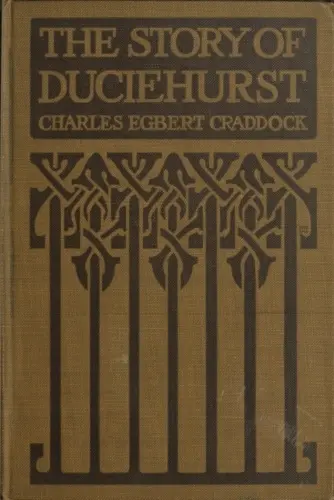
THE CLASSIC COLLECTION · 1914
"The Story of Duciehurst: A Tale of the Mississippi" by Charles Egbert Craddock is a historical novel written in the early 20th century. The narrative is set against the backdrop of the Mississippi River and revolves around the stranded steamboat "Cherokee Rose" and the lives of several passengers, particularly focusing on the complicated relationships and tensions among them. The central characters presented include the affluent but discontented Mr. Floyd-Rosney, his wife, and the Ducie brothers, with themes of wealth, social status, and hidden pasts beginning to unfold. At the start of the novel, the "Cherokee Rose" finds itself stuck on a sand-bar in the Mississippi River, creating an atmosphere of tension and uncertainty among the passengers. The scene introduces Mr. Floyd-Rosney, whose discontent with the situation reflects deeper issues within his marriage as his wife, Mrs. Floyd-Rosney, reveals hints of a complicated backstory involving the Ducies. The young man, Adrian Ducie, encounters an old acquaintance across the deck as the conversations bring in light unexpected connections and tensions, particularly when the subject of past relationships and fortunes comes to the forefront. As passengers engage in spirited discussions amid their predicament, the stage is set for unraveling not just the physical challenges posed by the river but also the emotional and social dynamics among the characters.
Introduction adapted from the source catalogue; source summaries may be automatically generated.
Free to read · English · 119,640 words · No account needed
MAKE TIME FOR A GOOD BOOK
On by default. Untick to stop anonymous reading totals. Each page counts after 10 seconds in view. How this works.
Anonymous counting is on unless you have switched it off.
Captain Treherne seemed all unconscious of the pallid countenance, the failing breath, the halting step of the old man. For, indeed, Colonel Kenwynton was fain to catch at his companion’s arm for support as he listened, panting.
“Come, Colonel, you will come with me. I need your advice. You can wield a paddle, and together we can make the distance.”
Only the obviously impossible checked the old soldier.
“Wield a paddle against this current, my dear sir? Make the distance! You forget my age--seventy-five, sir; seventy-five years.”
“It is not life and death, Colonel. We have faced that together, you and I, and laughed at both. Dishonest possession is involved now, and legalized robbery, and hidden assets. And I have the secret of the cache, Colonel, I, alone. It must be revealed. I need your help. This is the crucial crisis of my life. My life--!” He broke off with an accent of scorn--“of lives worth infinitely more than mine. And, Colonel Kenwynton,” he laid a sudden, lean hand on the old man’s arm, “the helpless! For they know nothing of their rights. It must be revealed to one who will annul this wrong, this heinous disaster.”
He had drawn very close, and his grasp on the Colonel’s arm, that had once been so firm-fleshed and sinewy, seemed to crush the collapsed muscles into the very bone. The old man winced with the pain, but stood firm.
“I’m with you, heart and soul, always. Command me. But, my dear boy, this is impracticable. Let’s get a roustabout to row.”
The intensifying grip might really have broken the old man’s bone.
“Not for your life--never a whisper to any other living creature! Only you can do this. I--I--I should not be believed.”
“Not believed! You!” cried Colonel Kenwynton in a tone of such indignant, vicarious, insulted pride, that what self-control the other man possessed broke down; he flung his arms about the old man’s quivering frame, bowed his head on the Colonel’s shoulder and sobbed aloud.
“Not even you would believe me--if you knew--if you knew what I have
been--what I am.”
“Exactly what I do know,” said the Colonel, sturdily. “You are overcome by your emotions, dear old fellow. You are overwrought. We will put an end to this, sir. Come, halloo the boat. I can’t halloo, Cap--think of that for me!--damn this cough! Halloo the boat, and tell the mate to send us a roustabout to paddle. Or, hadn’t we better take the yawl? That dug-out looks tricky--and, by God, man, it’s leaky.” He had advanced to the brink where the craft lay.
Your reading position is saved on this browser. Take it to another device with a library code. Reading pages adapt to text, rather than matching a printed edition.
Charles Egbert Craddock
Charles Egbert Craddock
Charles Egbert Craddock
Charles Egbert Craddock
BEHIND THE BOOK
This eBook is for the use of anyone anywhere in the United States and most other parts of the world at no cost and with almost no restrictions whatsoever. You may copy it, give it away or re-use it under the terms of the Project Gutenberg License included with this eBook or online at www.gutenberg.org. If you are not located in the United States, you will have to check the laws of the country where you are located before using this eBook. Read the source licence.
The original source file, including credits and licence, is retained by this library. Request an original-format copy at no charge. Please include the book title and Project Gutenberg identifier #56046.
KEEP YOUR CURIOSITY GOING
Cécile Tormay

Moritz Busch
Coulson Kernahan
John L. Ransom

Maurice Baring
Frances Wright