THE CLASSIC COLLECTION✦The story of Keedon BluffsCLASSIC FREE BOOKS
The story of Keedon Bluffs
Charles Egbert Craddock
THE CLASSIC COLLECTION · 1914
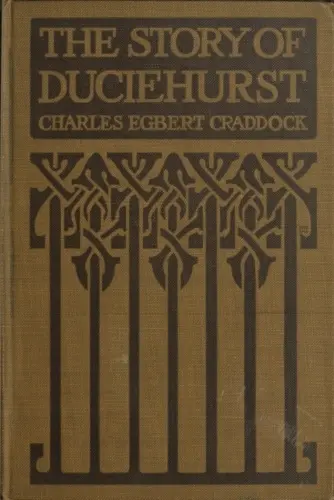
"The Story of Duciehurst: A Tale of the Mississippi" by Charles Egbert Craddock is a historical novel written in the early 20th century. The narrative is set against the backdrop of the Mississippi River and revolves around the stranded steamboat "Cherokee Rose" and the lives of several passengers, particularly focusing on the complicated relationships and tensions among them. The central characters presented include the affluent but discontented Mr. Floyd-Rosney, his wife, and the Ducie brothers, with themes of wealth, social status, and hidden pasts beginning to unfold. At the start of the novel, the "Cherokee Rose" finds itself stuck on a sand-bar in the Mississippi River, creating an atmosphere of tension and uncertainty among the passengers. The scene introduces Mr. Floyd-Rosney, whose discontent with the situation reflects deeper issues within his marriage as his wife, Mrs. Floyd-Rosney, reveals hints of a complicated backstory involving the Ducies. The young man, Adrian Ducie, encounters an old acquaintance across the deck as the conversations bring in light unexpected connections and tensions, particularly when the subject of past relationships and fortunes comes to the forefront. As passengers engage in spirited discussions amid their predicament, the stage is set for unraveling not just the physical challenges posed by the river but also the emotional and social dynamics among the characters.
Introduction adapted from the source catalogue; source summaries may be automatically generated.
Free to read · English · 119,640 words · No account needed
MAKE TIME FOR A GOOD BOOK
On by default. Untick to stop anonymous reading totals. Each page counts after 10 seconds in view. How this works.
Anonymous counting is on unless you have switched it off.
“But you are a good-looker, ennyways, Mrs. Berridge,” said the jockey, and he paid her the tribute of another facetious wink.
“But the woman would carry her di’monds in her trunk or hand-bag,” suggested the shanty-boater.
“Horace Dean ain’t aboard, eh? Let us have the men’s names,” said the smith. He was turning the matter over exactly as if he had it in some raw material on the anvil before him, striking it here and there, testing its malleability, shaping it to utility.
“Oh, well, there’s one of the Ducies, the fellow that has been abroad so long--registers from Lyons, France. Adrian Ducie.”
The younger Berridge turned half around from the table, chewing hard to clear his mouth before he spoke impressively: “One of the Ducies? Now you are coming to the Sure-enoughs! They used to own Duciehurst. They did for a fack. Finest place in Mississippi; in the world, I reckon.”
“But, used to be ain’t now, by a long shot,” said Jorrocks, the shanty-boater, sustaining the intention of the investigation. “No Ducie nowadays would be worth a hold-up.”
“This is a young man?” Binnhart queried.
“Rising thirty, I reckon,” replied the jockey.
“You dunno--you ain’t seen his teeth,” said Mrs. Berridge. “That’s the way you jockeys jedge of age.” She could be facetious, too.
“Then there’s old Colonel Kenwynton?” said Connover.
“He has got a deal of fight left in him yet,” observed Binnhart, reflectively. “He would put up a nervy tussle.”
“Yes, sir,” corroborated the shanty-boater, with emphasis. “The devil himself will have a tough job when he undertakes to tow old Jack Kenwynton in.”
“There are several other men, names I don’t know--dark horses,” said the jockey seriously, seeing at last the trend of the discussion.
Binnhart was slowly, thoughtfully, shaking his head. “A good many men, I misdoubts. Then there are the captain and the clerks and the mate, but they would all be took by surprise, an’ mos’ likely without arms.”
“An’ then there’s another man, besides,” suggested the elder Berridge. A certain wrinkled anxiety had corrugated the bedraggled limpness of his countenance and he was obviously relieved by the effect of the computation of the odds.
“Oh, yes,” cried Mrs. Berridge, “that comical galoot what bided here las’ night, an’ this evenin’ hired our dugout an’ paddled out to the steamboat. He ain’t back yit.” She paused at the door and peered into the gathering gloom.
“Jessy Jane,” cried her husband with an accession of interest, “tell ’em all what you heard him say las’ night. Every other word was ‘Duciehurst.’”
Your reading position is saved on this browser. Take it to another device with a library code. Reading pages adapt to text, rather than matching a printed edition.
Charles Egbert Craddock
Charles Egbert Craddock
Charles Egbert Craddock
Charles Egbert Craddock
BEHIND THE BOOK
This eBook is for the use of anyone anywhere in the United States and most other parts of the world at no cost and with almost no restrictions whatsoever. You may copy it, give it away or re-use it under the terms of the Project Gutenberg License included with this eBook or online at www.gutenberg.org. If you are not located in the United States, you will have to check the laws of the country where you are located before using this eBook. Read the source licence.
The original source file, including credits and licence, is retained by this library. Request an original-format copy at no charge. Please include the book title and Project Gutenberg identifier #56046.
KEEP YOUR CURIOSITY GOING
Cécile Tormay

Moritz Busch
Coulson Kernahan
John L. Ransom

Maurice Baring
Frances Wright