THE CLASSIC COLLECTION✦The story of Keedon BluffsCLASSIC FREE BOOKS
The story of Keedon Bluffs
Charles Egbert Craddock
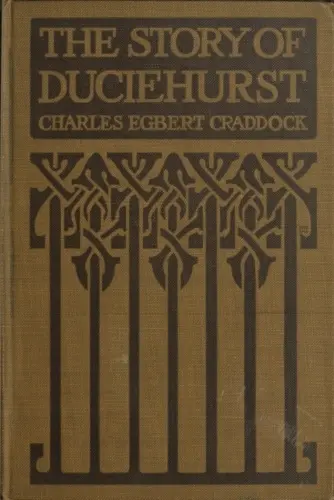
THE CLASSIC COLLECTION · 1914
"The Story of Duciehurst: A Tale of the Mississippi" by Charles Egbert Craddock is a historical novel written in the early 20th century. The narrative is set against the backdrop of the Mississippi River and revolves around the stranded steamboat "Cherokee Rose" and the lives of several passengers, particularly focusing on the complicated relationships and tensions among them. The central characters presented include the affluent but discontented Mr. Floyd-Rosney, his wife, and the Ducie brothers, with themes of wealth, social status, and hidden pasts beginning to unfold. At the start of the novel, the "Cherokee Rose" finds itself stuck on a sand-bar in the Mississippi River, creating an atmosphere of tension and uncertainty among the passengers. The scene introduces Mr. Floyd-Rosney, whose discontent with the situation reflects deeper issues within his marriage as his wife, Mrs. Floyd-Rosney, reveals hints of a complicated backstory involving the Ducies. The young man, Adrian Ducie, encounters an old acquaintance across the deck as the conversations bring in light unexpected connections and tensions, particularly when the subject of past relationships and fortunes comes to the forefront. As passengers engage in spirited discussions amid their predicament, the stage is set for unraveling not just the physical challenges posed by the river but also the emotional and social dynamics among the characters.
Introduction adapted from the source catalogue; source summaries may be automatically generated.
Free to read · English · 119,640 words · No account needed
MAKE TIME FOR A GOOD BOOK
On by default. Untick to stop anonymous reading totals. Each page counts after 10 seconds in view. How this works.
Anonymous counting is on unless you have switched it off.
There being only four places, the gentlemen occupying the front seats, Mrs. Floyd-Rosney, the nurse and the baby the others, there was no room for the groom, and Ducie, gathering up the reins preparatory to driving, directed him to return to the livery stable on one of the cotton wagons which would be starting in an hour or so. The ill-looking fellow touched his cap, loosed the bit and the horse sprang away with an action so fine, so well sustained, that Floyd-Rosney’s brow cleared. The pleasure of the moment was something.
“What will you take for him?” he asked, quite human for the nonce.
“Not for sale. Couldn’t spare him,” Ducie responded, the reins wound about his forearms, all his strength requisite to hold the abounding vitality and eagerness of the animal to the trot, the hoofs falling with the precision of machinery, mile after mile.
Only once did the pace falter. Suddenly the animal plunged. A man dashed out from the Cherokee rose hedge that bordered the high-way and clutched the bit. With the momentum of his pace the horse swung him off his feet, and frightened and swerving from the road, reared high. As the forefeet crashed to the ground once more with a sharp impact the man was thrown sprawling to the roadside, and the horse was a mile away before the occupants of the vehicle knew exactly what had happened.
“Oh,--oh----” cried Paula, “was the man hurt? What did he want?”
“No good,” said her husband grimly.
“Oh, oughtn’t we go back and see what we have done?” She could scarcely speak with the wind of their transit blowing the words down her throat. “Oh, I know Mr. Floyd-Rosney won’t, but, Randal, don’t you think we ought?”
“Hardly,” said Randal.
Floyd-Rosney’s head slowly turned, and his slumberous eyes, with a bated fury smoldering in their depths, looked their sneering triumph at his wife.
“That crack,--was it----?” he asked of Randal.
“A pistol ball, I think. I saw--I thought I saw a puff of smoke from the Cherokee hedge. My head feels hot yet. For simple curiosity look at my hat.”
Floyd-Rosney removed the hat from the head of the man by him. He turned it in his hand and his eyes glittered. Then he held it out for Ducie’s observation.
There was a small orifice on one side, and a corresponding rift, higher, on the other. Evidently, the ball had passed through.
“Thirty caliber, I should judge,” Floyd-Rosney ventured.
“Looks so?” Randal assented.
“But why--why----” exclaimed Paula, “should Randal be shot at--he might have been killed--oh, any of us might have been killed!”
Your reading position is saved on this browser. Take it to another device with a library code. Reading pages adapt to text, rather than matching a printed edition.
Charles Egbert Craddock
Charles Egbert Craddock
Charles Egbert Craddock
Charles Egbert Craddock
BEHIND THE BOOK
This eBook is for the use of anyone anywhere in the United States and most other parts of the world at no cost and with almost no restrictions whatsoever. You may copy it, give it away or re-use it under the terms of the Project Gutenberg License included with this eBook or online at www.gutenberg.org. If you are not located in the United States, you will have to check the laws of the country where you are located before using this eBook. Read the source licence.
The original source file, including credits and licence, is retained by this library. Request an original-format copy at no charge. Please include the book title and Project Gutenberg identifier #56046.
KEEP YOUR CURIOSITY GOING
Cécile Tormay

Moritz Busch
Coulson Kernahan
John L. Ransom

Maurice Baring
Frances Wright