THE CLASSIC COLLECTION✦The story of Keedon BluffsCLASSIC FREE BOOKS
The story of Keedon Bluffs
Charles Egbert Craddock
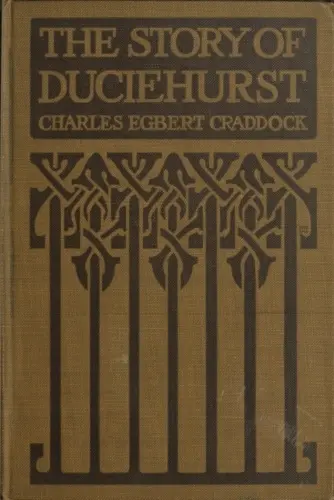
THE CLASSIC COLLECTION · 1914
"The Story of Duciehurst: A Tale of the Mississippi" by Charles Egbert Craddock is a historical novel written in the early 20th century. The narrative is set against the backdrop of the Mississippi River and revolves around the stranded steamboat "Cherokee Rose" and the lives of several passengers, particularly focusing on the complicated relationships and tensions among them. The central characters presented include the affluent but discontented Mr. Floyd-Rosney, his wife, and the Ducie brothers, with themes of wealth, social status, and hidden pasts beginning to unfold. At the start of the novel, the "Cherokee Rose" finds itself stuck on a sand-bar in the Mississippi River, creating an atmosphere of tension and uncertainty among the passengers. The scene introduces Mr. Floyd-Rosney, whose discontent with the situation reflects deeper issues within his marriage as his wife, Mrs. Floyd-Rosney, reveals hints of a complicated backstory involving the Ducies. The young man, Adrian Ducie, encounters an old acquaintance across the deck as the conversations bring in light unexpected connections and tensions, particularly when the subject of past relationships and fortunes comes to the forefront. As passengers engage in spirited discussions amid their predicament, the stage is set for unraveling not just the physical challenges posed by the river but also the emotional and social dynamics among the characters.
Introduction adapted from the source catalogue; source summaries may be automatically generated.
Free to read · English · 119,640 words · No account needed
MAKE TIME FOR A GOOD BOOK
On by default. Untick to stop anonymous reading totals. Each page counts after 10 seconds in view. How this works.
Anonymous counting is on unless you have switched it off.
The solitude was intense, the silence an awesome stillness, her thoughts, recurring to her own sorry fate, were strenuous and troublous, and thus even her strong, elastic young physique was beginning to feel very definitely the stress of fatigue, and excitement, and fear, that had filled the day as well as the effects of the emotional crisis which she had endured. She found that she could scarcely stand; indeed, she tottered with a sense of feebleness, of faintness, as she looked about for some support, something on which she might lean, or better still, something that might serve as a seat. Suddenly she started forward toward the window near the outer corner of the room. The low sill was broad and massive in conformity with the general design of the house, and she sank down here in comfort, resting her head against the heavy moulding of the frame. Her eyes turned without, and she noted with a certain interest the great foliated ornaments, the carved acanthus leaves of the capitals of the Corinthian columns, one of which was so close at hand that she might almost have touched it, for the roof of the portico here, which had been nearly on a level with the window, was now in great part torn away, giving a full view of the stone floor below. This column was the pilaster, half the bulk of the others, being buttressed against the wall. The size of the columns was far greater than she had supposed, looking at them from below, the capitals were finished with a fine attention to detail. The portico was indeed an admirable example of this sort of adapted architecture which is usually distinguished rather by its license than its success. But she had scant heart to mark its values or effect. Her reflections were introspective. She looked out drearily on the wan wastes of the skies, and the somber night closing in, and bethought herself of the woeful change in the atmosphere of her soul since the skies last darkened. She said to herself that illusions were made for women, who were not fitted to cope with facts, and that it was better to be a loving fool, gulled into the fancy that she, too, is beloved, than to see clearly, and judge justly, and harbor an empty aching heart. For there was no recourse for her. It was not in her power to frame her future. Her husband had, and he knew he had, the most complete impunity, and doubtless this gave him an assurance in domineering that he would not otherwise have dared to exert. He was cognizant of her delicate pride, the odium in which she would hold the idea of publicity in conjugal dissension. She would never have permitted, save under some extreme stress like that of the single instance of the morning, others to look in upon a difference between them, yet there had been from the first much to bear from his self-absorbed and imperious temper, and she had borne it to the extent of self-immolation, of self-extinction. In fact, she was not, she had not been for years, herself. She could not say, indeed, when her old identity had asserted itself before to-day. It was the aspect of the Ducie face, the associations of the past that had recalled her real self to life, that had relumed the spark of pride which had once been her dominant trait, that had given her courage to revolt at rebuke in Adrian’s presence, to hold up her head, to speak from her own individuality, to be an influence to be reckoned with. But of what avail? Life must go on as heretofore, the old semblance of submission, of adulation, the adjustment of every word, every idea, every desire, to the mould of her husband’s thought, his preference. She wondered how she would be enabled to maintain the farce of her love, that had hitherto seemed capable of infinite endurance, of limitless pardoning power, and the coercive admiration for him that she had felt throughout all these five years. He was aware, and this fact was so certain that she was sure he had never given the matter even a casual, careless thought, that for the sake of their son, his precious presence, his comfort and care, his future standing before the world, no recourse was possible for her, no separation, no divorce. Floyd-Rosney might beat her with a stick if he would, instead of that deft, crafty little blow he had dealt on her wrist with his knuckles, and she would hide the wales for her child’s sweet sake. No law was ever framed comprehensive enough to shield her. She was beyond the pale and the protection of the law. And as she realized this she held down her head and began to shed some miserable tears.
Your reading position is saved on this browser. Take it to another device with a library code. Reading pages adapt to text, rather than matching a printed edition.
Charles Egbert Craddock
Charles Egbert Craddock
Charles Egbert Craddock
Charles Egbert Craddock
BEHIND THE BOOK
This eBook is for the use of anyone anywhere in the United States and most other parts of the world at no cost and with almost no restrictions whatsoever. You may copy it, give it away or re-use it under the terms of the Project Gutenberg License included with this eBook or online at www.gutenberg.org. If you are not located in the United States, you will have to check the laws of the country where you are located before using this eBook. Read the source licence.
The original source file, including credits and licence, is retained by this library. Request an original-format copy at no charge. Please include the book title and Project Gutenberg identifier #56046.
KEEP YOUR CURIOSITY GOING
Cécile Tormay

Moritz Busch
Coulson Kernahan
John L. Ransom

Maurice Baring
Frances Wright