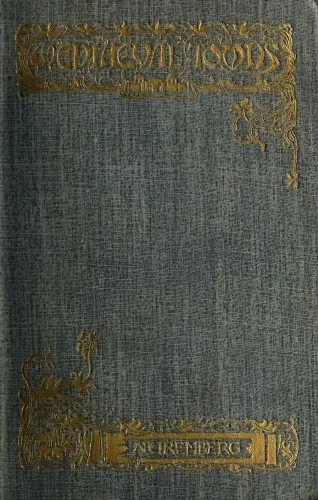
The Story of Nuremberg
Cecil Headlam
THE CLASSIC COLLECTION · 1902
"The Story of Chartres" by Cecil Headlam is a historical account written in the early 20th century. The book delves into the rich and intricate history of Chartres, particularly focusing on its renowned Cathedral, its religious significance, and the evolution of the city from ancient Druidic times through Roman rule and into the Middle Ages. At the start of the narrative, the author vividly describes the geographical setting of Chartres, nestled in the Beauce region, and highlights its significance as a spiritual center since antiquity. The opening chapter introduces the religious traditions associated with Chartres, tracing the lineage of worship from Druidic practices to early Christian establishments. Headlam draws connections between historical events and local legends, illustrating how the city's past has shaped its identity, particularly its veneration for the Virgin Mary, as seen through the veneration of the crypt under the Cathedral, which housed early Christian martyrs. This foundation sets the stage for an exploration of the various transformations and challenges the city faced throughout its storied history.
Introduction adapted from the source catalogue; source summaries may be automatically generated.
Free to read · English · 98,663 words · No account needed
MAKE TIME FOR A GOOD BOOK
On by default. Untick to stop anonymous reading totals. Each page counts after 10 seconds in view. How this works.
Anonymous counting is on unless you have switched it off.
‘Even the cheeks of the saint were sprinkled with the precious liquid, and he, having wiped off some drops thereof with costly linen, left them to the Church of Chartres as relics, and as a token of the miracle which had been wrought in his favour.’ ‘Qui se veoid encores parmi les reliques,’ adds Souchet.
But Fulbert’s reputation does not rest on these passive acts of sanctity. An event was to happen shortly which brought out all the energy that lay beneath his mild excellence and his scholarly instructions.
‘It was on the 7th September 1020,’ says Souchet, ‘that the burning of the Church of Chartres happened, on the eve of the nativity of Our Lady. It is not known how or by whose agency this disaster occurred; but there was nothing in this holy temple that the fire did not consume.’ Rouillard (1608) piously supposes that lightning was sent from heaven to destroy the church, as a punishment for the sins of the pilgrims, some of whom, among the crowds of both sexes who kept vigil there, may by some act of impurity have defiled the sanctity of the place.
However it may have been, the church was once more destroyed, and, as was happening all over Italy and France at this period, it was destroyed only to rise from its ashes more beautiful than ever. So Angers, Poitiers, Beauvais, Cambrai, Rouen were rebuilt almost as soon as burnt, in the enthusiastic rivalry of the Christian builders of the day. ‘Humanity,’ in the fine phrase of Raoul Glaber, ‘rose from its long agony and set itself to build, and to shake off the rags of its old age in order to put on the white robe of the churches.’
The great bishop with whose name the new Cathedral at Chartres was to be indissolubly connected, the Fulbert of Fulbert’s Cathedral, had been the favourite pupil of Gerbert of Reims and had practised medicine in the Monastery of S. Père, where that art was long held in high honour. But Fulbert was more than a mere doctor. He was a poet, a mathematician, a theologian, grammarian and skilful musician as well. When, therefore, he became the head of the School of Chartres (from which a few years later John, called the Deaf, was to issue, doctor of Henry I. and chief of the sect of Nominalists, whose pupil was Rosselin, whose pupil Abeilard) scholars flocked from England, Germany, Denmark and all parts of France to listen to the teachings of the French Socrates, and to receive from his eloquent lips the precepts of wisdom and the counsel of friendship. For his knowledge was immense and his learning encyclopædic, ranging from the minutest details of the exact sciences to the most daring speculations of metaphysics. Fulbert, we are told, like a modern Plato, would often withdraw to a garden near the bishop’s palace, watered by the clear stream (it was clear in those days), and there, surrounded by his chosen pupils, expound with mingled sweetness and force the tenets of philosophy and the doctrines of faith. ‘The teacher of philosophers, the marvel of his age, the sun whose rays gave life,’ his pupil Adelmann called him. And among the philosophers he taught, and the rare flowers of intellect which in this age of brute force expanded beneath the quickening rays of his mind, Adelmann enumerates Lanfranc, the Archbishop of Canterbury, Walter of Burgundy, Lambert and Engelbert of Paris and Orléans, Hildier, wise as Socrates and learned as Pythagoras, and Sigo, the musician of the delicate ear. Fulbert’s letters,[37] which place him among the most interesting historians of this obscure period, reveal him as a theologian firm and decided, as a statesman eager to enforce order and to secure the administration of justice, as a man broad-minded, charming, enthusiastic, humane.
Your reading position is saved on this browser. Take it to another device with a library code. Reading pages adapt to text, rather than matching a printed edition.
Cecil Headlam
BEHIND THE BOOK
This eBook is for the use of anyone anywhere in the United States and most other parts of the world at no cost and with almost no restrictions whatsoever. You may copy it, give it away or re-use it under the terms of the Project Gutenberg License included with this eBook or online at www.gutenberg.org. If you are not located in the United States, you will have to check the laws of the country where you are located before using this eBook. Read the source licence.
The original source file, including credits and licence, is retained by this library. Request an original-format copy at no charge. Please include the book title and Project Gutenberg identifier #46662.
KEEP YOUR CURIOSITY GOING
Cécile Tormay

Moritz Busch
John L. Ransom
Frances Wright
Cécile Tormay

Mabel Potter Daggett