
Dreams and delights
L. Adams (Lily Adams) Beck
THE CLASSIC COLLECTION · 1926
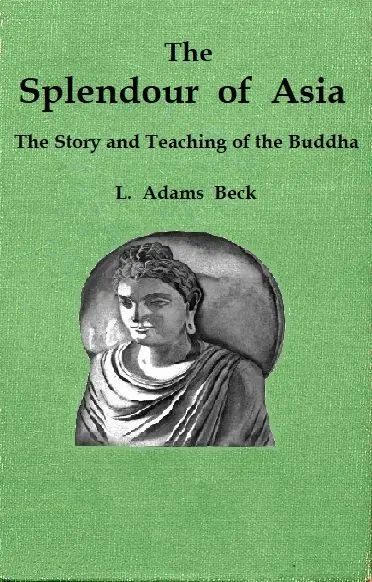
"The Splendour of Asia: The Story and Teaching of the Buddha" by L. Adams Beck is a historical account written in the early 20th century. The work explores the life and teachings of Siddhartha Gautama, also known as the Buddha, attempting to render these profound ideas more accessible to a modern audience. Through a blend of narrative and philosophical insight, the book delves into the circumstances surrounding the Buddha's birth and the early years of his life, emphasizing the significance of his teachings for overcoming human suffering and understanding one's destiny. The opening of the narrative introduces us to the ancient city of Kapila, where Siddhartha is born to the princely family. It paints a vivid backdrop of a peaceful, fertile land, rich in culture and ideals. As Siddhartha grows, his parents, particularly his father Maharaja Suddhodana, are depicted as dedicated to providing their son with a life of luxury, seeking to shield him from the harsh realities of old age, illness, and death. However, the narrative foreshadows Siddhartha's eventual confrontation with these truths, setting the stage for his transformation into a seeker of wisdom and enlightenment. Amidst the idyllic life of the palace, hints of a deeper quest emerge, marking the tension between worldly pleasures and spiritual fulfillment that Siddhartha will ultimately face.
Introduction adapted from the source catalogue; source summaries may be automatically generated.
Free to read · English · 72,638 words · No account needed
MAKE TIME FOR A GOOD BOOK
On by default. Untick to stop anonymous reading totals. Each page counts after 10 seconds in view. How this works.
Anonymous counting is on unless you have switched it off.
SO continued our Lord, wandering from place to place, or resting in the season of the rains in the monasteries provided by the supporters of the Brotherhood, and, followed by his own, he taught the Breaking of the Fetters—and the fetters he broke are these:
The delusion of self—namely that the individual ego is real and self-existent. For what can exist outside the Universal Self? And egoism is the very root of death.
Doubt. For who can advance boldly, doubting the way and where he shall
set the next step?
Belief in good works and ceremonies. For what good work can open a man’s eyes if his motive is mean, and what value have rites and ceremonies in themselves?
Fleshly lust. By no means did the Lord command a cruel asceticism, for this he had tried to the uttermost and having laid it aside, passed on. No, but a joyous temperance, the child of wisdom and duty, the fosterer of endeavour. And duty in all things, a strength by some to be attained now, by others with patience in later lives.
Ill-will. For this is a cruel fetter, biting to the very bone of the wretch who carries it, and it is forged indeed from the black iron of egoism and belief in the separate ego.
And this being all accomplished the last fetters to be broken are:
The desire for separate and individual life in the world of forms we see
about us.
The desire for separate life in the formless world to which we shall
attain.
Pride—the very snarer of Divine Beings.
Self-righteousness, the womb-sister of pride.
And last, the most terrible of fetters—
Ignorance—mother of a deadly brood.
And where he went these fetters fell before him, and prison doors were opened and they who had sat in darkness walked in light. And they aspired to perfection for he taught that Perfection was their heritage, if not now, then in some future life where the sown seeds of good expanding should throw out strong arms and glorious blossom.
And they believed, and some set tottering steps in the path, and some advanced with wings rather than feet, but all were seekers and finders.
But he compelled none, nor threatened, for by a man’s true self comes his salvation, and seated among his own he said:
“The Tathagata—He who has thus Attained, does not think that it is he who must lead the Brotherhood or that the Order is dependent upon him.”
Only, steadfastly pointing the way, he rejoiced that men should follow it, casting forth his light like the sun, not compelling men to guide their steps by it.
Your reading position is saved on this browser. Take it to another device with a library code. Reading pages adapt to text, rather than matching a printed edition.
L. Adams (Lily Adams) Beck
L. Adams (Lily Adams) Beck

L. Adams (Lily Adams) Beck
BEHIND THE BOOK
This eBook is for the use of anyone anywhere in the United States and most other parts of the world at no cost and with almost no restrictions whatsoever. You may copy it, give it away or re-use it under the terms of the Project Gutenberg License included with this eBook or online at www.gutenberg.org. If you are not located in the United States, you will have to check the laws of the country where you are located before using this eBook. Read the source licence.
The original source file, including credits and licence, is retained by this library. Request an original-format copy at no charge. Please include the book title and Project Gutenberg identifier #69787.
KEEP YOUR CURIOSITY GOING

David Patterson (Spirit) Hatch

David Patterson (Spirit) Hatch

David Patterson (Spirit) Hatch
Cécile Tormay

Moritz Busch
John L. Ransom