
Dreams and delights
L. Adams (Lily Adams) Beck
THE CLASSIC COLLECTION · 1926
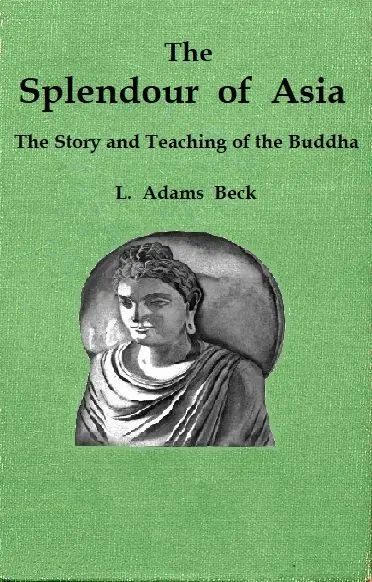
"The Splendour of Asia: The Story and Teaching of the Buddha" by L. Adams Beck is a historical account written in the early 20th century. The work explores the life and teachings of Siddhartha Gautama, also known as the Buddha, attempting to render these profound ideas more accessible to a modern audience. Through a blend of narrative and philosophical insight, the book delves into the circumstances surrounding the Buddha's birth and the early years of his life, emphasizing the significance of his teachings for overcoming human suffering and understanding one's destiny. The opening of the narrative introduces us to the ancient city of Kapila, where Siddhartha is born to the princely family. It paints a vivid backdrop of a peaceful, fertile land, rich in culture and ideals. As Siddhartha grows, his parents, particularly his father Maharaja Suddhodana, are depicted as dedicated to providing their son with a life of luxury, seeking to shield him from the harsh realities of old age, illness, and death. However, the narrative foreshadows Siddhartha's eventual confrontation with these truths, setting the stage for his transformation into a seeker of wisdom and enlightenment. Amidst the idyllic life of the palace, hints of a deeper quest emerge, marking the tension between worldly pleasures and spiritual fulfillment that Siddhartha will ultimately face.
Introduction adapted from the source catalogue; source summaries may be automatically generated.
Free to read · English · 72,638 words · No account needed
MAKE TIME FOR A GOOD BOOK
On by default. Untick to stop anonymous reading totals. Each page counts after 10 seconds in view. How this works.
Anonymous counting is on unless you have switched it off.
Hear also the story of the very wise and glad and gay Lady Visakha—that pillar of the Order, who abiding in the world as a great lady of riches yet gave her heart to wisdom and the Law of the Perfect One, for open is the way to all.
She was daughter to a great man, Balamitra, and was a young maiden in her father’s house, when a Brahman commissioned by the Treasurer Migara to choose a wife for his son came that way, and when he arrived he saw Visakha and other girls going into the wood in search of amusement, and he watched them idly.
Now the other girls were frivolous, running, skipping, whirling about and singing, but Visakha walked quietly with them, observing all and saying little. And when they came to the tank the others carelessly stripped themselves and began to play in the clear water. But Visakha lifted her clothes by degrees as she entered and by degrees lowered them as she came out, careful and modest in her conduct. And, after this, food was distributed, and the other girls ate hurriedly and greedily and then gave the remnants to their attendants. But Visakha gave food first to those who served her, and then ate temperately herself.
And the Brahman, still watching, saw that as the girls returned there was water across the path and the others took off their shoes and waded, but Visakha remained shod, and when they came to a wood she kept her sunshade up though the others had lowered theirs.
And there the Brahman came up with her, in much astonishment and questioned her, and seeing him to be a holy and dignified person she replied with respectful courtesy. And thus he said:
“Dear girl, whose daughter are you?”
“Sir, I am the daughter of Balamitra.”
“Dear girl, be not angry if I question you.”
“While those girls were skipping, dancing and twirling, with other unseemly manners, you walked quietly; why, dear girl?”
“Because, great sir, all girls are their parents’ merchandise. If in leaping and twirling I were to injure myself, I must be kept by my parents while I live, for none would woo me.”
“Good, dear girl. I understand. Now, in entering the water your
companions stripped themselves but you went clothed and modest. And
why?”
“O uncle, maidens must be shame-faced. It is not well for them to be
seen unclothed.”
“Dear girl, there was none to see.”
“Uncle, you saw.”
“Good, dear girl. And again, the others neglected their attendants, but you fed yours first. And why?”
“For this reason, uncle; we have easy days and feastful; they, hard work
always.”
Your reading position is saved on this browser. Take it to another device with a library code. Reading pages adapt to text, rather than matching a printed edition.
L. Adams (Lily Adams) Beck
L. Adams (Lily Adams) Beck
L. Adams (Lily Adams) Beck
BEHIND THE BOOK
This eBook is for the use of anyone anywhere in the United States and most other parts of the world at no cost and with almost no restrictions whatsoever. You may copy it, give it away or re-use it under the terms of the Project Gutenberg License included with this eBook or online at www.gutenberg.org. If you are not located in the United States, you will have to check the laws of the country where you are located before using this eBook. Read the source licence.
The original source file, including credits and licence, is retained by this library. Request an original-format copy at no charge. Please include the book title and Project Gutenberg identifier #69787.
KEEP YOUR CURIOSITY GOING

David Patterson (Spirit) Hatch

David Patterson (Spirit) Hatch

David Patterson (Spirit) Hatch
Cécile Tormay

Moritz Busch
John L. Ransom