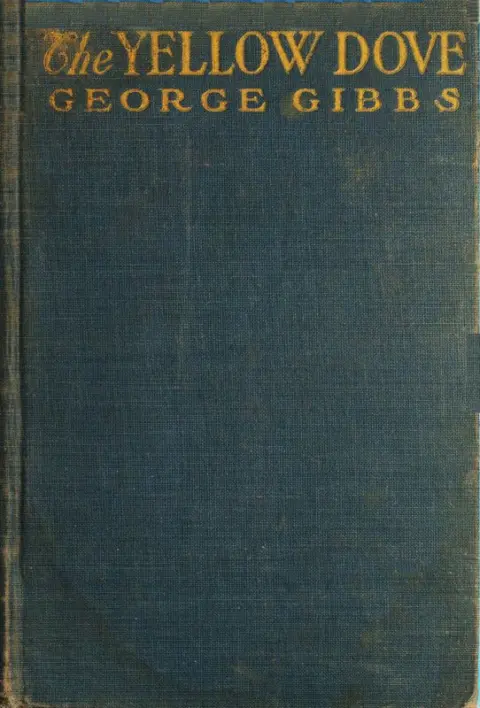
The Yellow Dove
George Gibbs
THE CLASSIC COLLECTION · 1920
"The Splendid Outcast" by George Gibbs is a novel written in the early 20th century. The story follows Jim Horton, a war-injured soldier in a hospital recovering from a successful operation, who grapples with his identity after assuming his cowardly twin brother Harry's name and position. The narrative seems to delve into themes of honor, identity, and deception against the backdrop of World War I, suggesting an exploration of the complexities of brotherhood and moral choices. The opening of the novel presents Jim Horton awakening in a hospital bed, struggling with pain and confusion as he learns that he has taken on the identity of his brother, Harry, a lieutenant thought to be wounded in battle. Jim recalls the events leading to his injuries and taxingly considers his brother’s cowardice and the decisions he made during their time in the war. As Jim pieces together his memories, he contemplates the implications of his actions, including the attendance of both his twin brother's wife, Moira, and her father, Barry Quinlevin, who are oblivious to the ruse. This opening setup establishes a tension-filled scenario filled with potential conflicts regarding identity and honor, and hints at the evolving dynamics as Jim must choose whether to maintain the deception or reveal the truth to Moira and face the consequences.
Introduction adapted from the source catalogue; source summaries may be automatically generated.
Free to read · English · 99,128 words · No account needed
MAKE TIME FOR A GOOD BOOK
On by default. Untick to stop anonymous reading totals. Each page counts after 10 seconds in view. How this works.
Anonymous counting is on unless you have switched it off.
"He is down there. What did you do with the papers? Answer me."
"Let me go."
"No."
"What will you do?"
"Unless you tell me the truth--shoot him from the window."
"You would not dare----" she whispered, in spite of her pain, "the people of the hotel--will investigate. The police----"
"Bah! A burglar comes along the portico, I shoot him. He falls--will you tell the truth? Are the papers in this room?"
"I won't tell."
"Very well." And then turning to his companion at the window, "What is
he doing now, Tricot?"
"He does not move----"
The Irishman released Piquette suddenly.
"A better chance for a shot, then," he snapped. "Here, Tricot." And he moved toward the window, his weapon eloquent.
Piquette sprang up despairingly.
"Monsieur," she cried, "for the love of God. Don't shoot. I will
tell."
"I thought so. Where are they? Quick."
He had her by the wrists now, one on each side, and Tricot's skinny hand
threatened her throat.
"Speak----!"
"I--I threw them out of the window," she gasped.
It was evident that at last in her terror she had spoken the truth. With an oath Quinlevin threw her aside and ran to the window while Tricot twisted her arm back of her, his other hand at her throat.
"Jeem!" she shrieked in a last despairing effort. "Go! Go!" And then the fingers of the apache closed and the sound was stifled as she fell back in a chair helpless.
"Shut up, damn you," growled Quinlevin. "Keep her quiet, you. Not death, you understand. We may need her."
Piquette heard these things dimly. A torrent was roaring at her ears and her eyeballs seemed to be starting from her head as she fought for her breath, but the relentless fingers pressed at her windpipe.
"And you, Monsieur?" she heard Tricot ask.
"I'm going down--into the garden. If she speaks the truth I'll find it
out."
Dimly she heard the door open and shut and the key turned in the lock, while she fought Tricot. But strong as she was, she knew, that she was no match for him. His arms were like steel springs, his fingers like iron. But still she fought, trying to make a commotion that would arouse the hotel. But Tricot had pinioned her in her chair and even the dim light that came in at the open, window grew black before her eyes. She struggled again at the very verge of the gate of oblivion it seemed, choking--choking, when a pain sharper than that at her throat came at her side.
"Be quiet," croaked Tricot's voice at her ear--"or I'll----"
Your reading position is saved on this browser. Take it to another device with a library code. Reading pages adapt to text, rather than matching a printed edition.
George Gibbs
George Gibbs
George Gibbs
George Gibbs
BEHIND THE BOOK
This eBook is for the use of anyone anywhere in the United States and most other parts of the world at no cost and with almost no restrictions whatsoever. You may copy it, give it away or re-use it under the terms of the Project Gutenberg License included with this eBook or online at www.gutenberg.org. If you are not located in the United States, you will have to check the laws of the country where you are located before using this eBook. Read the source licence.
The original source file, including credits and licence, is retained by this library. Request an original-format copy at no charge. Please include the book title and Project Gutenberg identifier #47900.
KEEP YOUR CURIOSITY GOING
Coulson Kernahan

Maurice Baring
Frances Wright
Cécile Tormay

Frederic Jesup Stimson

W. H. P. (William Henry Pope) Jarvis