THE CLASSIC COLLECTION✦Ewing’s LadyCLASSIC FREE BOOKS
Ewing’s Lady
Harry Leon Wilson
THE CLASSIC COLLECTION · 1902
"The Spenders: A Tale of the Third Generation" by Harry Leon Wilson is a novel written in the early 20th century. The narrative delves into the life of the Bines family, particularly focusing on the repercussions of the death of Daniel J. Bines, a self-made millionaire. Through the contrasting perspectives of his father, Peter Bines, a rugged prospector, and his son, Percival or "P. Percival Bines," who is returning from the East, the story explores themes of legacy, wealth, and the generational clashes between the values of the West and the East. At the start of the book, readers are introduced to the disjointed dynamics of the Bines family following the sudden death of Daniel J. Bines. Peter Bines, the patriarch and seasoned prospector, is largely disconnected from urban society, while his grandson Percival, fresh from Harvard, is more aligned with the Eastern elite lifestyle. The opening scenes focus on the immediate family reactions highlighting Peter’s profound grief and his desire to connect with Percival, who has been raised in a world of luxury far removed from the rugged life of his grandfather. This juxtaposition sets the stage for an exploration of the evolving American identity as the characters navigate their relationships and the changing landscape of wealth and social status.
Introduction adapted from the source catalogue; source summaries may be automatically generated.
Free to read · English · 118,525 words · No account needed
MAKE TIME FOR A GOOD BOOK
On by default. Untick to stop anonymous reading totals. Each page counts after 10 seconds in view. How this works.
Anonymous counting is on unless you have switched it off.
The New Argonauts
Mrs. van Geist came flustering out to the carriage.
"You and Briggs may get out here, Jarvis. There, that's for you, and that's for Briggs--and thank you both very much!"
"Child, child! what does it mean?"
"Mr. Bines is my husband, Muetterchen, and we're leaving for the West in
the morning."
The excitement did not abate for ten minutes or so. "And do say something cheerful, dear," pleaded Avice, at parting.
"You mad child--I was always afraid you might do something like this; but I will say I'm not altogether sure you've acted foolishly."
"Thank you, you dear old Muetterchen! and you'll come to see us--you shall see how happy I can be with this--this boy--this Lochinvar, Junior--I'm sure Mrs. Lochinvar always lived happily ever after."
Mrs. Van Geist kissed them both.
"Back to Thirty-seventh Street, driver."
"I shall want you at seven-thirty sharp, to-morrow morning," he said, as they alighted. "Will you be here, sure?"
"Sure, boss!"
"You'll make another one of those if you're on time."
The driver faced the bill toward the nearest street-light and scanned it. Then he placed it tenderly in the lining of his hat, and said, fervently:
"I'll be here, gent!"
"My trunks," Avice reminded him.
"And, driver, send an express wagon at seven sharp. Do you understand,
now?"
"Sure, gent, I'll have it here at seven, and be here at seven-thirty."
They went in.
"You've sent Briggs off, and I've all that packing and unpacking to
do."
"You have a husband who is handy at those things."
They went up to her room where two trunks yawned open.
Under her directions and with her help he took out the light summer things and replaced them with heavier gowns, stout shoes, golf-capes, and caps.
"We'll be up on the Bitter Root ranch this summer, and you'll need heavy things," he had told her.
Sometimes he packed clumsily, and she was obliged to do his work over. In these intervals he studied with interest the big old room and her quaint old sampler worked in coloured worsteds that had faded to greys and dull browns: "La Nuit Porte Conseil."
"Grandma Loekermann did it at the convent, ages ago," she told him.
"What a cautious young thing she must have been!"
She leaned against his shoulder.
"But she eloped with her true love, young Annekje Van Schoule; left the home in Hickory Street one night, and went far away, away up beyond One Hundred and Twenty-fifth Street, somewhere, and then wrote them about it."
"And left the sampler?"
Your reading position is saved on this browser. Take it to another device with a library code. Reading pages adapt to text, rather than matching a printed edition.
Harry Leon Wilson
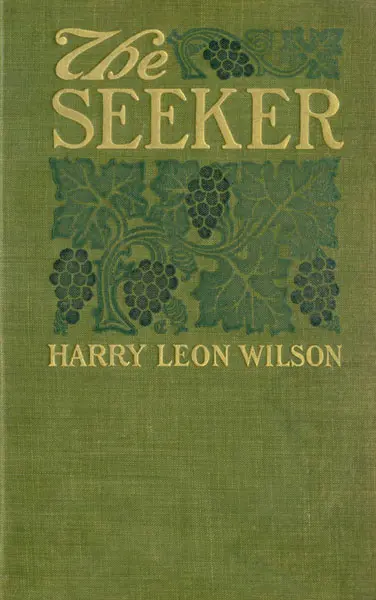
Harry Leon Wilson
Harry Leon Wilson
Harry Leon Wilson
BEHIND THE BOOK
This eBook is for the use of anyone anywhere in the United States and most other parts of the world at no cost and with almost no restrictions whatsoever. You may copy it, give it away or re-use it under the terms of the Project Gutenberg License included with this eBook or online at www.gutenberg.org. If you are not located in the United States, you will have to check the laws of the country where you are located before using this eBook. Read the source licence.
The original source file, including credits and licence, is retained by this library. Request an original-format copy at no charge. Please include the book title and Project Gutenberg identifier #9981.
KEEP YOUR CURIOSITY GOING
Coulson Kernahan

Maurice Baring
Frances Wright
Cécile Tormay

Frederic Jesup Stimson

W. H. P. (William Henry Pope) Jarvis