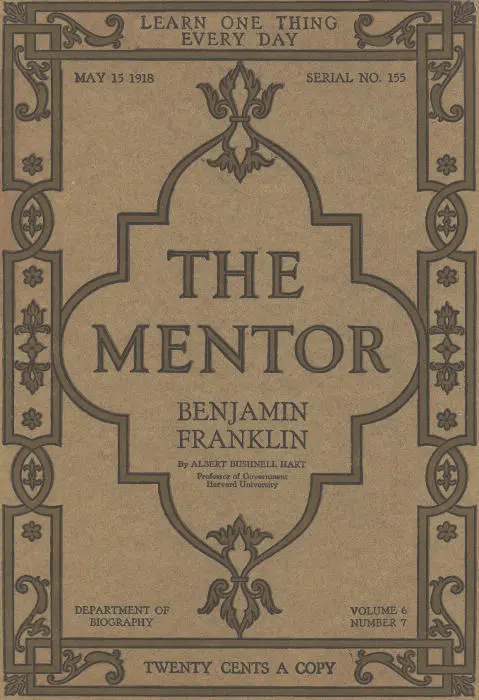
The Mentor: The Cradle of Liberty, Vol. 6, Num. 10, Serial No. 158, July 1, 1918
Albert Bushnell Hart
THE CLASSIC COLLECTION · 1910
"The Southern South" by Albert Bushnell Hart is a historical account written in the early 20th century. The book explores the complexities and unique characteristics of Southern society, particularly concerning race relations, economic conditions, and the social dynamics influenced by a history of slavery. Hart, a professor of history at Harvard University, aims to provide insights into the South's distinct cultural identity within the larger context of the United States. At the start of the book, Hart sets the stage by discussing the vital themes of Americanism and regional identity, outlining the South's notable differences from the North. He emphasizes the significance of historical factors such as the Civil War and traditions of slavery in shaping the South's social fabric. Hart draws attention to the complexities of the Southern "problem," particularly concerning the duality of its White and Negro populations, and the ongoing effects of these historical legacies. He shares his personal experiences and observations as an outsider who has sought to understand these dynamics through extensive travels and interactions with Southern communities, intending to characterize the South as a distinct entity shaped by its unique history and challenges.
Introduction adapted from the source catalogue; source summaries may be automatically generated.
Free to read · English · 124,064 words · No account needed
MAKE TIME FOR A GOOD BOOK
On by default. Untick to stop anonymous reading totals. Each page counts after 10 seconds in view. How this works.
Anonymous counting is on unless you have switched it off.
McDonogh, John, educational bequest by, 289.
McKinley, William, price of wheat and election of, 261.
Macon Telegraph on Northern criticism, 243.
Madison, Ga., popular hysteria in, on negro question, 164.
Magic, negro belief in, 137.
Malaria in South, 25.
Manufacturers' Record.
On immigration, 54;
on Southern wealth, 242, 243;
on wealth in cotton, 250;
opposition to Northern educational aid, 307;
on Atlanta riots. 390.
Manufactures of South, 24, 224-225;
cheap power, 26, 225;
cotton, 45, 274-276;
importation of aliens, 52;
comparative statistics, North and South, 237, 238, 276, 404-405.
Marriage. See Miscegenation.
Maryland.
And South, 20;
problem of negro education, 307, 329;
comparative statistics, 397-417.
Massachusetts and school tax, 329.
Mean Whites, name for Poor Whites, 38.
Medicine.
Negro physicians, 129, 335;
schools in South, 303.
Memphis, progress, 242.
Methodist Church.
Negro, 117;
educational commission of Southern, 300.
Michigan, comparative statistics of, 397-417.
Military service, negro, 129.
Militia and lynchings, 212.
Miller, Kelly.
On Dixon, 10;
as writer, 15, 325;
on race antagonism, 160;
on negro advancement, 368, 371.
Mining in South. 24, 224.
Minnesota, comparative statistics of, 397-417.
Minor, C. L. C.
On Negroes under slavery, 83;
"Real Lincoln," 85.
Miscegenation, 151-154;
and principle of social inequality, 154, 156;
prohibition of marriage, 155;
white exclusion of mulattoes, 156;
remedy, 157;
and calamity of amalgamation, 157.
Mississippi.
Postbellum vagrant laws, 168;
negro voters, 176;
valuations, 238;
illiteracy, 294,
school statistics, 295;
lynchings, 363;
comparative statistics, 395-415.
Missouri.
And South, 20;
illiteracy, 292;
comparative statistics, 397-417.
Mitchell, S. C., and negro development, 179, 345.
Mitchell Co., N. C., Negroes excluded from, 166.
Mobile.
As port, 22, 229;
progress, 28.
Monroe, La., as trade center, 26.
Montana, comparative statistics of, 397-417.
Montgomery, founder of negro community, 141.
Montgomery, Ala., progress, 29.
Morals.
Mountaineer, 35;
poor white, 43;
negro, 108-109, 134-137;
mulatto, 112;
miscegenation, 151-157.
See also Crime.
Morristown, Tenn., treatment of Negroes in, 167.
Mound Bayou, Miss., negro community at, 141.
Mt. Moriah, Ala., school at, 297.
Mountaineers, Southern, as frontiersmen, 23, 33, 37;
conditions, 30-38;
uniqueness, 30;
region, 31;
descent, 31-33;
self-sustenance, 32;
lowest type, "boomer," 33-35;
higher type, 35;
advancement, 35-38;
crime, 37;
and negro question, 38;
as laborers in cotton mills, 275;
Northern aid for education, 306.
Mulattoes.
And negro "race traits," 102;
proportion, 110-111;
physique, 111;
character, 112;
social position, 112, 156, 339;
and private negro schools, 316;
literature, 325.
Murders.
Proportion in South, 84;
varieties, 185;
of Negroes by Whites, 195-196;
conduct of trials, 198;
lynchings for, 209, 362.
Murphy, E. G.
"Present South," 13;
on democratic development, 65;
on race problem, 69, 79, 345;
on South and Northern criticism, 73;
on survival of Negroes, 109;
on race association, 150;
and negro development, 179;
on Poor Whites, 293;
on Negro academic training, 331.
Museums, Southern, 304.
Nashua, N. H., manufacturing output of, 276.
National banks, comparative statistics of, North and South, 402-403.
See also Banking.
Naval stores, Southern, 223.
Nebraska.
Illiteracy, 292;
comparative statistics, 397-417.
"Negro a Beast," 11.
Your reading position is saved on this browser. Take it to another device with a library code. Reading pages adapt to text, rather than matching a printed edition.
Albert Bushnell Hart
Albert Bushnell Hart
Albert Bushnell Hart
Albert Bushnell Hart
BEHIND THE BOOK
This eBook is for the use of anyone anywhere in the United States and most other parts of the world at no cost and with almost no restrictions whatsoever. You may copy it, give it away or re-use it under the terms of the Project Gutenberg License included with this eBook or online at www.gutenberg.org. If you are not located in the United States, you will have to check the laws of the country where you are located before using this eBook. Read the source licence.
The original source file, including credits and licence, is retained by this library. Request an original-format copy at no charge. Please include the book title and Project Gutenberg identifier #42257.
KEEP YOUR CURIOSITY GOING
Cécile Tormay

Moritz Busch
John L. Ransom
Frances Wright
Cécile Tormay

Mabel Potter Daggett