The Happy-go-lucky Morgans
Edward Thomas
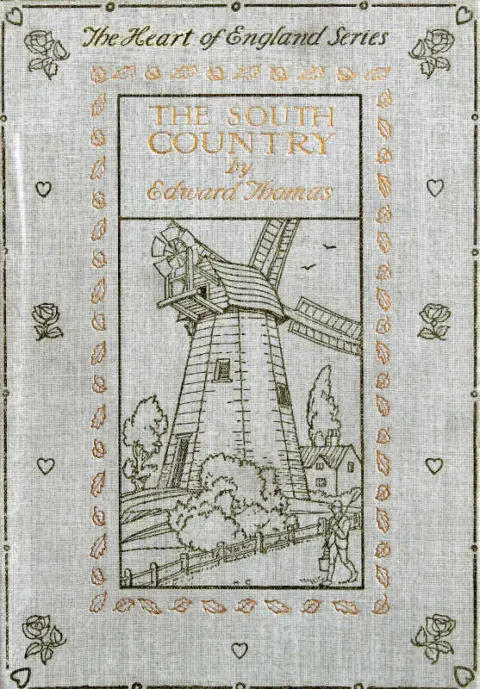
THE CLASSIC COLLECTION · 1909
"The South Country" by Edward Thomas is a reflective travelogue written in the early 20th century. In this book, the author shares his impressions from a year of wandering through the picturesque southern counties of England, particularly focusing on the beauty of Kent, Sussex, Hampshire, Wiltshire, and Cornwall. With a lyrical and poetic prose style, Thomas captures the essence of the landscapes, the changing seasons, and his deep connection to nature. The opening of the work presents a vivid and detailed description of the "South Country." It begins by establishing the geographic context, explaining the significance of this area in relation to other parts of England. Thomas expresses his preference for uninhabited paths and the tranquility found away from towns, where he can immerse himself in the natural beauty surrounding him. Through rich imagery, he reflects on the diverse landscapes, the rivers, and the flora that characterize the countryside while expressing a longing for solitude and an intimate relationship with the land. This opening sets the tone for a meditative exploration of both the physical and emotional landscapes as he embarks on his journey through the South Country.
Introduction adapted from the source catalogue; source summaries may be automatically generated.
Free to read · English · 83,338 words · No account needed
MAKE TIME FOR A GOOD BOOK
On by default. Untick to stop anonymous reading totals. Each page counts after 10 seconds in view. How this works.
Anonymous counting is on unless you have switched it off.
It is curious, too, how many different kinds of Eden or Golden Age Nature has in her gift, as if she silently recorded the backward dreams of each generation and reproduced them for us unexpectedly. It is, for instance, an early morning in July. The cows pour out from the milking-stalls and blot out the smell of dust with their breath in the white road between banks of hazel and thorn. The boy who is driving them to the morning’s pasture calls to them monotonously, persuasively, in turn, as each is tempted to crop the roadside sward: “Wo, Cherry! Now, Dolly! Wo, Fancy! Strawberry!... Blanche!... Blossom!... Cowslip!... Rosy! Smut!... Come along, Handsome!... Wo, Snowdrop!... Lily!... Darky!... Roany!... Come along, Annie!” Here the road is pillowed with white aspen-down, there more fragrant than pines with the brown sheddings of yew, and here thick with the dry scent of nettle and cow-parsnip, or glorious in perfect mingling of harebell and foxglove among the bracken and popping gorse on the roadside. The cows turn into the aftermath of the sainfoin, and the long valley echoes to their lowing. After them, up the road, comes a gypsy-cart, and the boy hangs on the gate to see the men and women walking, black-haired, upright, bright-eyed, and on the name-board of the cart the words: “Naomi Sherwood, Burley, Hampshire.” These things also propose to the roving, unhistoric mind an Eden, one still with us, one that is passing, not, let us hope, the very last.
Some of these scenes, whether often repeated or not, come to have a rich symbolical significance; they return persistently and, as it were, ceremoniously--on festal days--but meaning I know not what. For example, I never see the flowers and scarlet-stained foliage of herb-robert growing out of old stone-heaps by the wayside without a feeling of satisfaction not explained by a long memory of the contrast between the plant and the raw flint; so also with the drenched lilac-bloom leaning out over high walls of unknown gardens; and inland cliffs, covered with beech, jutting out westward into a bottomless valley in the mist of winter twilights, in silence and frost. Something in me belongs to these things, but I hardly think that the mere naming of them will mean anything except to those--many, perhaps--who have experienced the same. A great writer so uses the words of every day that they become a code of his own which the world is bound to learn and in the end take unto itself. But words are no longer symbols, and to say “hill” or “beech” is not to call up images of a hill or a beech-tree, since we have so long been in the habit of using the words for beautiful and mighty and noble things very much as a book-keeper uses figures without seeing gold and power. I can, therefore, only try to suggest what I mean by the significance of the plant in the stone-heap, the wet lilac, the misty cliff, by comparing it with that of scenes in books where we recognize some power beyond the particular and personal. All of Don Quixote’s acts have this significance; so have the end of Mr. Conrad’s story of Youth and the opening of Mr. Hudson’s El Ombu--the old man sitting on a summer’s day under the solitary tree to tell the history “of a house that had been.” Malory’s Morte d’Arthur is full of scenes like this. For ten centuries, from the battle of Badon to the writing of Morte d’Arthur, these stories were alive on the lips of many kinds of men and women in many lands, from Connemara to Calabria. Many of these men and women survive only in the turns which their passionate hearts gave to these ghostly, everlastingly wandering tales. Artists have worked upon them. Bards have sung them, and the sound of their harping is entangled in the words that have reached us to-day. This blending of many bloods is suggested by the Saracen in the Morte d’Arthur who was descended from Hector and Alexander and Joshua and Maccabæus; by Taliesin, whose “original country is the region of the summer stars,” who was with Noah and Alexander and at the birth of Christ. And thus has the tale become so full in the ear of humanity, so rich in scenes designed to serve only an immediate purpose, yet destined by this grace to move all kinds of men in manifold ways. Such is the chess-playing in The Dream of Rhonabwy; the madness of Tristram when he ran naked in the wood many days, but was lured by the music of a damsel playing on his own harp; the speech of Arthur at the scattering of his knights in the Sangraal quest; Launcelot’s fighting with the black knights against the white; Launcelot’s adventures ending at the castle of Carbonek, where he put on all his arms and armour and went--“and the moon shone clear”--between the lions at the gate and forced open the door, and saw the “Holy Vessel, covered with red samite, and many angels about it”; and Arthur and Guenevere watching the dead Elaine in the barge; and in the wars of Arthur and Launcelot, the scene opening with the words: “Then it befell upon a day in harvest-time, Sir Launcelot looked over the walls, and spake on high unto King Arthur and Sir Gawaine....”
Your reading position is saved on this browser. Take it to another device with a library code. Reading pages adapt to text, rather than matching a printed edition.
Edward Thomas
Edward Thomas

Edward Thomas
Edward Thomas
BEHIND THE BOOK
This eBook is for the use of anyone anywhere in the United States and most other parts of the world at no cost and with almost no restrictions whatsoever. You may copy it, give it away or re-use it under the terms of the Project Gutenberg License included with this eBook or online at www.gutenberg.org. If you are not located in the United States, you will have to check the laws of the country where you are located before using this eBook. Read the source licence.
The original source file, including credits and licence, is retained by this library. Request an original-format copy at no charge. Please include the book title and Project Gutenberg identifier #60760.
KEEP YOUR CURIOSITY GOING
Wilfrid Scawen Blunt
Wilfrid Scawen Blunt

E. W. (Edgar Watson) Howe
Cécile Tormay

Moritz Busch
John L. Ransom