The Happy-go-lucky Morgans
Edward Thomas
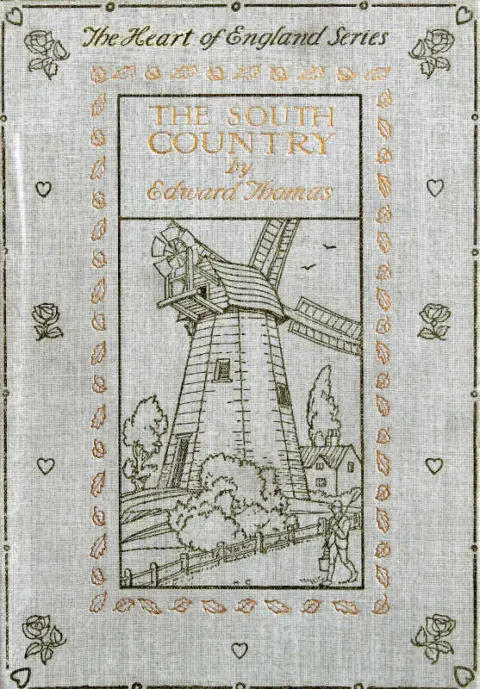
THE CLASSIC COLLECTION · 1909
"The South Country" by Edward Thomas is a reflective travelogue written in the early 20th century. In this book, the author shares his impressions from a year of wandering through the picturesque southern counties of England, particularly focusing on the beauty of Kent, Sussex, Hampshire, Wiltshire, and Cornwall. With a lyrical and poetic prose style, Thomas captures the essence of the landscapes, the changing seasons, and his deep connection to nature. The opening of the work presents a vivid and detailed description of the "South Country." It begins by establishing the geographic context, explaining the significance of this area in relation to other parts of England. Thomas expresses his preference for uninhabited paths and the tranquility found away from towns, where he can immerse himself in the natural beauty surrounding him. Through rich imagery, he reflects on the diverse landscapes, the rivers, and the flora that characterize the countryside while expressing a longing for solitude and an intimate relationship with the land. This opening sets the tone for a meditative exploration of both the physical and emotional landscapes as he embarks on his journey through the South Country.
Introduction adapted from the source catalogue; source summaries may be automatically generated.
Free to read · English · 83,338 words · No account needed
MAKE TIME FOR A GOOD BOOK
On by default. Untick to stop anonymous reading totals. Each page counts after 10 seconds in view. How this works.
Anonymous counting is on unless you have switched it off.
So amiable, fair, so pure, so delicate, So plump, so full, so fresh, her eyes so wondrous clear: And first unto her lord, at Wandsworth doth appear, That in the goodly court, of their great sovereign Tames, There might no other speech be had amongst the streams, But only of this Nymph, sweet Wandel, what she wore; Of her complexion, grace, and how herself she bore.
Nor can I omit the Wiltshire and Berkshire canal, as it was fifteen years ago, between Swindon and Dauntsey, an unfrequented by-way through a quiet dairy country, and full of pike and tench among the weeds and under the tall water docks and willow herbs which even then threatened to subdue it as they now have done.
The chief roads make south, south-east, south-west and west from London; almost the only road going east and west and not touching London is the old road known between Winchester and Canterbury as the Pilgrims’ Way.
Most of the towns are small market towns, manufacturing chiefly beer; or they are swollen, especially in the neighbourhood of London, as residential quarters on lines of railway or as health and pleasure resorts on the sea. But any man used to maps will be wiser on these matters in an hour than I am. For what I have sought is quiet and as complete a remoteness as possible from towns, whether of manufactures, of markets or of cathedrals. I have used a good many maps in my time, largely to avoid the towns; but I confess that I prefer to do without them and to go, if I have some days before me, guided by the hills or the sun or a stream--or, if I have one day only, in a rough circle, trusting, by taking a series of turnings to the left or a series to the right, to take much beauty by surprise and to return at last to my starting-point. On a dull day or cloudy night I have often no knowledge of the points of the compass. I never go out to see anything. The signboards thus often astonish me. I wish, by the way, that I had noted down more of the names on the signboards at the cross-roads. There is a wealth of poetry in them, as in that which points--by a ford, too--first, to Poulner and Ringwood; second, to Gorley and Fordingbridge; third, to Linwood and Broomy: and another pointing to Fordingbridge, to Ringwood, and to Cuckoo Hill and Furze Hill: and another in the parish of Pentlow, pointing to Foxearth and Sudbury, to Cavendish and Clare, and to Belchamps and Yeldham. Castles, churches, old houses, of extraordinary beauty or interest, have never worn out any of my shoe leather except by accident. I like to come upon them--usually without knowing their names and legends--but do not lament when chance takes me a hundred times out of their way. Nor have I ever been to Marlow to think about Shelley, or to Winterslow for Hazlitt’s sake; and I enter Buriton many times without remembering Gibbon. They would move me no more than the statue of a man and a fat horse (with beribboned tail), which a grateful countryside erected to William III in the market square at Petersfield. I prefer any country church or chapel to Winchester or Chichester or Canterbury Cathedral, just as I prefer “All round my hat,” or “Somer is icumen in,” to Beethoven. Not that I dislike the cathedrals, or that I do not find many pleasures amongst them. But they are incomprehensible and not restful. I feel when I am within them that I know why a dog bays at the moon. They are much more difficult or, rather, I am more conscious in them of my lack of comprehension, than the hills or the sea; and I do not like the showmen, the smell and look of the museum, the feeling that it is admiration or nothing, and all the well-dressed and flyblown people round about. I sometimes think that religious architecture is a dead language, majestic but dead, that it never was a popular language. Have some of these buildings lived too long, been too well preserved, so as to oppress our little days with too permanent an expression of the passing things? The truth is that, though the past allures me, and to discover a cathedral for myself would be an immense pleasure, I have no historic sense and no curiosity. I mention these trivial things because they may be important to those who read what I am paid for writing. I have read a great deal of history--in fact, a university gave me a degree out of respect for my apparent knowledge of history--but I have forgotten it all, or it has got into my blood and is present in me in a form which defies evocation or analysis. But as far as I can tell I am pure of history. Consequently I prefer the old brick houses round the cathedral, and that avenue of archaic bossy limes to the cathedral itself with all its turbulent quiet and vague antiquity. The old school also close at hand! I was there after the end of the term once, and two boys were kicking a football in a half-walled court; it was a bright, cold, windy April afternoon; and the ancient brick was penetrated with their voices and the sound of the ball, and I thought there could be nothing lovelier than that court, the pleasant walls, and the broad playing fields in sight of a smooth noble hill and a temple of dark firs on top. I was not thinking of Winchester or of any one older than the fondest son of that “mother, more than mother,” and little of him; but was merely caught up by and with the harmony of man and his work, of two children playing, and of the green downs and windy sky.
Your reading position is saved on this browser. Take it to another device with a library code. Reading pages adapt to text, rather than matching a printed edition.
Edward Thomas
Edward Thomas

Edward Thomas
Edward Thomas
BEHIND THE BOOK
This eBook is for the use of anyone anywhere in the United States and most other parts of the world at no cost and with almost no restrictions whatsoever. You may copy it, give it away or re-use it under the terms of the Project Gutenberg License included with this eBook or online at www.gutenberg.org. If you are not located in the United States, you will have to check the laws of the country where you are located before using this eBook. Read the source licence.
The original source file, including credits and licence, is retained by this library. Request an original-format copy at no charge. Please include the book title and Project Gutenberg identifier #60760.
KEEP YOUR CURIOSITY GOING
Wilfrid Scawen Blunt
Wilfrid Scawen Blunt

E. W. (Edgar Watson) Howe
Cécile Tormay

Moritz Busch
John L. Ransom